May 20, 2011

Illegal Art is a sampling label that was started by a person using the name Philo T. Farnsworth in 1998. Its first release was ‘Deconstructing Beck,’ a compilation made exclusively from sampling Beck’s music. This was followed by two other theme-based compilations, ‘Extracted Celluloid’ and ‘Commercial Ad Hoc.’
All three were co-released on Seeland Records, an independent record label created by experimental music band Negativland in 1979 to release their own recordings. The releases were also sponsored by RTMark, an activist collective formed to fight the unchecked growth of corporate interests. After these theme based compilations, Illegal Art focused on artist releases. One of the most popular artists on Illegal Art is Girl Talk (aka Gregg Gillis), who in 2006 released his third album, Night Ripper, to critical acclaim on the label. Illegal Art also released the Steinski Retrospective, spanning his work from 1983-2006.
Posted in Art, Money, Politics |
Leave a Comment »
May 20, 2011


Gregg Michael Gillis (b. 1981), better known by his stage name Girl Talk, is an American musician specializing in mashups and digital sampling. Gillis has released five LPs on the record label Illegal Art. He ended his career in biomedical engineering in 2007 to focus solely on music. He uses often a dozen or more unauthorized samples from different songs to create a new song. He cites fair use as a legal backbone for his sampling practices. After the success of his album Feed the Animals, for which listeners were asked to pay a price of their choosing, Gillis made all of his other albums similarly available via the Illegal Art website.
Regarding his stage name, Gillis has said, ‘the name Girl Talk is a reference to many things, products, magazines, books. It’s a pop culture phrase. The whole point of choosing the name early on was basically to just stir things up a little within the small scene I was operating from. I came from a more experimental background and there were some very overly serious, borderline academic type electronic musicians. I wanted to pick a name that they would be embarrassed to play with. You know Girl Talk sounded exactly the opposite of a man playing a laptop, so that’s what I chose.’
Posted in Art, Money, Politics |
Leave a Comment »
May 20, 2011

Ultra Music Festival is an annual outdoor electronic music festival that occurs in March in the city of Miami usually during the annual Winter Music Conference.
It is held in Downtown Miami in Bicentennial Park. It was a 1-day festival from 1999-2006, a 2-day festival from 2007-2010, and was a 3-day festival in 2011. Ultra celebrated its 10th anniversary in 2008 with performances by Tiesto, Underworld, Justice, Deadmau5, Moby, The Crystal Method, and David Guetta.
Posted in Art, Technology |
1 Comment »
May 20, 2011

Olafur Eliasson (b. 1967) is a Danish-Icelandic artist known for sculptures and large-scale installation art employing elemental materials such as light, water, and air temperature to enhance the viewer’s experience.
In 1996, Eliasson started working with Einar Thorsteinn, an architect and geometry expert 25 years his senior as well as a former friend of Buckminster Fuller’s. Thorsteinn’s knowledge of geometry and space has been integrated into Eliasson’s artistic production, often seen in his geometric lamp works as well as his pavilions, tunnels and camera obscura projects.
read more »
Posted in Art |
Leave a Comment »
May 20, 2011

Desiderata [dih-sid-uh-rey-tuh] (Latin: ‘desired things’) is a 1927 poem by American writer Max Ehrmann (1872-1945).
The text was largely unknown in the author’s lifetime and became widely known after its use in a devotional in 1959 by a church in Baltimore. When Adlai Stevenson died in 1965, a guest in his home found the Desiderata near his bedside and discovered that Stevenson had planned to use it in his Christmas cards.
read more »
Posted in Art, Language, Philosophy |
Leave a Comment »
May 18, 2011

Blue Velvet is a 1986 American mystery film written and directed by David Lynch. The movie exhibits elements of both film noir and surrealism. The film features Kyle MacLachlan, Isabella Rossellini, Dennis Hopper, and Laura Dern. The title is taken from the 1963 Bobby Vinton song of the same name.
Although initially detested by some mainstream critics, the film is now widely acclaimed, and earned Lynch his second Academy Award nomination for Best Director. As an example of a director casting against the norm, Blue Velvet is also noted for re-launching Hopper’s career and for providing Rossellini with a dramatic outlet beyond the work as a fashion model and a cosmetics spokeswoman for which she had until then been known.
read more »
Posted in Art |
Leave a Comment »
May 18, 2011

The Golden Age of Porn or porno chic refers to a period in the history of pornography, approximately from the late-1960s to the early-to-mid-1980s that is idealized as a time where difficult to treat STDs had not achieved wide public notice. This freedom was ostensibly reflected in the pornography industry, with adult movies and adult magazines approaching the mainstream and becoming increasingly visible.
The golden age was also typified by interactions with the contemporaneous second wave of feminism. These were radical and cultural feminists which, along with the Christian right, attacked pornography, while other feminists were more concerned with ideas of sexual liberation and freedom from government intrusion into the growing industry.
read more »
Posted in Art, Money, Sex |
Leave a Comment »
May 18, 2011


In the context of a work of fiction, the term canon denotes the material accepted as ‘official,’ in a fictional universe’s fan base. It is often contrasted with, or used as the basis for, works of fan fiction, which are not considered canonical. It is used in two slightly different meanings: first, it refers to the overall set of storylines, premises, settings, and characters offered by the source media text. In this sense, canon is the original work from which the fan fiction author borrows. Secondly, it is used as a descriptor of specific incidents, relationships, or story arcs that take place within the overall canon; thus certain incidents or relationships may be described as being canon or not.
The use of the word ‘canon’ in reference to a set of texts derives from Biblical canon, the set of books regarded as scripture. The term was first used in the context of fiction to refer to the Sherlock Holmes stories and novels, written by Sir Arthur Conan Doyle, to distinguish those works from subsequent pastiches by other authors. It has subsequently been applied to many media franchises. Among these are science fiction franchises such as Star Trek, Star Wars, and Doctor Who, in which many stories have been told in different media, some of which contradict or appear to contradict each other.
Posted in Art, Language |
Leave a Comment »
May 18, 2011


Tartan [tahr-tn] is a pattern consisting of criss-crossed horizontal and vertical bands in multiple colors that originated in Scotland. Scottish kilts almost always have tartan patterns. Tartan is also known as ‘plaid’ in North America, but in Scotland, a plaid is a tartan cloth slung over the shoulder, or a blanket. The Dress Act of 1746 attempted to bring the warrior clans under government control by banning the tartan and other aspects of Gaelic culture. When the law was repealed in 1782, it was no longer ordinary Highland dress, but was adopted instead as the symbolic national dress of Scotland. It is generally stated that the most popular tartans today are the Black Watch (also known as Old Campbell, Grant Hunting, Universal, Government) and Royal Stewart.
Tartan is made with alternating bands of colored (pre-dyed) threads woven as both warp and weft at right angles to each other. The weft is woven in a simple twill, two over – two under the warp, advancing one thread each pass. This forms visible diagonal lines where different colors cross, which give the appearance of new colors blended from the original ones. The resulting blocks of color repeat vertically and horizontally in a distinctive pattern of squares and lines known as a sett.
Posted in Art, Language, World |
Leave a Comment »
May 17, 2011

Iggy Pop (b. 1947), born James Newell Osterberg, is an American musician. He is considered an influential innovator of punk rock music. He began calling himself ‘Iggy’ after his first band in high school (for which he was drummer), The Iguanas. He was lead singer/songwriter of influential protopunk band The Stooges and became known for his outrageous and unpredictable stage antics. Inspired by the antagonism of Jim Morrison, Pop was the first performer to do a stage-dive, which he started at a concert in Detroit. Other exploits of Pop include rolling around in broken glass, exposing himself to the crowd and vomiting on stage.
Osterberg was raised in a trailer park in Ypsilanti, Michigan. He began his music career as a drummer in different high school bands in Ann Arbor, Michigan. He later moved to Chicago where he played drums in blues clubs, helped by Sam Lay (formerly of the Paul Butterfield Blues Band). In 1968, he and his new band, ‘The Stooges,’ signed with Elektra Records, again following in the footsteps of The Doors, who were Elektra’s biggest act at the time. Reportedly, Pop called Moe Howard to see if it was alright to call his band ‘The Stooges,’ to which Howard responded by merely saying ‘I don’t care what they call themselves, as long as they’re not the Three Stooges!’ and hung up the phone).
Posted in Art |
Leave a Comment »
May 16, 2011
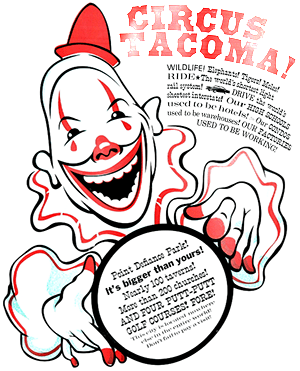

Beautiful Angle is a guerrilla arts poster project in Tacoma, Washington. Approximately once per month, graphic designer Lance Kagey and writer Tom Llewellyn create hand-crafted, letterpress posters and then distribute them around the city’s downtown core via wheat paste and staples.
The first poster, Swirl, was distributed on May 23, 2010. Beautiful Angle has a ‘strange, contradictory relationship with the city’; even though the posters are posted perhaps illegally, the group has won a Chamber of Commerce award of merit.
Posted in Art, Money, Politics |
2 Comments »
May 16, 2011

FAILE is a Brooklyn-based artistic collaboration between Patrick McNeil (b. 1975) and Patrick Miller (b. 1976). Since its inception in 1999, FAILE has been recognized for their pioneering use of wheatpasting and stenciling in the increasingly established arena of street art, and for their explorations of duality through a fragmented style of appropriation and collage.
During this time, FAILE adapted its signature mass culture-driven iconography to a wide array of media, from wooden boxes and window pallets to more traditional canvas, prints, sculptures, stencils, multimedia installation, and prayer wheels. While FAILE’s work is constructed from found visual imagery, and blurs the line between ‘high’ and ‘low’ culture, recent exhibitions demonstrate an emphasis on audience participation, a critique of consumerism, and the incorporation of religious media and architecture into their work.
Posted in Art, Money, Politics |
Leave a Comment »







 The Daily Omnivore