May 4, 2011


Hot Sauce Committee Part Two is the eighth studio album by the Beastie Boys released in May 2011. Originally planned for release in 2009 under the title ‘Hot Sauce Committee, Pt. 1,’ the album was delayed after Adam Yauch was diagnosed with cancer.
The working title was ‘Tadlock’s Glasses,’ which was stated to be a reference to a former bus driver named Tadlock, who used to drive for Elvis Presley’s back-up singers. Presley once gave Tadlock a pair of glasses which he was proud of. Regarding the structure of the album, Yauch stated, ‘It’s a combination of playing and sampling stuff as we’re playing, and also sampling pretty obscure records. There are a lot of songs on the record and there are a lot of short songs and they kind of all run into each other.’
Posted in Art |
Leave a Comment »
May 3, 2011

‘Happy Xmas (War Is Over)’ is a song written by John Lennon and Yoko Ono and released in 1971 as a single by John & Yoko/Plastic Ono Band with the Harlem Community Choir. Ostensibly a protest song about the Vietnam War, it has become a Christmas standard and has appeared on several Christmas albums. The lyric is based on a campaign in late 1969 by Lennon and Ono, who rented billboards and posters in eleven major cities around the world that read: ‘WAR IS OVER! (If You Want It) Happy Christmas from John and Yoko.’ In 1971, the US was deeply entrenched in the unpopular Vietnam War.
The melody and chord structure are from the folk standard ‘Stewball,’ about a race-horse. Lennon and Ono added modulation through several keys and the ‘War is over’ counter-melody. It was recorded at Record Plant Studios in New York City in late October 1971, with the help of producer Phil Spector. It features heavily echoed vocals and backing vocals from children from the Harlem Community Choir.
Posted in Art, Humor, War |
Leave a Comment »
May 3, 2011

In infrared photography, the film or image sensor used is sensitive to infrared light, which is the domain of thermal imaging. Wavelengths used for photography range from about 700 nm to about 900 nm. Usually an ‘infrared filter’ is used; this lets infrared (IR) light pass through to the camera, but blocks all or most of the visible light spectrum (the filter thus looks black or deep red).
When these filters are used together with infrared-sensitive film or sensors, very interesting ‘in-camera effects’ can be obtained; false-color or black-and-white images with a dreamlike or sometimes lurid appearance known as the ‘Wood Effect,’ an effect mainly caused by foliage (such as tree leaves and grass) strongly reflecting in the same way visible light is reflected from snow. There is a small contribution from chlorophyll fluorescence, but this is marginal and is not the real cause of the brightness seen in infrared photographs. The effect is named after the infrared photography pioneer Robert W. Wood.
Posted in Art, Science, Technology |
Leave a Comment »
May 3, 2011

Anton Stankowski (1906 – 1998) was a German graphic designer, photographer and painter. Typical Stankowski designs attempt to illustrate processes or behaviors rather than objects. Such experiments resulted in the use of fractal-like structures long before their popularization by Benoît Mandelbrot in 1975. Despite producing many unique examples of concrete art and photographics, Stankowski is best known for designing the simple trademark of the Deutsche Bank.
His work is noted for straddling the camps of fine and applied arts by synthesising information and creative impulse. He was inspired by the abstract paintings of Mondrian, van Doesburg, and Kandinsky. Stankowski advocated graphic design as a field of pictorial creation that requires collaboration with free artists and scientists.
Posted in Art, Money, Technology |
Leave a Comment »
May 3, 2011

The Yellow Kid emerged as the lead character in ‘Hogan’s Alley,’ a comic first drawn by Richard F. Outcault in 1894, which became one of the first Sunday supplement comic strips in an American newspaper. The Yellow Kid was a bald, snaggle-toothed boy who wore a yellow nightshirt and hung around in a ghetto alley filled with equally odd characters, mostly other children.
With a goofy grin, the Kid habitually spoke in a ragged, peculiar ghetto argot printed on his shirt, a device meant to lampoon advertising billboards. His head was drawn wholly shaved as if having been recently ridden of lice, a common sight among children in New York’s tenement ghettos at the time. His nightshirt, a hand-me-down from an older sister, was white or pale blue in the first color strips.
read more »
Posted in Art, Humor, Money |
Leave a Comment »
May 3, 2011
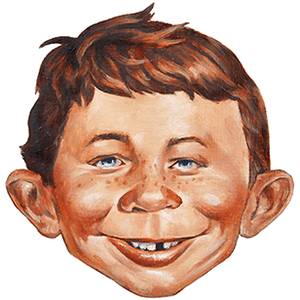
Alfred E. Neuman is the fictional mascot and iconic cover boy of Mad magazine. The face had drifted through American pictography for decades before being claimed and named by Mad editor Harvey Kurtzman. Since his debut in Mad, Neuman’s likeness, distinguished by jug ears, a missing front tooth, and one eye lower than the other has graced the cover of all but a handful of the magazine’s 500 issues. His face is rarely seen in profile; he has virtually always been shown in full frontal view, directly from behind, or in silhouette.
Harvey Kurtzman first spotted the image on a postcard pinned to the office bulletin board of Ballantine Books editor Bernard Shir-Cliff. ‘It was a face that didn’t have a care in the world, except mischief,’ recalled Kurtzman.
read more »
Posted in Art, Humor |
Leave a Comment »
May 3, 2011

The Stay Puft Marshmallow Man is a fictional mascot from the Ghostbusters franchise of media, which sometimes appears as a giant, lumbering paranormal monster.
It first appears in the 1984 film Ghostbusters as a picture logo on a prop package of marshmallows in Dana Barrett’s apartment when she places the groceries on her kitchen counter, on a graffiti advertisement on the building next to the Ghostbuster’s HQ when the ghosts are released from the containment grid after the power is shut down, then later in the climax of the film.
read more »
Posted in Art, Humor |
Leave a Comment »
May 2, 2011


The final girl is a thriller and horror film (particularly slasher film) trope that specifically refers to the last woman or girl alive to confront the killer, ostensibly the one left to tell the story. The final girl has been observed in dozens of films, including Halloween, Friday the 13th, A Nightmare on Elm Street, The Texas Chain Saw Massacre, Alien and Scream. The term was coined by American professor of film studies, Carol J. Clover, who argues that in these films, the viewer begins by sharing the perspective of the killer, but experiences a shift in identification to the final girl partway through the film.
According to Clover, the final girl is typically sexually unavailable or virginal, avoiding the vices of the victims (sex, narcotic usage, etc.). She sometimes has a unisex name (e.g., Teddy, Billie, Georgie, Sidney). Occasionally the Final Girl will have a shared history with the killer. The final girl is the ‘investigating consciousness’ of the film, moving the narrative forward and as such, she exhibits intelligence, curiosity, and vigilance. One of the basic premises of Clover’s theory is that audience identification is unstable and fluid across gender lines, particularly in the case of the slasher film. During the final girl’s confrontation with the killer, Clover argues, she becomes masculinized through ‘phallic appropriation’ by taking up a weapon, such as a knife or chainsaw, against the killer.
Posted in Art, Death, Sex |
1 Comment »
April 29, 2011

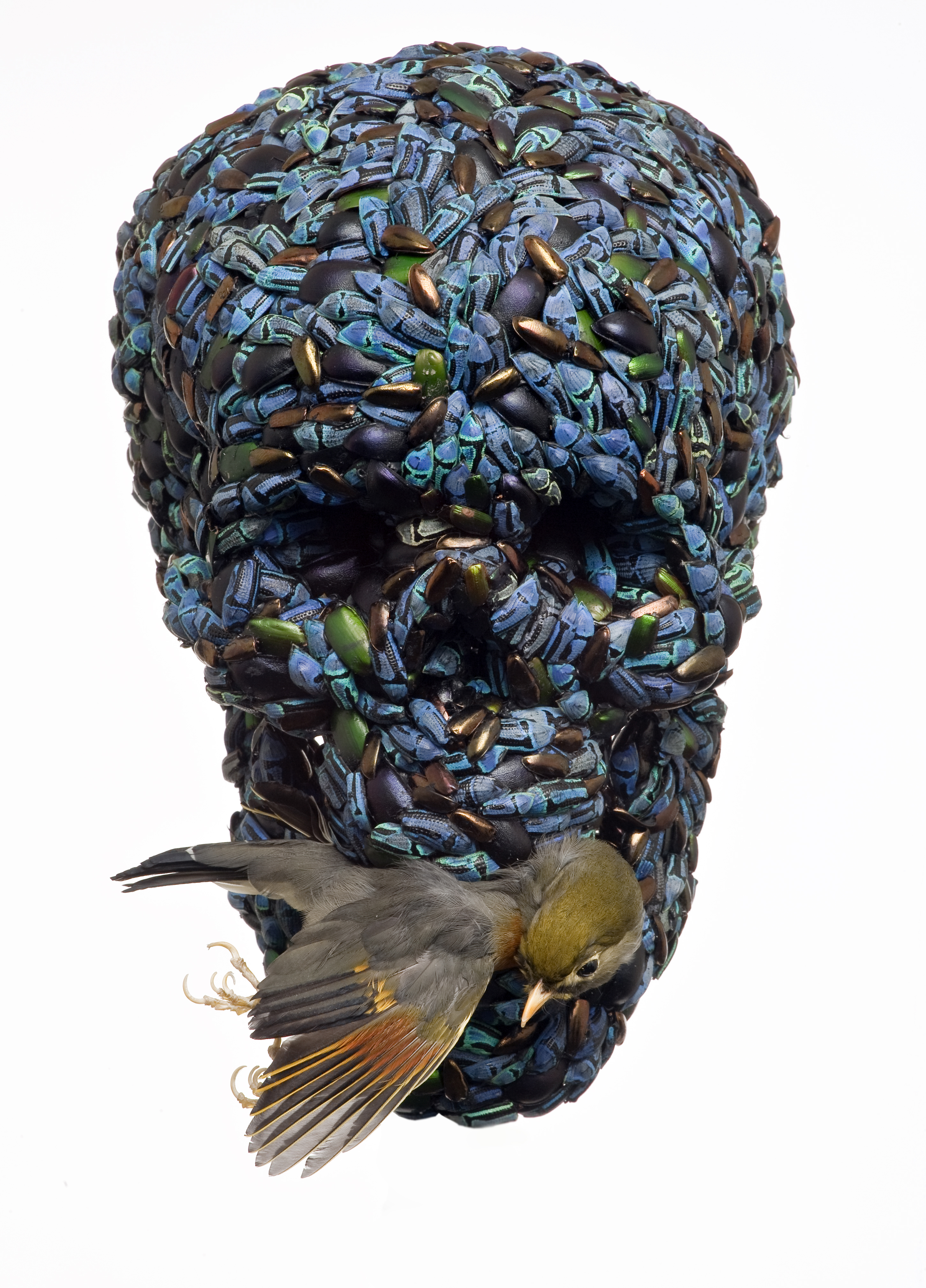
Jan Fabre [fah-ber] (b. 1958) is a Belgian multidisciplinary artist, playwright, stage director, choreographer and designer. Fabre is famous for his Bic-art (ballpoint drawings). In 1990, he covered an entire building with ballpoint drawings.
His decoration of the ceiling of the Royal Palace in Brussels ‘Heaven of Delight’ (made out of one million six hundred thousand jewel-scarab wing cases) is widely praised. In 2004 he erected Totem, a giant bug stuck on a 70 foot steel needle in Leuven, Belgium.
Posted in Art |
2 Comments »
April 28, 2011

A leisure suit is a casual suit consisting of a shirt-like jacket and matching trousers, often associated with American-influenced fashion and fads of the 1970s.
Suits as casual wear became popular among members of Britain’s mod subculture in the 1960s, but only achieved widespread popularity in the United States when—with the creation and popularization of synthetic materials—unprecedented cheapness met with a culture that had come to hate formality.
read more »
Posted in Art, Humor, Money |
2 Comments »
April 27, 2011

Proun is a freeware racing game in a world of geometric objects and large colored surfaces. You avoid obstacles by rotating around a cable in order to gain as much speed as possible. There is no up or down; there is only the cable to which you are attached. The game was developed by Amsterdam-based, Joost van Dongen.
Posted in Art, Games, Technology |
Leave a Comment »
April 27, 2011

The Art of the Motorcycle was an exhibition that presented 114 motorcycles chosen for their historic importance or design excellence in a display designed by Frank Gehry in the curved rotunda of the Frank Lloyd Wright-designed Solomon R. Guggenheim Museum in New York City, running for three months in late 1998.
read more »
Posted in Art, Money, Technology |
Leave a Comment »