April 1, 2011

Gashapon [gosh-uh-pone] is a Bandai brand trademark widely used throughout the world for their capsule toys.
‘Gashapon’ is a Japanese onomatopoeia, made up of two sounds: ‘gasha’ for the turning of a crank on a toy vending machine, and ‘pon’ for the sound of the toy capsule dropping into the receptacle. It is used to describe both the machines themselves, and any toy obtained from them.
read more »
Posted in Art, Games, Money |
Leave a Comment »
April 1, 2011

Disney Vinylmation is a brand of vinyl toys sold at Disney theme parks and other locations. The toys all have a common shape (that of Mickey Mouse) but have different themed markings, colors and patterns.
The first figures were introduced in November 2008. The figures are sold in sealed packaging. The purchaser does not know which figure they are buying until they have opened it.
Posted in Art, Games, Money |
Leave a Comment »
March 31, 2011

Das Racist is a rap group based in Brooklyn, composed of Heems (Himanshu Suri) and Kool A.D. (Victor Vazquez) joined by hype man Dap (Ashok Kondabolu) for live performances and in music videos. Known for their use of humor, obscure references, and unconventional style, Das Racist has been both dismissed as joke rap and hailed as an urgent new voice in rap. The name derives from a segment on sketch comedy program, ‘Wonder Showzen.’
Posted in Art, Humor |
Leave a Comment »
March 31, 2011

Infrasound [in-fruh-sound] is sound that is lower in frequency than 20 Hz or cycles per second, the ‘normal’ limit of human hearing. Hearing becomes gradually less sensitive as frequency decreases, so for humans to perceive infrasound, the sound pressure must be sufficiently high. The ear is the primary organ for sensing infrasound, but at higher levels it is possible to feel infrasound vibrations in various parts of the body.
The study of such sound waves is sometimes referred to as infrasonics, covering sounds beneath 20 Hz down to 0.001 Hz. This frequency range is utilized for monitoring earthquakes, charting rock and petroleum formations below the earth, and also to study the mechanics of the heart. Infrasound is characterized by an ability to cover long distances and get around obstacles with little dissipation.
read more »
Posted in Art, Health, Science |
Leave a Comment »
March 31, 2011

Musical ear syndrome (MES) refers to auditory hallucinations subsequent to hearing loss. It is comparable to Charles Bonnet syndrome (visual hallucinations by visually impaired people) and some have suggested this phenomenon could be included under that diagnosis. The occurrence of MES has been suggested to be very high among the hearing impaired. Sufferers typically hear music or singing and the condition is more common in women. The hallucinatory experiences differ from psychotic disorders although there may be some overlap.
The likely cause is a small cerebrovascular event affecting the auditory cortex. The ‘hole’ in the hearing range is ‘plugged’ by the brain confabulating a piece of information – in this case a remembered melody. A similar occurrence is seen with strokes of the visual cortex where a visual field defect occurs and the brain confabulates a piece of visual data to fill the spot. Towards the end of his life, Robert Schumann said he heard angelic music and music from other composers, which formed the basis for his violin concerto (however, his symptoms may also have been caused by syphilis or mercury poisoning).
Posted in Art, Health, Science |
1 Comment »
March 30, 2011
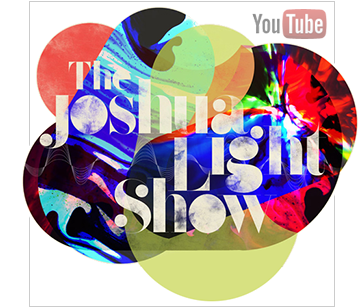
Liquid light shows or psychedelic light shows surfaced in the mid 1960s and early 1970s in America and Europe. They were an integral part of the Progressive music scene well into the seventies. Shows could be as simple as a single operator and two or three modified slide or overhead projectors and a couple of color wheels or as complex as shows with ten or more operators, 70 plus projectors (including liquid slide, liquid overhead, movie and still image models plus a vast array of highly advanced (for the time) special effects equipment).
read more »
Posted in Art, Drugs, Technology |
Leave a Comment »
March 30, 2011

Mark Mothersbaugh (b. 1950) is an American musician; he is the co-founder of the new wave band Devo and has been its lead singer since 1972. Mothersbaugh attended Kent State as an art student, where he met Devo co-founders Jerry Casale and Bob Lewis. In early 1970, Lewis and Casale formed the idea of the ‘devolution’ of the human race; Mothersbaugh, intrigued by the concept, joined them, building upon it with elements of early poststructuralist ideas and oddball arcana, most notably unearthing the infamous ‘Jocko-Homo Heavenbound’ pamphlet (the basis for the song).
Since Devo, Mothersbaugh developed a successful career writing musical scores for film and television. In film, he has worked frequently with filmmaker Wes Anderson, and scored many of his feature films (‘Bottle Rocket,’ ‘Rushmore,’ ‘The Royal Tenenbaums,’ and ‘The Life Aquatic with Steve Zissou’). His music has been a staple of the children’s television shows ‘Rugrats,’ ‘Beakman’s World,’ and ‘Clifford the Big Red Dog.’ He also wrote some music for ‘Pee-Wee’s Playhouse’ in 1990. His commercial work is often performed with Mutato Muzika, the music production company he formed with several other former members of Devo including his brother, Bob Mothersbaugh.
Posted in Art, Humor, Money |
1 Comment »
March 29, 2011

AKIRA is a manga series by Katsuhiro Otomo. Set in a post-apocalyptic Neo-Tokyo, the work uses conventions of the cyberpunk genre to detail a saga of turmoil. Initially serialized in the pages of Young Magazine from 1982 until 1990, the work was collected in six volumes by Japanese publisher Kodansha. Otomo’s art on the series is considered outstanding, and the work is a breakthrough for both Otomo and the manga form.
An identically titled anime film adaptation was released in 1988, shortening the plot, but with its structure and scenes heavily informed by the manga and its serial origins. The manga takes place in a vastly larger time frame than the film and involves a far wider array of characters and subplots. Through the breadth of the work, Otomo explicates themes of social isolation, corruption and power.
read more »
Posted in Art, Technology, World |
Leave a Comment »
March 29, 2011
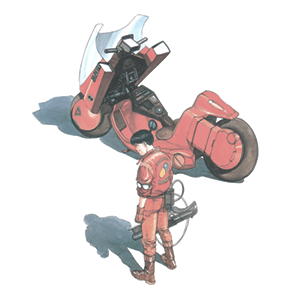
Akira is a 1988 Japanese animated science fiction film set in a futuristic and post-war city, Neo-Tokyo, in 2019. It was written and directed by Katsuhiro Otomo, who based it on his manga of the same name. The film explores a number of psychological and philosophical themes, such as the nature of corruption, the will to power, and the growth from childhood to maturity both in individuals and the human race itself. Elements of Buddhist and Christian symbolism are also present in the film. Other notable themes include youth culture, cyberpunk, delinquency, psychic awareness, social unrest and revolution, the world’s reaction toward a nuclear holocaust and Japan’s post-war economic revival.
The film’s plot focuses on Shotaro Kaneda, a biker gang member, as he tries to stop Tetsuo Shima from releasing Akira, the eponymous, principal subject of the story, a young boy who developed transcendent psionic, god-like abilities when serving as a test subject for secret government ESP experiments in the 1980s. He subsequently lost control of this power and the ensuing blast completely annihilated Tokyo in a horrifying explosion in 1988. After the apocalyptic event, Akira was recovered and sealed within a cryonic chamber underneath the Neo-Tokyo Olympic Stadium.
Posted in Art, Technology, World |
Leave a Comment »
March 29, 2011

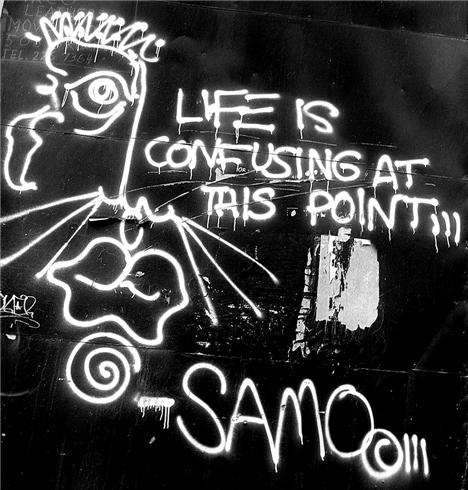
SAMO© graffiti appeared in NYC from 1977 to early 1980. They were short phrases, in turns poetic and sarcastic, mainly painted in downtown Manhattan. The tag has been primarily associated with the artist Jean-Michel Basquiat, but was developed in collaboration with his high school friend Al Diaz, and a few others. Diaz had previously been part of the New York graffiti scene, using the tag ‘Bomb I.’ Later Basquiat took on the tag himself, creating some non-graffiti work on paper and canvas with it, just before and after killing off the SAMO graffiti by painting ‘SAMO IS DEAD’ around the streets of downtown in early 1980.
Basquiat claims the name was first developed in a stoned conversation with Diaz, calling the marijuana they smoked ‘the same old shit.’ The character of SAMO was first developed by Basquiat, Diaz, and Shannon Dawson while they were students at City As School high school. Basquiat took the lead in the project, selling a false religion, in comics made in high school. The concept was further developed in a theatre-as-therapy course in upper Manhattan (called ‘Family Life’).
Posted in Art |
Leave a Comment »
March 29, 2011

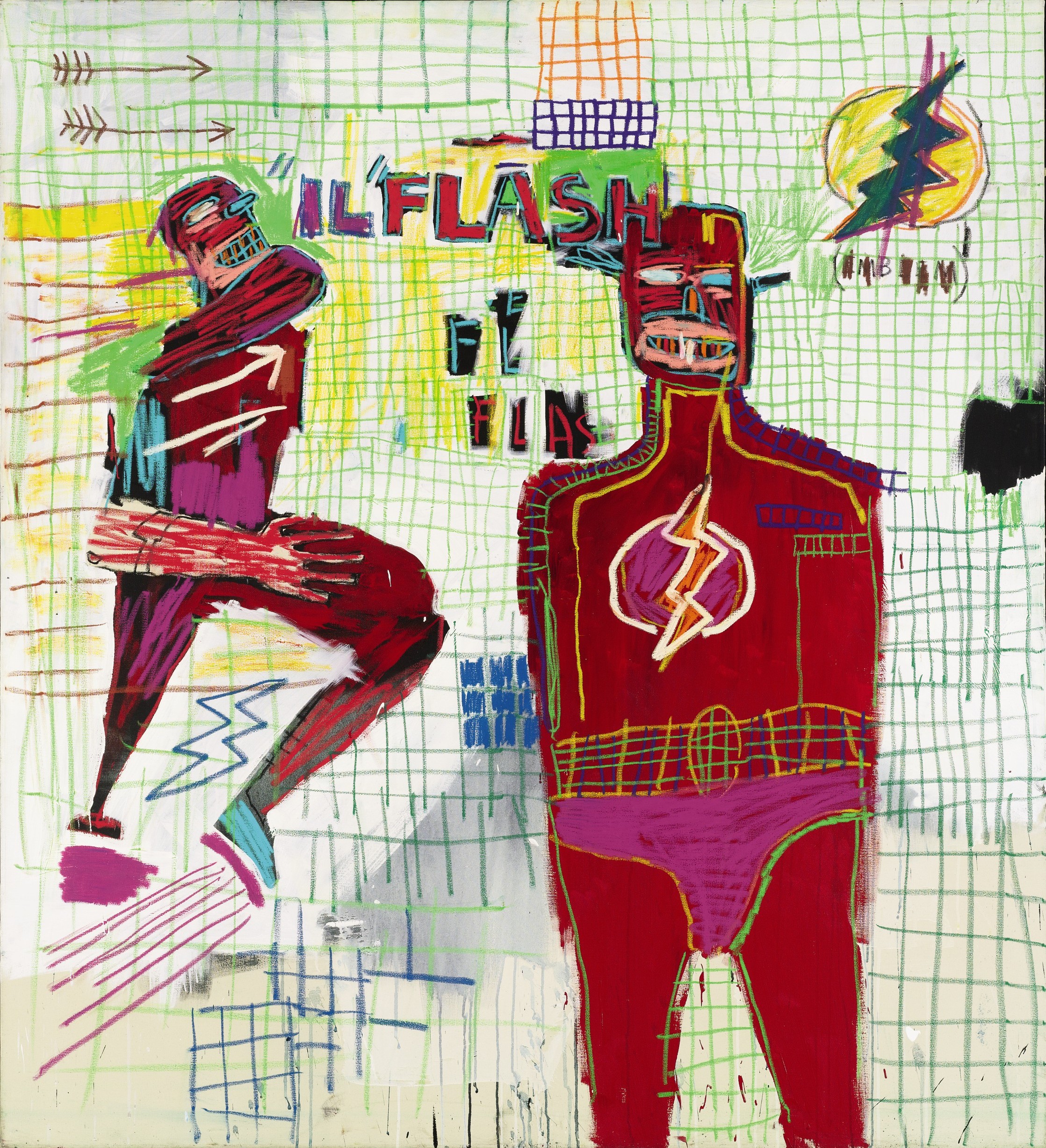
Jean-Michel Basquiat [bah-skee-ott] (1960 – 1988) was a Neo-expressionist painter who got his start as a graffiti artist in NYC in the late 1970s. He died of a heroin overdose at the age of 27. In 1976, Basquiat and friend Al Diaz began spray-painting political-poetical graffiti on buildings in Lower Manhattan, working under the pseudonym SAMO. In 1979, he formed the noise rock band Gray with Vincent Gallo. In 1983-84 he was a frequent collaborator with Andy Warhol. The record price for a Basquiat painting is $14.6 million, paid in 2007 for an untitled 1981 piece. In keeping with his street art roots, Basquiat often incorporated words into his paintings.
He would often draw on random objects and surfaces. A major reference source throughout his career was ‘Gray’s Anatomy,’ which his mother gave to him while in the hospital at age seven. It remained influential in his depictions of internal human anatomy, and in its mixture of image and text. Other reference sources were Henry Dreyfuss’ ‘Symbol Sourcebook,’ Da Vinci’s notebooks, and Brentjes’ ‘African Rock Art.’ Basquiat doodled often, and some of his later pieces, done mostly with colored pencils on paper, exhibit this, often with a loose, spontaneous, and dirty style much like his paintings.
Posted in Art, Money |
Leave a Comment »
March 28, 2011

Red Hot Organization (RHO) is an international not-for-profit organization dedicated to fighting AIDS through pop culture. Since its inception in 1989, over 400 artists, producers and directors have contributed to over 15 compilation albums, related television programs and media events to raise donations totaling more than 10 million dollars for HIV / AIDS relief and awareness around the world.
First founded as King Cole, Inc. by Leigh Blake and John Carlin, Red Hot was established in response to the devastation wrought by AIDS on a generation of New York artists and intellectuals. Carlin had an ‘improbable dream: to create an AIDS charity album with pop stars singing Cole Porter songs.’ In 1990 the dream was realized when ‘Red Hot + Blue’ was released, featuring David Byrne, Annie Lennox, Tom Waits, U2, and Erasure.
read more »
Posted in Art, Health, Money |
Leave a Comment »





 The Daily Omnivore