April 1, 2011

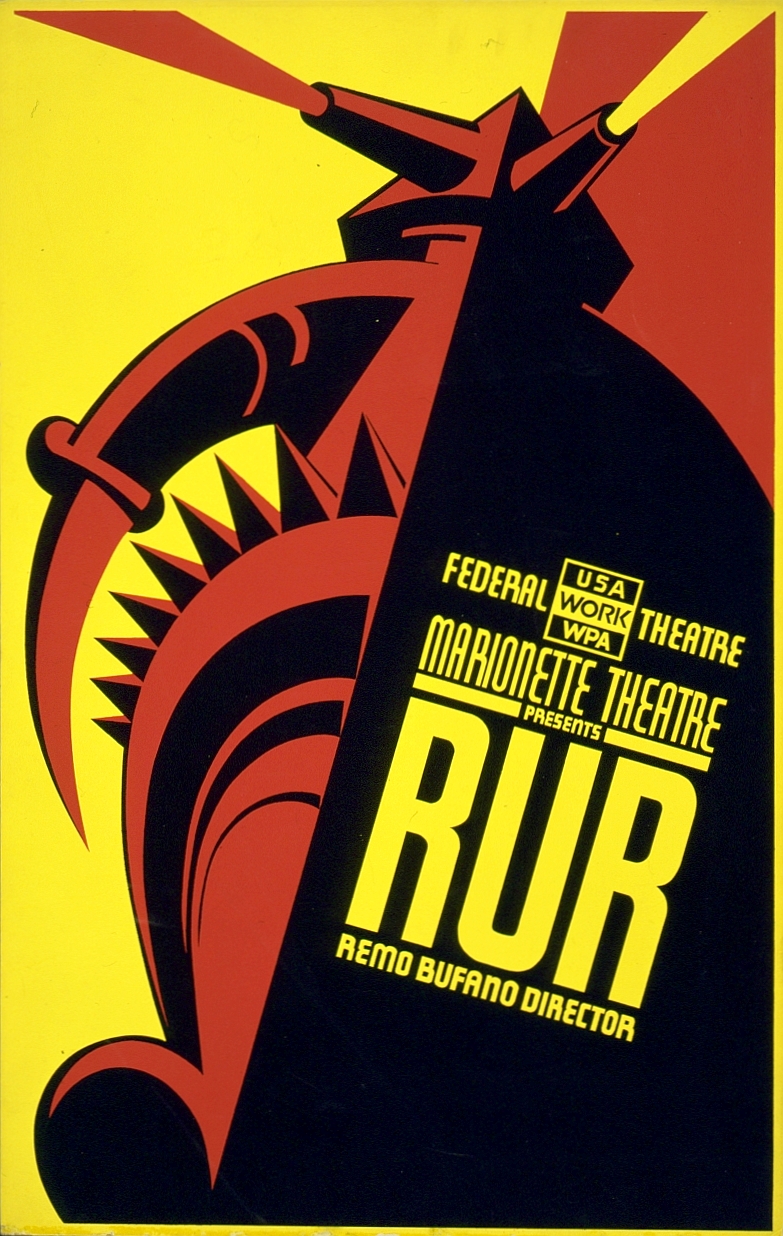
R.U.R. is a 1921 science fiction play in the Czech language by Karel Čapek. R.U.R. stands for Rossum’s Universal Robots, an English phrase used as the subtitle in the Czech original. The play begins in a factory that makes artificial people called ‘robots.’ Unlike the modern usage of the term, these creatures are closer to the modern idea of androids or even clones, as they can be mistaken for humans and can think for themselves.
They seem happy to work for humans, although that changes and a hostile robot rebellion leads to the extinction of the human race. After finishing the manuscript, Čapek realized that he had created a modern version of the Jewish Golem legend. The play introduced the word ‘Robot’ which displaced older words such as ‘automaton’ or ‘android’ in languages around the world. In its original Czech, ‘robota’ means forced labor of the kind that serfs had to perform on their masters’ lands, and is derived from rab, meaning ‘slave.’
Posted in Art, Language, Technology |
Leave a Comment »
April 1, 2011

Jingle truck is US Military slang for colorfully decorated trucks, typically in central Asia. It is a slang term for the customised trucks and buses common throughout the region, including Afghanistan, Pakistan, and India. The name refers to a’ jingling’ sound made by chains hanging from the bumpers of the vehicles.
Posted in Art, Language, World |
1 Comment »
April 1, 2011

David Gonzales is a Mexican-American cartoonist from Richmond, California, currently living in nearby Hercules. He is the creator of the ‘Homies’ line of toys, a series of 2-inch figurines based upon Chicano (Mexican American) characters.
read more »
Posted in Art, Politics |
Leave a Comment »
April 1, 2011

Homies are a series of 2-inch figurines loosely based upon Chicano (Mexican American) characters in the life of artist David Gonzalez. First created in 1998, these plastic figurines were initially sold via vending machines typically positioned in supermarkets. Homies have become a highly collectible item among fans of the line, and many imitation toys have sprung up. The figures caused controversy after their initial release as members of the Los Angeles Police Department, argued that the figures glorified gang life. Many stores stopped selling the toys after the complaint.
Gonzales then created a story for each of the Homies’ characters, each of which had a positive view of the characters. Some became former jail mates who went on to educate children about how to avoid prison. Mainstream stores, such as Walmart, quickly returned the Homies to their stacks, and the toy branched out to include a line of diecast cars, among other things. By 2005, the Homies character line had women, as well as Filipino, Japanese and Puerto Rican, and even Evil Clown characters. The Puerto Ricans set, which includes twelve of the Homies, are nicknamed Los Boricuas.
Posted in Art, Games, Money |
Leave a Comment »
April 1, 2011

Gashapon [gosh-uh-pone] is a Bandai brand trademark widely used throughout the world for their capsule toys.
‘Gashapon’ is a Japanese onomatopoeia, made up of two sounds: ‘gasha’ for the turning of a crank on a toy vending machine, and ‘pon’ for the sound of the toy capsule dropping into the receptacle. It is used to describe both the machines themselves, and any toy obtained from them.
read more »
Posted in Art, Games, Money |
Leave a Comment »
April 1, 2011

Disney Vinylmation is a brand of vinyl toys sold at Disney theme parks and other locations. The toys all have a common shape (that of Mickey Mouse) but have different themed markings, colors and patterns.
The first figures were introduced in November 2008. The figures are sold in sealed packaging. The purchaser does not know which figure they are buying until they have opened it.
Posted in Art, Games, Money |
Leave a Comment »
March 31, 2011

Das Racist is a rap group based in Brooklyn, composed of Heems (Himanshu Suri) and Kool A.D. (Victor Vazquez) joined by hype man Dap (Ashok Kondabolu) for live performances and in music videos. Known for their use of humor, obscure references, and unconventional style, Das Racist has been both dismissed as joke rap and hailed as an urgent new voice in rap. The name derives from a segment on sketch comedy program, ‘Wonder Showzen.’
Posted in Art, Humor |
Leave a Comment »
March 31, 2011

Infrasound [in-fruh-sound] is sound that is lower in frequency than 20 Hz or cycles per second, the ‘normal’ limit of human hearing. Hearing becomes gradually less sensitive as frequency decreases, so for humans to perceive infrasound, the sound pressure must be sufficiently high. The ear is the primary organ for sensing infrasound, but at higher levels it is possible to feel infrasound vibrations in various parts of the body.
The study of such sound waves is sometimes referred to as infrasonics, covering sounds beneath 20 Hz down to 0.001 Hz. This frequency range is utilized for monitoring earthquakes, charting rock and petroleum formations below the earth, and also to study the mechanics of the heart. Infrasound is characterized by an ability to cover long distances and get around obstacles with little dissipation.
read more »
Posted in Art, Health, Science |
Leave a Comment »
March 31, 2011
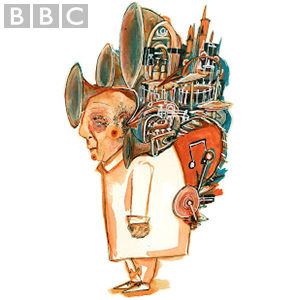
Musical ear syndrome (MES) refers to auditory hallucinations subsequent to hearing loss. It is comparable to Charles Bonnet syndrome (visual hallucinations by visually impaired people) and some have suggested this phenomenon could be included under that diagnosis. The occurrence of MES has been suggested to be very high among the hearing impaired. Sufferers typically hear music or singing and the condition is more common in women. The hallucinatory experiences differ from psychotic disorders although there may be some overlap.
The likely cause is a small cerebrovascular event affecting the auditory cortex. The ‘hole’ in the hearing range is ‘plugged’ by the brain confabulating a piece of information – in this case a remembered melody. A similar occurrence is seen with strokes of the visual cortex where a visual field defect occurs and the brain confabulates a piece of visual data to fill the spot. Towards the end of his life, Robert Schumann said he heard angelic music and music from other composers, which formed the basis for his violin concerto (however, his symptoms may also have been caused by syphilis or mercury poisoning).
Posted in Art, Health, Science |
1 Comment »
March 30, 2011
Liquid light shows or psychedelic light shows surfaced in the mid 1960s and early 1970s in America and Europe. They were an integral part of the Progressive music scene well into the seventies. Shows could be as simple as a single operator and two or three modified slide or overhead projectors and a couple of color wheels or as complex as shows with ten or more operators, 70 plus projectors (including liquid slide, liquid overhead, movie and still image models plus a vast array of highly advanced (for the time) special effects equipment).
read more »
Posted in Art, Drugs, Technology |
Leave a Comment »
March 30, 2011

Mark Mothersbaugh (b. 1950) is an American musician; he is the co-founder of the new wave band Devo and has been its lead singer since 1972. Mothersbaugh attended Kent State as an art student, where he met Devo co-founders Jerry Casale and Bob Lewis. In early 1970, Lewis and Casale formed the idea of the ‘devolution’ of the human race; Mothersbaugh, intrigued by the concept, joined them, building upon it with elements of early poststructuralist ideas and oddball arcana, most notably unearthing the infamous ‘Jocko-Homo Heavenbound’ pamphlet (the basis for the song).
Since Devo, Mothersbaugh developed a successful career writing musical scores for film and television. In film, he has worked frequently with filmmaker Wes Anderson, and scored many of his feature films (‘Bottle Rocket,’ ‘Rushmore,’ ‘The Royal Tenenbaums,’ and ‘The Life Aquatic with Steve Zissou’). His music has been a staple of the children’s television shows ‘Rugrats,’ ‘Beakman’s World,’ and ‘Clifford the Big Red Dog.’ He also wrote some music for ‘Pee-Wee’s Playhouse’ in 1990. His commercial work is often performed with Mutato Muzika, the music production company he formed with several other former members of Devo including his brother, Bob Mothersbaugh.
Posted in Art, Humor, Money |
1 Comment »
March 29, 2011

AKIRA is a manga series by Katsuhiro Otomo. Set in a post-apocalyptic Neo-Tokyo, the work uses conventions of the cyberpunk genre to detail a saga of turmoil. Initially serialized in the pages of Young Magazine from 1982 until 1990, the work was collected in six volumes by Japanese publisher Kodansha. Otomo’s art on the series is considered outstanding, and the work is a breakthrough for both Otomo and the manga form.
An identically titled anime film adaptation was released in 1988, shortening the plot, but with its structure and scenes heavily informed by the manga and its serial origins. The manga takes place in a vastly larger time frame than the film and involves a far wider array of characters and subplots. Through the breadth of the work, Otomo explicates themes of social isolation, corruption and power.
read more »
Posted in Art, Technology, World |
Leave a Comment »