August 15, 2011

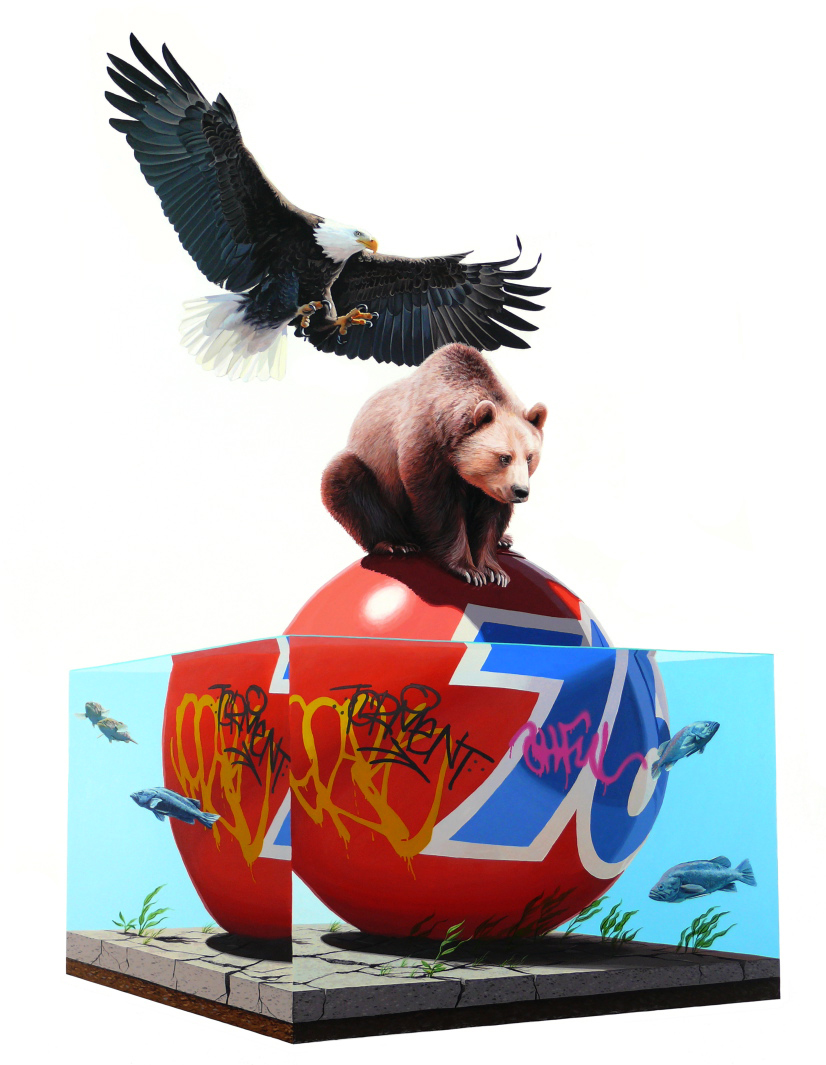
Josh Keyes (b. 1969) is an American contemporary artist who works with painting, drawing, and installation art. He currently works out of Portland, Oregon. His work has been described as ‘a satirical look at the impact urban sprawl has on the environment and surmises, with the aid of scientific slices and core samples, what could happen if we continue to infiltrate and encroach on our rural surroundings.’
Josh’s work brings to mind the detail and complexity of natural history dioramas, and the color and diagrammatic complexity one might find in cross section illustrations from a vintage science textbook. His work has developed over the past years into a complex personal vocabulary of imagery that creates a mysterious and sometimes unsettling juxtaposition between the natural world and the man made landscape.
read more »
Posted in Art, Politics, Technology |
Leave a Comment »
August 15, 2011
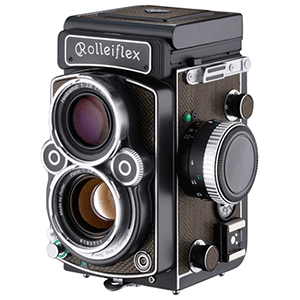
A twin-lens reflex camera (TLR) is a type of camera with two objective lenses of the same focal length. One of the lenses is the photographic objective or ‘taking lens,’ while the other is used for the viewfinder system, which is usually viewed from above at waist level. In addition to the objective, the viewfinder consists of a 45-degree mirror (the reason for the word reflex in the name), a matte focusing screen at the top of the camera, and a pop-up hood surrounding it. The two objectives are connected, so that the focus shown on the focusing screen will be exactly the same as on the film.
However, many inexpensive TLRs are fixed-focus models. Most TLRs use leaf shutters with shutter speeds up to 1/500th sec with a B setting. For practical purposes, all TLRs are film cameras, most often using 120 film, although there are many examples which used other formats. No general-purpose digital TLRs exist, since their heyday ended long prior to the digital era. The main exception is the collector-oriented Rollei Mini-Digi, introduced as a rather expensive ‘toy’ in 2004.
read more »
Posted in Art, Money, Technology |
Leave a Comment »
August 15, 2011
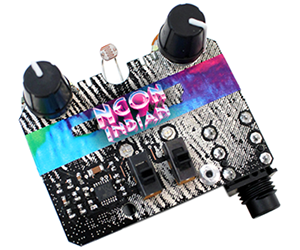

Chillwave, sometimes also referred to as Glo-Fi, is a genre of music where artists are often characterized by their heavy use of effects processing, synthesizers, looping, sampling, and heavily filtered vocals with simple melodic lines.
The genre combines the larger 2000s trends towards 80s retro music and (in indie music) use of ambient sound, with modern pop. The term is said to have been originated on the Hipster Runoff blog.
read more »
Posted in Art, Language, Technology |
Leave a Comment »
August 11, 2011

Ferdinand Cheval (1836 – 1924) was a French postman who spent thirty-three years of his life building Le Palais Idéal (‘The Ideal Palace’) in Hauterives. The structure is regarded as an extraordinary example of naïve art architecture. Cheval began the building in April 1879. He claimed that he had tripped on a stone and was inspired by its shape. He returned to the same spot the next day and started collecting stones. For the next thirty-three years, Cheval picked up stones during his daily mail round and carried them home to build with. He spent the first twenty years building the outer walls. At first, he carried the stones in his pockets, then switched to a basket. Eventually, he used a wheelbarrow. He often worked at night, by the light of an oil lamp.
The Palais is a mix of different styles with inspirations from Christianity to Hinduism. Cheval bound the stones together with lime, mortar and cement. He also wanted to be buried in his palace. However, since that is illegal in France, he proceeded to spend eight more years building a mausoleum for himself in the Hauterives cemetery. He died one year after he had finished building it, and is buried there. Just prior to his death, Cheval began to receive some recognition from luminaries like André Breton and Pablo Picasso. His work is commemorated in an essay by Anaïs Nin. In 1932, the German artist Max Ernst created a collage titled ‘The Postman Cheval.’ The work belongs to the Peggy Guggenheim Collection and is on display there.
Posted in Art, Humor, World |
Leave a Comment »
August 10, 2011

Since its premiere in 1968, 2001: A Space Odyssey has been analyzed and interpreted by multitudes of people ranging from professional movie critics to amateur writers and science fiction fans. The director of the film, Stanley Kubrick, wanted to leave the film open to philosophical and allegorical interpretation, purposely presenting the final sequences of the film without the underlying thread being apparent; a concept illustrated by the final frame of the film, which contains the image of the embryonic ‘Starchild.’
Kubrick encouraged people to explore their own interpretations of the film, and refused to offer an explanation of ‘what really happened’ in the movie, preferring instead to let audiences embrace their own ideas and theories. In a 1968 interview with Playboy magazine, Kubrick stated: ‘You’re free to speculate as you wish about the philosophical and allegorical meaning of the film—and such speculation is one indication that it has succeeded in gripping the audience at a deep level—but I don’t want to spell out a verbal road map for ‘2001’ that every viewer will feel obligated to pursue or else fear he’s missed the point.’
read more »
Posted in Art, Philosophy, Technology |
Leave a Comment »
August 9, 2011

Taqwacore [tok-wah-kor] is a genre of punk music dealing with Islam and its culture, originally conceived in Michael Muhammad Knight’s 2003 novel, ‘The Taqwacores.’ The name is a portmanteau of hardcore and the Arabic word Taqwa, which is usually translated as ‘piety’ or the quality of being ‘God-fearing,’ and thus roughly denotes fear and love of the divine. The scene is composed mainly of young Muslim artists living in the US and other western countries, many of whom openly reject traditionalist interpretations of Islam.
Although Muslim punk music dates at least to the 1979 founding of British band Alien Kulture, and in the 90’s, Nation Records act Fun-Da-Mental and Asian Dub Foundation, this is the first example of US Muslim generated punk. Knight’s novel was instrumental in encouraging the growth of a contemporary North American Muslim punk movement. There is not a definitive ‘taqwacore sound,’ and the scene is much more diverse now than the fictional one portrayed in Knight’s novel, with artists incorporating various styles, ranging from punk to hip-hop, and musical traditions from the Muslim world; the Kominas describe their sound as ‘Bollywood punk,’ Sagg Taqwacore Syndicate is rap and techno inspired, and Al-Thawra uses the term ‘raicore,’ based on Arabic Raï music.
Posted in Art, Philosophy, Politics |
Leave a Comment »
August 9, 2011

Moombahton is a genre of electronic dance music that was created by American dj/producer Dave Nada (aka Dave Villegas) at a high school homecoming ‘skipping party’ for his younger cousin in Washington, D.C., in the fall of 2009.
The specific event that stimulated NADA’s development of the Moombahton genre was his slowing the Afrojack remix of the Silvio Ecomo and DJ Chuckie song ‘Moombah’ to 108 beats per minute. Because that tempo nears that of the reggaeton, Nada created the neologism ‘Moombahton.’
Posted in Art, Technology |
Leave a Comment »
August 8, 2011

Hipster is a slang term that first appeared in the 1940s, was revived in the 1990s, and continued to be used in the 2000s and 2010s, to describe young, recently settled urban middle class adults and older teenagers with musical interests mainly in indie rock. Other interests in media would include independent film, magazines such as Vice and Clash, and websites like Pitchfork Media. In some contexts, hipsters are also called scenesters.
‘Hipster’ has been used in sometimes contradictory ways, making it difficult to precisely define ‘hipster culture,’ which has been described as a ‘mutating, trans-Atlantic melting pot of styles, tastes and behavior.’ Hipsterism fetishizes the authentic elements of all of the ‘fringe movements of the postwar era—beat, hippie, punk, even grunge,’ and draws on the ‘cultural stores of every unmelted ethnicity,’ and ‘regurgitates it with a winking inauthenticity.’ Others, like Arsel and Thompson, argue that hipster signifies a cultural mythology, a crystallization of a mass-mediated stereotype generated to understand, categorize, and marketize indie consumer culture, rather than an objectified group of people.
read more »
Posted in Art, Language, Money |
Leave a Comment »
August 3, 2011

The Electric Kool-Aid Acid Test is a work of literary journalism by Tom Wolfe, published in 1968. Using techniques from the genre of hysterical realism and pioneering new journalism, the ‘nonfiction novel’ tells the story of Ken Kesey and his band of Merry Pranksters.
The book follows the Pranksters across the country driving in a psychedelic painted school bus dubbed ‘Furthur,’ reaching what they considered to be personal and collective revelations through the use of LSD and other psychedelic drugs. The book also describes the Acid Tests, early performances by The Grateful Dead, and Kesey’s exile to Mexico.
Posted in Art, Drugs, Language |
Leave a Comment »
August 1, 2011

Billy Preston (1946 – 2006) was an African American rhythm and blues musician from Houston, Texas, raised mostly in Los Angeles. In addition to his career as a solo artist, Preston collaborated with some of the greatest names in the music industry, including The Beatles, The Rolling Stones, Nat King Cole, Little Richard, Ray Charles, Elton John, Eric Clapton, Bob Dylan, Aretha Franklin, and Johnny Cash. He played the Fender Rhodes electric piano and the Hammond organ on the Get Back sessions in 1969.
Preston began playing piano while sitting on his mother’s lap at age three, and he was considered something of a child prodigy on piano and organ. By the age of 10 he was performing in the bands of gospel singers Mahalia Jackson, James Cleveland, and Andrae Crouch. In the 1960s he performed with Little Richard and Ray Charles, and in 1963, aged just 16, he played organ on the Sam Cooke album ‘Night Beat.’ He also began a recording career as a solo artist with the 1965 album ‘The Most Exciting Organ Ever.’
read more »
Posted in Art |
Leave a Comment »
July 30, 2011

Max Hattler (b. 1976) is a German video artist and experimental filmmaker best-known for his kaleidoscopic political short films ‘Collision’ (2005) and ‘Spin’ (2010), abstract stop motion work ‘Aanaatt’ (2008), and psychedelic animation loops ‘1923 aka Heaven’ and ‘1925 aka Hell’ (2010).
He also works extensively in the field of audiovisual performance, and has created concert visuals for Basement Jaxx, Diplo, Jovanotti, The Egg, and Ladyscraper.
Posted in Art, Technology |
Leave a Comment »
July 30, 2011


Turntablism is the art of manipulating sounds and creating music using phonograph turntables and a DJ mixer. The word ‘turntablist’ was coined in 1995 by DJ Babu to describe the difference between a DJ who just plays records, and one who performs by touching and moving the records, stylus and mixer to manipulate sound. The new term co-occurred with a resurgence of the art of hip hop style DJing in the 1990s.
Composer John Oswald described the art: ‘A phonograph in the hands of a ‘hiphop/scratch’ artist who plays a record like an electronic washboard with a phonographic needle as a plectrum, produces sounds which are unique and not reproduced — the record player becomes a musical instrument.’
read more »
Posted in Art, Games, Technology |
Leave a Comment »