June 3, 2011
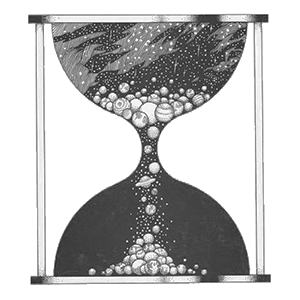
The Forever War is a 1974 science fiction novel by American author Joe Haldeman, telling the contemplative story of soldiers fighting an interstellar war between humanity and the enigmatic Tauran species.
The pithy, insightful explorations of the inhumanity of war and of bureaucracy, and of the psychological effects resulting from time dilation space travel (a soldier returns home after centuries away), won acclaim immediately.
read more »
Posted in Art, Technology, War |
Leave a Comment »
June 3, 2011

Stella is a comedy trio consisting of Michael Showalter, Michael Ian Black, and David Wain (all three of whom are alumni of the comedy troupe, The State). The group formed in 1997 as a weekly nightclub comedy attraction, performing at a New York City nightclub from 1997 until 2005. Stella soon gained a wider cult following after a series of self-produced shorts were released in limited quantities on DVD. Now known for their unique blend of potently mainstream comedy and surrealist humor, Stella has garnered a small but dedicated fanbase.
A noted aspect of Stella’s stand-up routine involved the members arguing with each other on stage. Michael Ian Black once referred to it as, ‘professional bickering,’ which some have compared to a ‘postmodern Smothers Brothers.’ Michael Showalter once said of their onstage bickering, ‘When people aren’t sure if what they’re watching is real or not, it kind of creates a tension. We have a certain amount of tension that’s very ripe comedically.’
read more »
Posted in Art, Humor |
Leave a Comment »
June 3, 2011
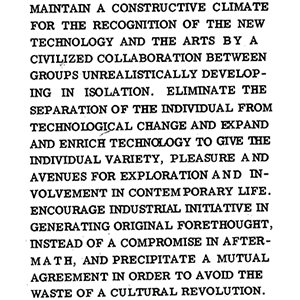
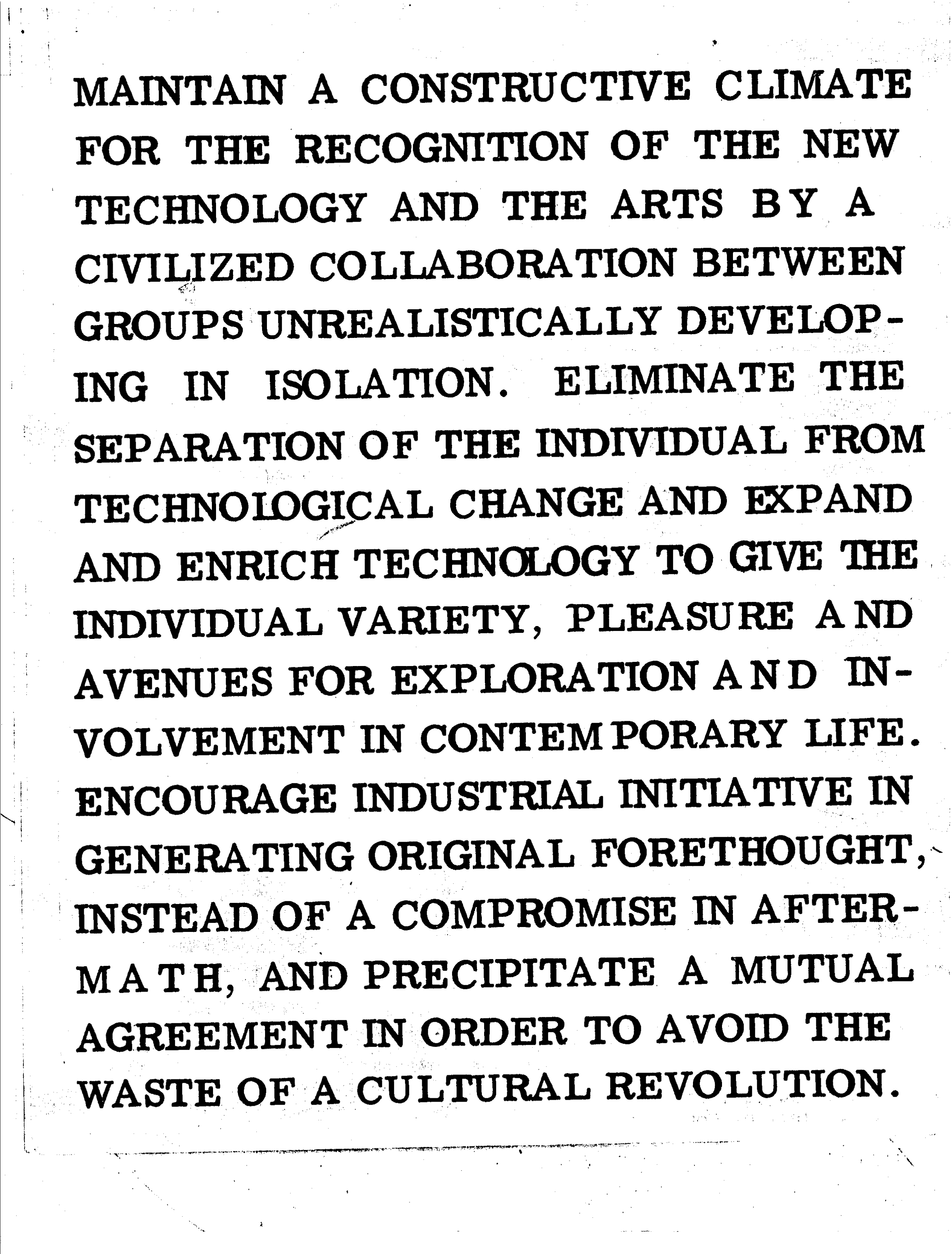
Experiments in Art and Technology (E.A.T.) was a non-profit established in 1967 to develop collaborations between artists and engineers by the engineers Billy Klüver and Fred Waldhauer and the artists Robert Rauschenberg and Robert Whitman. They had previously collaborated, most notably in 1966 for ‘9 Evenings: Theatre and Engineering,’ a series of performance art presentations that united artists and engineers. Also in 1966, 10 New York artists worked with 30 engineers and scientists from the world renowned Bell Telephone Laboratories to create groundbreaking performances that incorporated new technology. Video projection, wireless sound transmission, and Doppler sonar had never been seen in art.
The installation gathered the vast and insightful but also often undecipherable shards, artifacts, apparatus, photographs, drawings, diagrams, correspondence, and documentary film footage that provides information, but little if any comprehensive understanding of a series of ten individual works that, although wildly uneven on every level from aesthetic to technical, have entered the canon of performance art, experimental music and theater, bridging the gap from the eras of Dada, Fluxus and the Happenings/Actions of the 1960s, through the current generation of arts for whom multimedia and technology are the norm. The pinnacle of E.A.T. activity is generally considered to be the Pepsi Pavilion at Expo ’70 at Osaka Japan where E.A.T. artists and engineers collaborated to design and program an immersive dome that included a fog sculpture by Fujiko Nakaya.
Posted in Art, Technology |
Leave a Comment »
June 3, 2011
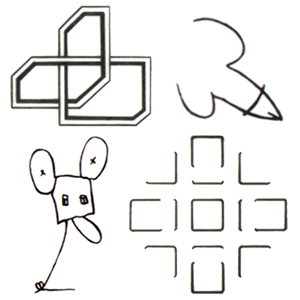
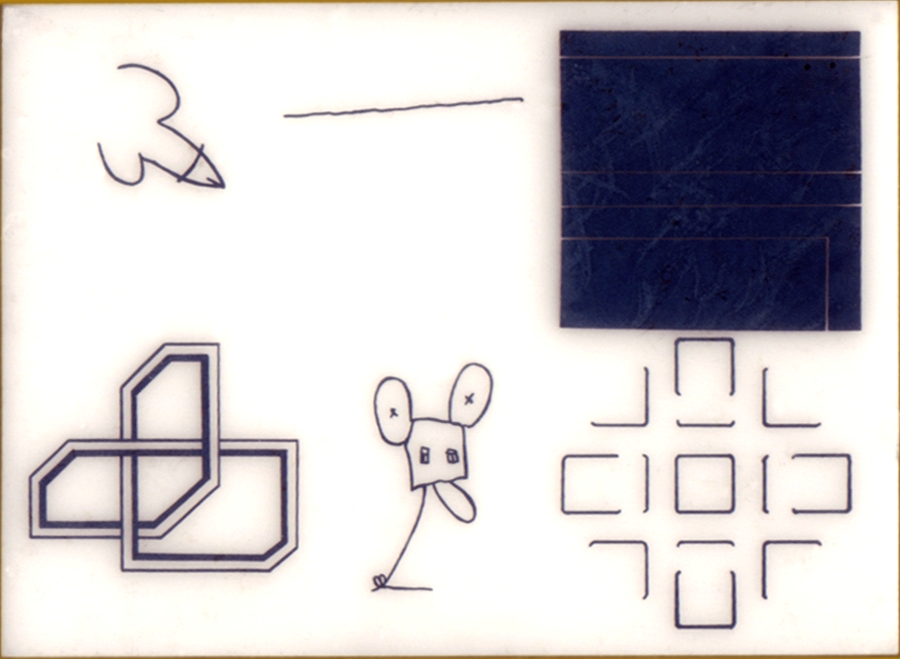
The Moon Museum is a small ceramic wafer three-quarters of an inch by half an inch in size, containing artworks by six prominent artists from the late 1960s. The artists with works in the ‘museum’ are Robert Rauschenberg, David Novros, John Chamberlain, Claes Oldenburg, Forrest Myers, and Andy Warhol.
This wafer was supposedly covertly attached to a leg of the Intrepid landing module, and subsequently left on the moon during Apollo 12. The moon museum is considered the first Space Art object. While it is impossible to tell if the Moon Museum is actually on the moon without sending another mission to look, many other personal effects were smuggled onto the Apollo 12 lander and hidden in the layers of gold blankets that wrapped parts of the spacecraft.
read more »
Posted in Art, Humor, Technology |
Leave a Comment »
June 3, 2011
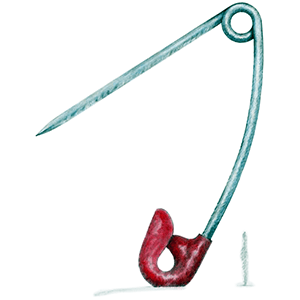
Claes Oldenburg (b. 1929) is a Swedish sculptor, best known for his public art installations typically featuring very large replicas of everyday objects. Another theme in his work is soft sculpture versions of everyday objects. He first opened his own studio in 1953, and became a naturalized citizen of the United States that year as well.
Many of Oldenburg’s large-scale sculptures of mundane objects elicited public ridicule before being embraced as whimsical, insightful, and fun additions to public outdoor art. In the 1960s he became associated with the Pop Art movement and created many so-called happenings, which were performance art related productions of that time. The name he gave to his own productions was ‘Ray Gun Theater.’
read more »
Posted in Art, Humor |
Leave a Comment »
June 3, 2011
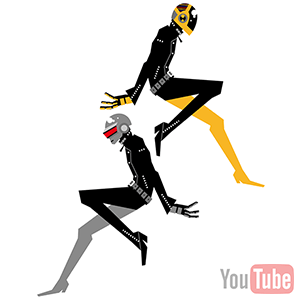
Daft Punk’s Electroma is a 2007 film by French duo Daft Punk. The plot revolves around the quest of two robots (the band members, played by Peter Hurteau and Michael Reich) to become human. The music featured in this film is not by Daft Punk, which is a first for the duo after their previous film and home video releases, ‘D.A.F.T.’ and ‘Interstella 5555.’
The two lead characters appear as the robotic forms of Daft Punk; one wears a silver helmet and the other wears a gold one. An opening scene shows the duo driving in a 1987 Ferrari 412 with its license plate displaying ‘HUMAN.’ After passing through a Southwestern United States landscape, the duo arrives at a town in Inyo County, California. The town’s denizens are robots physically identical to the two main characters, but at different ages, with different clothing and alternating gender.
read more »
Posted in Art |
2 Comments »
June 1, 2011
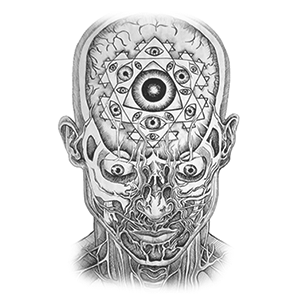
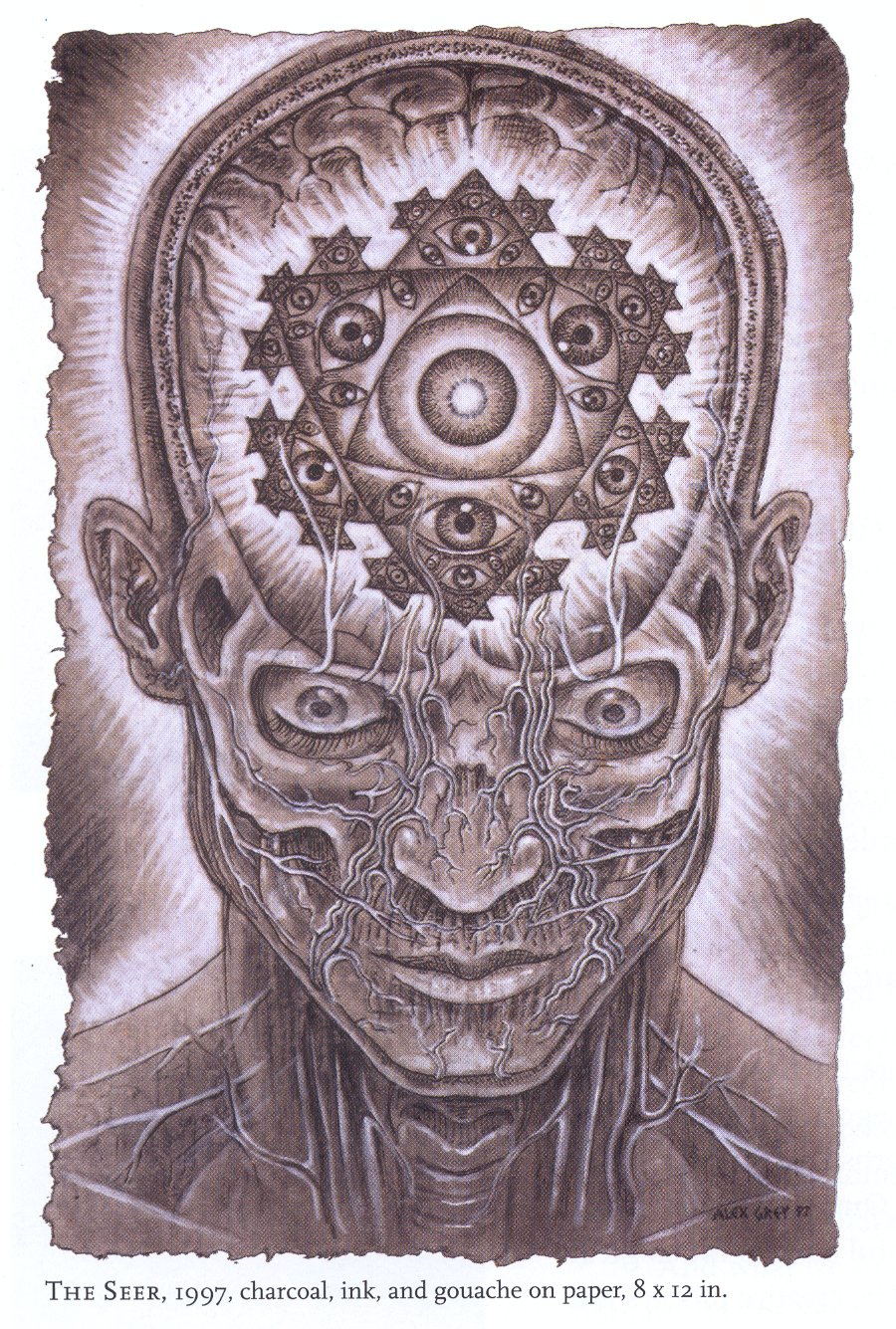
Alex Grey (b. 1953) is an American artist specializing in spiritual and psychedelic art (or visionary art) that is sometimes associated with the New Age movement. Grey is a Vajrayana practitioner, one the three main sects of Buddhism. His body of work spans a variety of forms including performance art, process art, installation art, sculpture, and painting. He and his wife Allyson Grey are the co-founders of the Chapel of Sacred Mirrors, a non-profit institution supporting Visionary Culture in New York City.
Grey’s paintings can be described as a blend of sacred, visionary art and postmodern art. He is best known for his paintings of glowing anatomical human bodies, images that ‘x-ray’ the multiple layers of reality. His art is a complex integration of body, mind, and spirit. ‘The Sacred Mirrors,’ a life-sized series of 21 paintings, took 10 years to complete, and examines in detail the physical and metaphysical anatomy of the individual.
read more »
Posted in Art, Philosophy, Science |
1 Comment »
June 1, 2011

The Ethiopians is a ska, rocksteady, and reggae vocal group, founded by Leonard Dillon, Stephen Taylor and Aston Morris. The group started out recording for Clement ‘Coxsone’ Dodd in 1966. Dillon had previously released some mento songs under the name Jack Sparrow. Around late 1966, Morris left the Ethiopians.
Having left Dodd, the Ethiopians started recording at Dynamic Studios for the W.I.R.L. label, releasing the rocksteady classic ‘Train to Skaville,’ which was their first success. In 1968 they recorded the song ‘Everything Crash,’ their first big hit. The song criticised the political situation in Jamaica at the time, such as water rationing and power cuts that led to unrest; such as an incident in which 31 people were shot by police.
Posted in Art, Politics, World |
Leave a Comment »
June 1, 2011


Toots and the Maytals are a Jamaican ska and reggae vocal group. The Maytals were key figures in reggae music. Formed in the early 1960s when ska was hot, the Maytals had a reputation for having strong, well-blended voices and a seldom-rivaled passion for their music. Frederick ‘Toots’ Hibbert (b. 1945) is the group’s frontman.
He met Henry ‘Raleigh’ Gordon and Nathaniel ‘Jerry’ Mathias, forming in 1961 a group whose early recordings were incorrectly attributed to ‘The Flames’ and ‘The Vikings’ in the UK by Island Records. The Maytals first had chart success recording for producer Clement ‘Coxsone’ Dodd at Studio One. With musical backing from Dodd’s house band, The Skatalites, the Maytals’ close-harmony gospel singing overshadowed Dodd’s other up-and-coming vocal group, The Wailers.
read more »
Posted in Art, World |
Leave a Comment »
June 1, 2011

‘54-46 (That’s My Number)‘ is a song by Fred ‘Toots’ Hibbert, recorded by Toots & the Maytals and originally released on the Beverly’s label in Jamaica and the Pyramid label in the UK. It was one of the first ska songs to receive widespread popularity outside Jamaica and is seen as being one of the defining songs of the reggae genre. It has been anthologized repeatedly and the titles of several reggae anthologies include ’54-46′ in their title.
The lyrics describe Toots’ time in prison for an arrest for possession of marijuana. The song features the same riddim (instrumental accompaniment) to a song as ‘Train to Skaville’ by Toots & the Maytals’ contemporaries The Ethiopians. Hibbert later admitted that 54-46 was not his actual jail number, and that he was not arrested for a crime related to marijuana.
Posted in Art, Drugs, Politics |
Leave a Comment »
June 1, 2011

New Belgium Brewing Company is a regional brewery located in Fort Collins, Colorado. The brewery was founded by husband-and-wife team Jeff Lebesch and Kim Jordan in 1991 and emphasizes eco-friendly practices and employee ownership in its marketing materials. Fat Tire, an amber ale, is the company’s flagship beer. Its recipe originates from a co-founder’s bicycle trip through Belgium from brewery to brewery. The company promotes its Fat Tire ale locally by the public placement of colorful vintage bicycles outside its brewery, which is located adjacent to the public bike path along the Cache La Poudre River. New Belgium beer labels are designed by Anne Fitch, a watercolorist. Kim Jordan, the President of New Belgium Brewery, credits the success of New Belgium Brewery in part on Anne’s artwork, ‘Our beers were good, our labels were interesting to people, and we pretty quickly had a fairly robust following.’ In 2006, her artwork appeared on each of the over 125 million bottles sold by New Belgium.
Tour de Fat is a bicycle parade and festival sponsored by New Belgium. The events, which take place annually in various large- and medium-sized cities around the West, include music, New Belgium beer, circus- and -vaudeville type acts, bicycle dance troupes, and the main activist spectacle, a giant group bike ride/parade wherein the participants, many of whom are in fanciful costume, ride through town. The actual activist climax of the tour, however, is the bike trade, in which a local participant transfers the keys and title of their motor vehicle to New Belgium in exchange for a new commuter bike and trailer in order to promote bike riding and sustainability. The ‘Fat Tire’ bike is so strongly associated with New Belgium Breweries that employees of the brewery are given a ‘cruiser bike’ ‘like the one pictured on its Fat Tire Amber Ale label’ on their one -year anniversary with the company.
Posted in Art, Food, Money |
Leave a Comment »
May 31, 2011
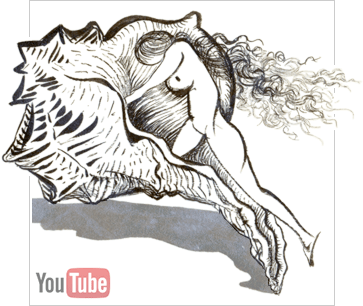
Destino is an animated short film released in 2003 by The Walt Disney Company. The six-minute short follows the story of Chronos and the ill-fated love he has for a mortal female. It is unusual in that its production originally began in 1945.
The project was a collaboration between Walt Disney and Salvador Dalí, and features music written by Mexican songwriter Armando Dominguez and performed by Dora Luz.
read more »
Posted in Art |
1 Comment »