July 16, 2024
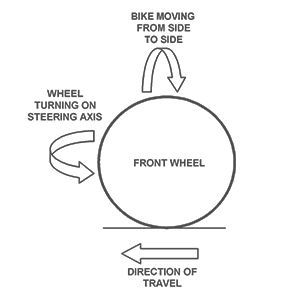
Speed wobble (also known as shimmy, tank-slapper, or speed wobble) is a rapid side-to-side shaking of a vehicle’s front wheel(s) that occurs at high speeds and can lead to loss of control. It presents as a quick (4–10 Hz) oscillation of primarily the steerable wheel(s) of a vehicle. It is caused by a combination of factors, including initial disturbances and insufficient damping, which can create a resonance effect. Initially, the rest of the vehicle remains mostly unaffected, until translated into a vehicle yaw oscillation of increasing amplitude producing loss of control.
Vehicles that can experience this oscillation include motorcycles and bicycles, skateboards, and, in theory, any vehicle with a single steering pivot point and a sufficient amount of freedom of the steered wheel, including that which exists on some light aircraft with tricycle gear where instability can occur at speeds of less than 80 km/h (50 mph); this does not include most automobiles. The initial instability occurs mostly at high speed and is similar to that experienced by shopping cart wheels and aircraft landing gear.
read more »
Posted in Death, Science, Technology |
Leave a Comment »
August 29, 2023

Guns don’t kill people, people kill people is a slogan popularized by the National Rifle Association of America (NRA) and other gun advocates. The slogan and connected understanding dates back to at least the 1910s, and it became widely popular among gun advocates in the second half of the 20th century, so much so that some have labeled it a cliché.
Gun control proponents claim the slogan is an example of bumper sticker logic and supports the larger folk psychology behind gun advocacy. In colloquial use, both parts of the statement are largely considered true. However, when the statement is used in the context of gun debates it becomes misdirection and can be considered a fallacy.
read more »
Posted in Death, Language, Politics |
Leave a Comment »
May 19, 2023

Balconing is the name given in Spain to the act of jumping into a swimming pool from a balcony or falling from height while climbing from one balcony to another, performed by foreign tourists during holidays. The term was formed through a combination of the Spanish-language word balcón (‘balcony’) and the English-language suffix ‘-ing,’ in reference to the origin of most practitioners.
In 2010 and 2011, a spate of injuries and deaths attributed by the Spanish press to ‘balconing’ occurred among tourists in the Balearic Islands (including Mallorca and Ibiza). Videos of people jumping into pools from balconies were posted on video sharing websites such as YouTube, which were alleged to have played a role in the spread of the phenomenon. A similar phenomenon has been described in college-related events in the United States.
read more »
Posted in Death, World |
Leave a Comment »
November 13, 2022
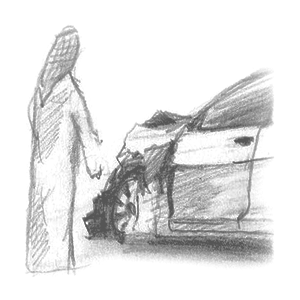
Tafheet (also known as hajwalah or Saudi drifting) is an Arab street racing subculture that involves repeatedly sliding around on a straight road at high speed, drifting sideways, and recovering with opposite lock, often with little or no concern for safety. It began in Saudi Arabia and United Arab Emirates in the 1970s. The cars are generally non-modifiedand are sometimes stolen or rented cars.
The technique does not involve recognized motorsport skills such as high-speed cornering using power slides. Many videos and compilations of the minor and horrific accidents that result are posted online.
read more »
Posted in Death, Games, World |
1 Comment »
September 29, 2022

Pepsi Number Fever, also known as the 349 incident, was a promotion held by PepsiCo in the Philippines in 1992, which led to riots and the deaths of at least five people.
In February 1992, Pepsi Philippines (PCPPI) announced that they would print numbers, ranging from 001 to 999, inside the caps (crowns) of Pepsi, 7-Up, Mountain Dew, and Mirinda bottles. Certain numbers could be redeemed for prizes, which ranged from 100 pesos (about US$4) to 1 million pesos for a grand prize (roughly US$40,000 in 1992), equivalent to 611 times the average monthly salary in the Philippines at the time. Pepsi allocated a total of US$2 million for prizes. Marketing specialist Pedro Vergara based Pepsi Number Fever on similar, moderately successful promotions that had been held previously in Vergara’s geographic area of expertise, Latin America.
read more »
Posted in Death, Games, Money |
3 Comments »
April 20, 2022

Terminal lucidity, also known as ‘rallying’ or ‘the rally,’ is an unexpected return of mental clarity and memory, or suddenly regained consciousness that occurs in the time shortly before death in patients suffering from severe psychiatric or neurological disorders. This condition has been reported by physicians since the 19th century.
Several case reports in the 19th century described the unusual condition of an improvement and recovery of the mental state in patients days or weeks before death. English physician William Munk, for instance, in 1887 called the phenomenon ‘lucidity before death.’
read more »
Posted in Death, Health |
Leave a Comment »
December 17, 2020

Going postal is an American slang phrase referring to becoming extremely and uncontrollably angry, often to the point of violence, and usually in a workplace environment. The expression derives from a series of incidents from 1986 onward in which United States Postal Service (USPS) workers shot and killed managers, fellow workers, and members of the police or general public in acts of mass murder.
Between 1970 and 1997, more than 40 people were killed by current or former employees in at least 20 incidents of workplace rage. Between 1986 and 2011, workplace shootings happened roughly twice per year, with an average of 11.8 people killed per year.
read more »
Posted in Death, Politics |
1 Comment »
August 2, 2020

Dead Birds is a 1963 American documentary film by American anthropologist Robert Gardner (1925-2014) about the ritual warfare cycle of the Dugum Dani tribe in New Guinea. The film presents footage of battles between the Willihiman-Wallalua clan and the Wittaia clan with scenes of the funeral of a small boy killed by a raiding party, the women’s work that goes on while battles continue, and the wait for enemy to appear.
The film’s theme is the encounter that all people must have with death, as told in a Dugum Dani myth of the origins of death that bookends the film. The film uses a nonlinear narrative structure of parallel or braided narrative that traces three individuals through a season of three deaths and one near-death as relayed by an expository voiceover that describes scenes and the thoughts of the film’s protagonists.
read more »
Posted in Death, Science, War, World |
Leave a Comment »
May 23, 2020
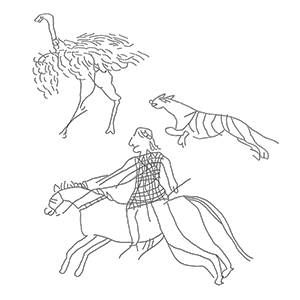
Venatio [ven-ah-tee-oh] (‘hunting’) was a type of entertainment in Roman amphitheaters involving the hunting and killing of wild animals.
The event was introduced by Roman General Marcus Fulvius Nobilior, who celebrated his Greek campaign in 189 BCE by celebrating games where gladiators would fight lions and panthers. He was possibly inspired by Alexander the Great’s purported pastime of pitting lions against both men and dogs.
read more »
Posted in Death, Games |
Leave a Comment »
March 25, 2020
Dark tourism refers to travel to places historically associated with death and tragedy. The main attraction to dark locations is their historical value rather than their associations with death and suffering.
While there is a long tradition of people visiting recent and ancient settings of death, such as travel to gladiator games in the Roman Colosseum, attending public executions by decapitation, and visiting the catacombs, this practice has been studied academically only relatively recently. Travel writers were the first to describe their tourism to deadly places. American political satirist and journalist P. J. O’Rourke called his travel to Warsaw, Managua, and Belfast in 1988 ‘holidays in hell’, or sociologist Chris Rojek talking about ‘black-spot’ tourism in 1993 or the ‘milking the macabre.’
read more »
Posted in Death, Education, World |
2 Comments »
January 8, 2020


Revolution 9 is a sound collage that appeared on the Beatles’ 1968 eponymous release (popularly known as the ‘White Album’). The composition, credited to Lennon–McCartney, was created primarily by John Lennon with assistance from George Harrison and Yoko Ono. Lennon said he was trying to paint a picture of a revolution using sound. The composition was influenced by the avant garde style of Ono as well as the musique concrète works of composers such as Edgard Varèse and Karlheinz Stockhausen.
British music critic Ian MacDonald remarked that ‘Revolution 9’ evoked the era’s revolutionary disruptions and their repercussions, and thus was culturally ‘one of the most significant acts the Beatles ever perpetrated,’ as well as ‘the world’s most widely distributed avant garde artifact.’
read more »
Posted in Art, Death |
Leave a Comment »
February 24, 2019
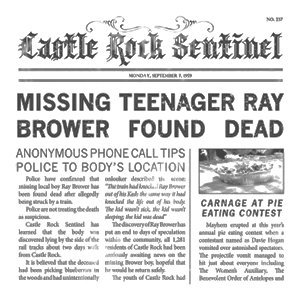
Legend tripping is a name bestowed by folklorists and anthropologists on an adolescent practice (containing elements of a rite of passage) in which a usually furtive nocturnal pilgrimage is made to a site which is alleged to have been the scene of some tragic, horrific, and possibly supernatural event or haunting.
While the stories that attach to the sites of legend tripping vary from place to place, and sometimes contain a kernel of historical truth, there are a number of motifs and recurring themes in the legends and the sites. Abandoned buildings, remote bridges, tunnels, caves, rural roads, specific woods or other uninhabited (or semi-uninhabited) areas, and especially cemeteries are frequent sites of legend-tripping pilgrimages
read more »
Posted in Death, Games, Philosophy |
Leave a Comment »


 The Daily Omnivore