July 29, 2014

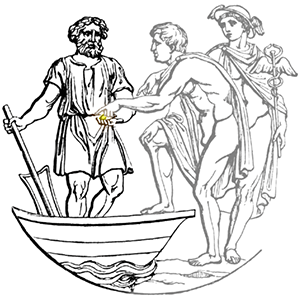
A psychopomp [sahy-koh-pomp] (from the Greek word ‘psuchopompos,’ literally meaning the ‘guide of souls’) are creatures, spirits, angels, or deities in many religions whose responsibility is to escort newly deceased souls to the afterlife. Their role is not to judge the deceased, but simply provide safe passage. Frequently depicted on funerary art, psychopomps have been associated at different times and in different cultures with horses, deer (harts) dogs, and several birds, such as whip-poor-wills, ravens, crows, owls, sparrows, cuckoos.
In Jungian psychology, which stresses the importance of the symbolic in human life, the psychopomp is a mediator between the unconscious and conscious realms. It is symbolically personified in dreams as a wise man or woman, or sometimes as a helpful animal. In many cultures, the shaman (medicine man) also fulfills the role of the psychopomp. This may include not only accompanying the soul of the dead, but also vice versa: to help at birth, to introduce the newborn child’s soul to the world. This also accounts for the contemporary title of ‘midwife to the dying,’ or ‘End of Life Doula’ which is another form of psychopomp work.
Posted in Death, Philosophy |
Leave a Comment »
June 26, 2014


A sedentary lifestyle is characterized by a lack of physical activity. A person who lives a sedentary lifestyle may colloquially be known as a ‘couch potato.’ It is commonly found in both the developed and developing world. Sedentary activities include sitting, reading, watching television, playing video games, and computer use for much of the day with little or no vigorous physical exercise. A sedentary lifestyle can contribute to many preventable causes of death. ‘Screen time’ is the amount of time a person spends watching a screen such as a television, computer monitor, or mobile device. Excessive screen time is linked to negative health consequences, such as insufficient blinking and tear flow.
The term couch potato was coined by a friend of underground comics artist Robert Armstrong in the 1970s; Armstrong featured a group of couch potatoes in a series of comics featuring sedentary characters and with Jack Mingo and Allan Dodge created a satirical organization that purported to watch television as a form of meditation. With two books and endless promotion through the 1980s, the ‘Couch Potatoes’ appeared in hundreds of newspapers, magazines and broadcasts, spreading its ‘turn on, tune in, veg out’ message, garnering 7,000 members, and popularizing the term.
read more »
Posted in Death, Health |
1 Comment »
June 9, 2014


Survivorship bias is the logical error of concentrating on the people or things that ‘survived’ some process and inadvertently overlooking those that did not because of their lack of visibility. The concept applies to actual people (e.g. subjects in a medical study), as well as companies, or anything that must make it past some selection process to be considered further (e.g. job applicants).
Survivorship bias can lead to overly optimistic beliefs because failures are ignored, such as when companies that no longer exist are excluded from analyses of financial performance. It can also lead to the false belief that the successes in a group always have some special property, rather than just benefiting from coincidence. For example, if the three of the five students with the best college grades went to the same high school, that can lead one to believe that the high school must offer an excellent education. This could be true, but the question cannot be answered without looking at the grades of all the other students from that high school, not just the ones who ‘survived’ the top-five selection process.
read more »
Posted in Death, Health, Science |
Leave a Comment »
June 4, 2014
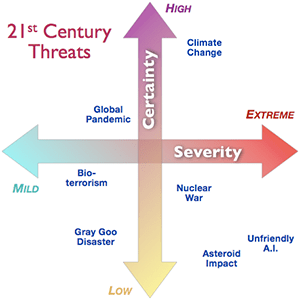

Ecophagy [ih-koh-fuh-jee] is a term coined by molecular engineering scientist Robert Freitas that means the literal consumption of an ecosystem. He wrote: ‘Perhaps the earliest-recognized and best-known danger of molecular nanotechnology is the risk that self-replicating nanorobots capable of functioning autonomously in the natural environment could quickly convert that natural environment (e.g., ‘biomass’) into replicas of themselves (e.g., ‘nanomass’) on a global basis, a scenario usually referred to as the ‘grey goo problem’ but perhaps more properly termed ‘global ecophagy.”
The term has since been used to describe several other world destroying events including nuclear war, catastrophic monoculture (lack of biodiversity in farming), and mass extinction due to climate change. Scholars suggest that these events might result in ecocide in that they would undermine the capacity of the Earth’s biological population to repair itself. Others suggest that more mundane and less spectacular events—the unrelenting growth of the human population, the steady transformation of the natural world by human beings—will eventually result in a planet that is considerably less vibrant, and one that is, apart from humans, essentially lifeless.
Posted in Death, Technology, World |
Leave a Comment »
May 22, 2014

Dr. Ignaz [ig-nahts] Semmelweis [zem-uhl-vahys] discovered in 1847 that hand-washing with a solution of chlorinated lime reduced the incidence of fatal childbed fever tenfold in maternity institutions. However, the reaction of his contemporaries was not positive; his subsequent mental disintegration led to him being confined to an insane asylum, where he died in 1865. His critics claimed his findings lacked scientific reasoning. The failure of the nineteenth-century scientific community to recognize Semmelweis’s findings, and the nature of the flawed critiques against him helped advance a positivist epistemology, leading to the emergence of evidence-based medicine.
To a modern reader, Semmelweis’s experimental evidence—that chlorine washings reduced childbed fever—seem obvious, and it may seem absurd that his claims were rejected on the grounds of purported lack of ‘scientific reasoning.’ His unpalatable observational evidence was only accepted when seemingly unrelated work by Louis Pasteur in Paris some two decades later offered a theoretical explanation for Semmelweis’s observations: the germ theory of disease.
read more »
Posted in Death, Health, Science |
1 Comment »
March 31, 2014

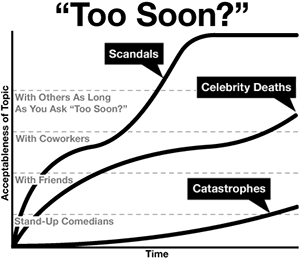
9/11 humor is black comedy or off-color humor that aims to make light of the September 11, 2001 terrorist attacks. A number of scholars have studied the ways in which humor has been used to deal with the trauma of the event. Researcher Bill Ellis found jokes about the attacks from Americans the day afterwards, and sociologist Giselinde Kuipers found jokes on Dutch websites a day later. Kuipers had collected around 850 online jokes about 9/11, Osama Bin Laden, and the Afghanistan war by 2005.
An early public attempt at 9/11 humor was made by Gilbert Gottfried just a few weeks after the attacks. During a comedy roast at the Friars Club his 9/11 gags ellicited angry shouts of ‘too soon.’ Gottfried improvised and performed ‘The Aristocrats’ routine (a famously vulgar joke), which got great applause from the crowd.
read more »
Posted in Death, Humor, War |
Leave a Comment »
March 22, 2014
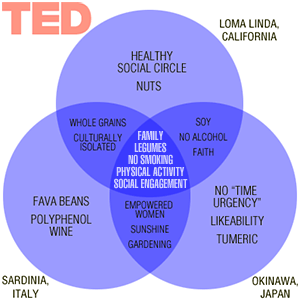
Blue Zone is a concept used to identify a demographic and/or geographic area of the world where people live measurably longer lives, as described in Dan Buettner’s book, ‘The Blue Zones: Lessons for Living Longer from people who lived the longest.’ The concept grew out of demographic work done by Gianni Pes and Michel Poulain, who identified Sardinia’s Nuoro province as the region with the highest concentration of male centenarians.
As the two men zeroed in on the cluster of villages with the highest longevity, they drew concentric blue circles on the map and began referring to the area inside the circle as the Blue Zone. Buettner identifies other zones in Okinawa, Japan; Nicoya, Costa Rica; Icaria, Greece; Vilcabamba, Ecuador; and among the Seventh-day Adventists in Loma Linda, California.
read more »
Posted in Death, Health, World |
1 Comment »
March 10, 2014

Taser safety issues include cardiac arrhythmia (irregular heartbeat) in susceptible subjects, possibly leading to heart attack or death in minutes by ventricular fibrillation, which leads to cardiac arrest and—if not treated immediately—to sudden death. People susceptible to this outcome are sometimes healthy and unaware of their susceptibility.
Although the medical conditions or use of illegal drugs among some of the casualties may have been the proximate cause of death, the electric shock of the Taser can significantly heighten such risk for subjects in an at-risk category. In some cases however, death occurred after Taser use coupled with the use of force alone, with no evidence of underlying medical condition and no use of drugs.
read more »
Posted in Death, Politics, Technology |
Leave a Comment »
January 21, 2014

Historically, the comparative merits of the tiger versus the lion have been a popular topic of discussion by hunters, naturalists, artists and poets, and it continues to inspire the popular imagination in the present day. Lions and tigers have competed in the wild where their ranges have overlapped. They have also been pitted against each other in captivity, either as deliberate contests or as a result of accidental encounters.
In the circuses of Ancient Rome, exotic beasts were commonly pitted against each other. The contest of the lion against the tiger was a classic pairing and the betting usually favored the tiger. A tiger that belonged to the King of Oude in India killed thirty lions, and destroyed another after being transferred to the zoological garden in London.
read more »
Posted in Death, Science |
Leave a Comment »
November 12, 2013

‘Horrible Histories‘ is a series of UK educational books first released in in 1993 with ‘The Terrible Tudors’ and ‘The Awful Egyptians.’ They are designed to engage children in history by presenting the unusual, gory, or unpleasant aspects in a tongue-in-cheek manner in contrast to the formality of lessons taught in school. The books are published by Scholastic and written primarily by Terry Deary (with illustrations by Martin Brown and others).
After a run of 60 books, Deary announced that the series would officially come to an end in 2013 for lack of stories, and said they would focus on the larger media franchise such as magazines, TV, and stage shows. Terry Deary studied at drama college and worked as an actor-teacher at the TIE company in Wales. He then became a theatre director and began to write plays for children. Many of his TIE plays were eventually rewritten and adapted for the ‘Horrible Histories’ books.
read more »
Posted in Death, Education, Language |
Leave a Comment »
October 21, 2013

Stroszek is a 1977 film by German director Werner Herzog. It was written in four days specifically for German actor and musician Bruno Schleinstein (known as Bruno S.) and was shot in Berlin, two towns in Wisconsin, and in North Carolina. Most of the lead roles are played by non-actors. Schleinstein was often beaten as a child, and spent much of his youth in mental institutions. He was a largely self-taught musician, who over the years developed considerable skill on the piano, accordion, glockenspiel and handbells.
He was spotted by director Werner Herzog in the documentary ‘Bruno der Schwarze – Es blies ein Jäger wohl in sein Horn’ (1970). Herzog promptly cast Schleinstein (under the name Bruno S.) as his lead actor in ‘The Enigma of Kaspar Hauser’ (1974), though he had no acting experience, and the historical figure he portrayed was only in his teens. ‘Stroszek’ has a number of biographical details from Schleinstein’s life, including the use of his own flat as the home of Bruno Stroszek. He also played his own instruments.
read more »
Posted in Art, Death, Humor |
Leave a Comment »
August 31, 2013

Search and Destroy, Seek and Destroy, or even simply S&D, refers to a military strategy that became a large component of the Vietnam War. The idea was to insert ground forces into hostile territory, search out the enemy, destroy them, and withdraw immediately afterward. The strategy was the result of a new technology, the helicopter, which resulted in a new form of warfare, air cavalry, and was thought to be ideally suited to counter-guerrilla jungle warfare.
The complementary conventional strategy, which entailed attacking and conquering an enemy position, then fortifying and holding it indefinitely, was known as ‘clear and hold’ or ‘clear and secure.’ In theory, the traditional methods of ‘taking ground’ could not be used in this war. Therefore the U.S. pursued a war of attrition instead, in which raw ‘body count’ would be the measuring tool to determine the success of a strategy.
read more »
Posted in Death, War, World |
Leave a Comment »



 The Daily Omnivore