September 24, 2012

Y: The Last Man is a dystopian science fiction comic book series by Brian K. Vaughan and Pia Guerra published by Vertigo (a DC subsidiary) beginning in 2002. The series is about the only man to survive the apparent simultaneous death of every male mammal (barring the same man’s pet monkey) on Earth.
The premise is noticeably similar to ‘Consider Her Ways,’ a 1964 episode of Alfred Hitchcock Presents where the world adopts a matriarchal society after a disease kills every man on Earth.
read more »
Posted in Art, Death, Sex |
Leave a Comment »
September 18, 2012

Religion and happiness have been studied by a number of researchers. The science of positive psychology has identified many components of happiness, and religion seems adapted to satisfy many of them. Some research suggests that both non-religious and religious meaning systems can be quite effective when it comes to managing death anxiety, and that the latter have a few additional advantages. There is extensive research suggesting that religious people are happier and less stressed.
There are a number of mechanisms through which religion may make a person happier, including social contact and support that result from religious pursuits, the mental activity that comes with optimism and volunteering, learned coping strategies that enhance one’s ability to deal with stress, and psychological factors such as ‘reason for being.’ It may also be that religious people engage in behaviors related to good health, such as less substance abuse) since the use of psychotropic substances is sometimes considered abuse. On the other hand, Rastafarians and others use cannabis as a religious sacrament.
read more »
Posted in Death, Health, Philosophy |
Leave a Comment »
September 14, 2012

Mike the Headless Chicken also known as Miracle Mike, was a Wyandotte chicken that lived for 18 months after his head had been mostly cut off. Thought by many to be a hoax, the bird’s owner took him to the University of Utah in Salt Lake City to establish the facts of the story.
In 1945, farmer Lloyd Olsen of Fruita, Colorado had his mother-in-law around for supper and was sent out to the yard by his wife to bring back a chicken. Olsen chose a five-and-a-half-month-old cockerel named Mike. The axe missed the jugular vein, leaving one ear and most of the brain stem intact. Despite Olsen’s botched handiwork, Mike was still able to balance on a perch and walk clumsily; he even attempted to preen and crow, although he could do neither.
read more »
Posted in Death, Food, Science |
1 Comment »
September 4, 2012
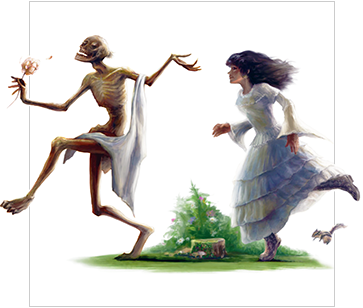
Dancing mania was a social phenomenon that occurred primarily in mainland Europe between the 14th and 17th centuries. It involved groups of people, sometimes thousands at a time, who danced uncontrollably and bizarrely. They would also scream, shout, and sing, and claim to have visions or hallucinations. The mania affected men, women, and children, who danced until they collapsed from exhaustion.
One of the first major outbreaks was in Aachen, Germany, in 1374, and it quickly spread throughout Europe; another particularly notable outbreak occurred in Strasbourg in 1518. Affecting thousands of people across several centuries, dancing mania was not a one-off event, and was well documented in contemporary reports.
read more »
Posted in Death, Health, Philosophy |
Leave a Comment »
September 4, 2012

Tarantism [tar-uhn-tiz-uhm] is an alleged, possibly deadly syndrome, popularly believed to result from the bite of a kind of a tarantula. It was originally described in the eleventh century and was supposedly common in southern Italy during the sixteenth and seventeenth centuries. There were strong suggestions that there is no organic cause for the heightened excitability and restlessness that gripped the victims. The stated belief of the time was that victims needed to engage in frenzied dancing to prevent death, and a particular kind of dance, called the tarantella, evolved from this therapy.
Arachnologist John Compton proposed that ancient Bacchanalian rites that had been suppressed by the Roman Senate in 186 BCE went underground, reappearing under the guise of emergency therapy for bite victims. The phenomenon of tarantism is consistent with mass psychogenic illness (the rapid spread of illness symptoms affecting members of a cohesive group, originating from a nervous system disturbance involving excitation, loss or alteration of function, whereby physical complaints that are exhibited unconsciously have no corresponding organic etiology). Although the popular belief persists that tarantism results from a spider bite, it remains scientifically unsubstantiated. The actual cause or causes of tarantism remain unknown.
Posted in Death, Health, Sex |
Leave a Comment »
August 15, 2012

Kurdaitcha [ka-dai-tcha] (or kurdaitcha man) is a ritual ‘executioner’ in Australian Aboriginal culture. The ‘execution’ in this case is a complex ritual similar to voodoo hexes or pagan curses. The kurdaitcha ritual is a nocebo, a negative response to physically harmless stimuli.
Voodoo death, also known as psychosomatic death, is a term coined by Harvard physiologist Walter Cannon in 1942 to describe the phenomenon of sudden death as brought about by a strong emotional shock, such as fear. The word ‘kurdaitcha’ is also used by Europeans to refer to the shoes worn by the Kurdaitcha, woven of feathers and human hair and treated with blood.
read more »
Posted in Death, Health, Philosophy |
Leave a Comment »
August 15, 2012

Voodoo death, a term coined by Harvard physiologist Walter Cannon in 1942 also known as psychogenic or psychosomatic death, is the phenomenon of sudden death as brought about by a strong emotional shock, such as fear. The anomaly is recognized as psychosomatic in that death is caused by an emotional response—often fear—to some suggested outside force.
Voodoo death is particularly noted in native societies, and concentration or prisoner of war camps, but the condition is not specific to any culture or mentality.
read more »
Posted in Death, Health, Philosophy |
Leave a Comment »
July 26, 2012
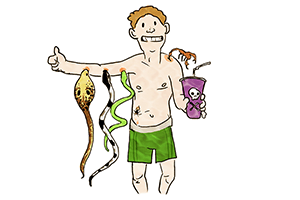

Mithridatism [mith-ri-dey-tiz-uhm] is the practice of protecting oneself against a poison by gradually self-administering non-lethal amounts. The word derives from Mithridates VI, the King of Pontus (modern-day Turkey), who so feared being poisoned that he regularly ingested small doses, aiming to develop immunity. Having been defeated by Roman general Pompey, legend has it that Mithridates tried to commit suicide using poison but failed because of his immunity and so had to resort to having a mercenary run him through with his sword.
There are only a few practical uses of mithridatism. It can be used by zoo handlers, researchers, and circus artists who deal closely with venomous animals. Mithridatization has been tried with success in Australia and Brazil and total immunity has been achieved even to multiple bites of extremely venomous cobras and pit vipers. Venomous snake handler Bill Haast used this method. Snake handlers from Burma tattoo themselves with snake venom for the same reason. Mithridatism is also used to treat peanut allergies.
read more »
Posted in Death, Drugs, Health |
1 Comment »
July 23, 2012
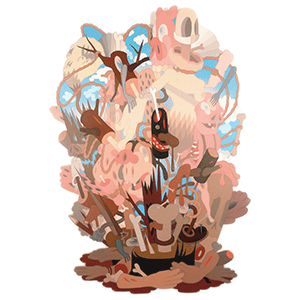
The murders perpetrated by members of Charles Manson’s ‘Family’ were inspired in part by Manson’s prediction of Helter Skelter, an apocalyptic war he believed would arise from tension over racial relations between blacks and whites. This ‘chimerical vision’—as it was termed by the court that heard Manson’s appeal from his conviction for the Tate/LaBianca killings—involved reference to music of The Beatles (particularly songs from ‘The White Album’ of 1968) and to the New Testament’s Book of Revelation.
In its final form, which was reached by 1969, the scenario had Manson as not only the war’s ultimate beneficiary but its musical cause. He and the Family would create an album with songs whose messages concerning the war would be as subtle as those he had heard in songs of The Beatles. More than merely foretell the conflict, this would trigger it; for, in instructing ‘the young love,’ America’s white youth, to join the Family, it would draw the young, white female hippies out of San Francisco’s Haight-Ashbury.
read more »
Posted in Death, Philosophy, Politics |
1 Comment »
July 19, 2012

Theobromine poisoning or chocolate poisoning is an adverse reaction to the alkaloid theobromine, found in chocolate, tea, cola beverages, açaí berries, and some other foods. Cacao beans contain about 1.2% theobromine by weight, while processed chocolate, in general, has smaller amounts.
The amount found in highly refined chocolate candies (~2 g/kg) is much lower than that of dark chocolate (~10 g/kg) or unsweetened baker’s chocolate (> 14 g/kg ). In general, the amount of theobromine found in chocolate is small enough such that chocolate can be safely consumed by humans. However, occasional serious side effects may result from the consumption of large quantities, especially in the elderly. In extreme cases, emergency room treatment may be required.
read more »
Posted in Death, Food, Health |
1 Comment »
July 19, 2012

Women in Refrigerators (or WiR) is a website that was created in 1999 by a group of comic book fans. The website features a list of female comic book characters that had been injured, killed, or depowered as a plot device within various superhero comic books. Also, the site seeks to analyze why these plot devices are used disproportionately on female characters.
The term was coined by comic book writer Gail Simone as a name for the website in early 1999 during on-line discussions about comic books with friends. It refers to an incident in ‘Green Lantern’ in 1994, written by Ron Marz, in which Kyle Rayner, the titular hero, comes home to his apartment to find that his girlfriend, Alex DeWitt, had been killed by the villain Major Force and stuffed in a refrigerator.
read more »
Posted in Death, Politics, Sex |
1 Comment »
July 3, 2012

A derecho [deh-rey-cho] is a widespread and damaging group of severe thunderstorms which often represent with rapid forward speeds. They have a distinct appearance on radars, known as bow echos (after an archer’s bow). The common definition of the word is: a thunderstorm complex that produces a damaging wind swath of at least 240 miles, featuring a concentrated area of convectively induced wind gusts exceeding 58 mph. Some studies add further criteria, such as a requirement that no more than two or three hours separate any two successive wind reports.
Unlike other thunderstorms, which typically can be heard in the distance when approaching, a derecho seems to strike suddenly. Within minutes, extremely high winds can arise, strong enough to knock over highway signs and topple large trees. These winds are accompanied by spraying rain and frequent lightning from all directions. It is dangerous to drive under these conditions, especially at night, because of blowing debris and obstructed roadways. A derecho moves through quickly, but can do much damage in a short period of time.
read more »
Posted in Death, Science, World |
Leave a Comment »


 The Daily Omnivore