July 3, 2012

Cinespia is an organization that hosts on-site screenings of classic films in and around Los Angeles, California. Launched in 2002, Cinespia shows films from the 1930s through the 1990s mostly in open-air settings at historic locations. Its most popular series runs weekly between May and August on Saturday (and occasionally Sunday) nights at the Hollywood Forever Cemetery. In addition, it screens films, both contemporary and canonical, at other locations throughout the year.
The series was the brainchild of John Wyatt, a set designer then in his mid-twenties. A student of influential film lecturer Jim Hosney at the Crossroads School in Santa Monica, Wyatt initially formed an Italian cinema club with friend Richard Petit, which evolved into Cinespia. The name is a portmanteau of the Italian word for film, ‘cine,’ and the third person singular conjugation of the verb ‘spiare,’ meaning ‘to observe,’ or more commonly, ‘to spy.’ Conjoined, cinespia was intended to suggest a film enthusiast or ‘watcher of films,’ although the actual term for film buff in Italian is ‘cinofilo.’ Cinespia, by contrast, means literally ‘he spies in the movie theater’ or ‘cinema spy.’
read more »
Posted in Art, Death |
Leave a Comment »
June 18, 2012
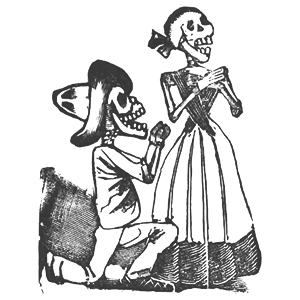
La Calavera Catrina (‘The Elegant Skull’) is a 1910 zinc etching by Mexican printmaker José Guadalupe Posada, part of his series of calaveras (humorous images of contemporary figures depicted as skeletons, which often were accompanied by a poem). The image has since become a staple of Mexican imagery, and often is incorporated into artistic manifestations of the Day of the Dead in November, such as altars and calavera costumes. Although these holy days have a long cultural history reaching into the prehistoric traditions of several European cultures, many aspects of the Mexican festival have indigenous origins in an Aztec festival dedicated to the goddess Mictecacihuatl. After the conquest of Mexico, the Spanish superimposed their cultural traditions upon the similar Aztec festival and a synthesis occurred.
‘La Catrina,’ as it is commonly known, was a popular print in Posada’s day, but soon faded from the popular memory. Along with the rest of Posada’s prints, it was revived by French artist and art historian Jean Charlot shortly after the Mexican Revolution in the 1920s. ‘La Catrina’ soon gained iconic status as a symbol of uniquely Mexican art and was reproduced en masse. The image was incorporated into Diego Rivera’s mural ‘Dream of a Sunday’in Alameda Park,’ which also includes images of his wife Frida Kahlo, Posada, and a self-portrait of Rivera. Notable paper cutter Marcelino Bautista Sifuentes has also recreated the famous ‘La Calavera Catrina’ in papel picado (a decorative craft made out of paper cut into elaborate designs).
Posted in Death, Philosophy, World |
Leave a Comment »
June 18, 2012

A calaca [kal-ah-kuh] (a colloquial Mexican Spanish name for skeleton) is a figure of a skull or skeleton (usually human) commonly used for decoration during the Mexican Day of the Dead festival, although they are made all year round. Tracing their origins from Aztec imagery, calacas are frequently shown with marigold flowers and foliage. As with other aspects of the Day of the Dead festival, calacas are generally depicted as joyous rather than mournful figures. They are often shown wearing festive clothing, dancing, and playing musical instruments to indicate a happy afterlife. This draws on the Mexican belief that no dead soul likes to be thought of sadly, and that death should be a joyous occasion. This goes back to Aztec beliefs, one of the few traditions to remain after the Spanish conquest.
Calacas used in the festival include carved skull masks worn by revelers, small figures made out of carved wood or fired clay, and sweet treats in the form of skulls or skeletons. Calacas are sometimes made of wood, stone, or even candy. A popular phrase among Mexicans and those Latinos that personally know some is ‘se lo (la) llevo la calaca’ after someone has died, literally meaning ‘the Calaca took him (her)’ or ‘death took him (her).’ In Guatemala, ‘calaca’ is understood as ‘death’ and implies fear of death. Thus, it is not depicted as a joyful image. Calaca-like figures can be seen in the Tim Burton films ‘The Nightmare Before Christmas’ and ‘Corpse Bride,’ the 2008 PlayStation 3 game ‘LittleBigPlanet,’ and the 1998 Tim Schafer computer game ‘Grim Fandango.’
Posted in Death, Philosophy, World |
Leave a Comment »
May 25, 2012

‘There are no atheists in foxholes‘ is an aphorism used to argue that in times of extreme stress or fear, such as when participating in warfare, all people will believe in or hope for a higher power. The precise origin of the phrase is uncertain.
While primarily used to comment on the specific experiences faced by combat soldiers, the statement is often adapted to other perilous situations such as ‘there are no atheists in Probate Court.’
read more »
Posted in Death, Philosophy, War |
Leave a Comment »
May 21, 2012

In philosophy, anamnesis [an-am-nee-sis] is a concept in Plato’s epistemological and psychological theory that he develops in his dialogues ‘Meno’ and ‘Phaedo,’ and alludes to in his ‘Phaedrus.’
In ‘Meno,’ Plato’s character (and old teacher) Socrates is challenged by Meno with what has become known as the sophistic paradox, or the paradox of knowledge: ‘And how are you going to search for [the nature of virtue] when you don’t know at all what it is, Socrates? Which of all the things you don’t know will you set up as target for your search? And even if you actually come across it, how will you know that it is that thing which you don’t know?’
read more »
Posted in Death, Education, Philosophy |
Leave a Comment »
May 18, 2012

An anxiolytic [ang-zee-uh-lit-ik] is a drug used for the treatment of anxiety and its related psychological and physical symptoms. Anxiolytics have been shown to be useful in the treatment of anxiety disorders. Beta-blockers, although not anxiolytics, can be used to combat the somatic symptoms of anxiety (such as an elevated heart rate).
Anxiolytics are also known as minor tranquilizers. The term is less common in modern texts, and was originally derived from a dichotomy with major tranquilizers, also known as neuroleptics or antipsychotics.
read more »
Posted in Death, Drugs, Health |
1 Comment »
May 14, 2012

Thief in law, a ‘thief who operates within the law’ or ‘a criminal who obeys The Thieves’ Code”) is a criminal who is respected, has authority and a high ranking status within the criminal underworld in the old Soviet Union, Russia and the republics that formed the former Soviet Union. Thieves in law are the elite of the Russian world of organized crime.
According to various Russian news sources there exist hundreds of organized units which retain independence in their actions. Estimates concerning the number of ‘Vory’ throughout the world range from several hundred to over 10,000. Many of thieves in law are no longer exclusively ethnic Russians but are drawn from other nationalities, including those living in other former Soviet states or former Warsaw pact nations such as Poland, the Czech Republic, and Bulgaria.
read more »
Posted in Death, Politics, World |
Leave a Comment »
April 18, 2012

Dave Duerson (1960 – 2011) played in the NFL from 1983–1993. Duerson played football, basketball, and baseball in high school. He was given an opportunity to play for the Los Angeles Dodgers as a pitcher and outfielder in 1979, but declined, choosing to play football at Notre Dame from 1979 to 1982. He graduated with honors, with a BA in Economics. Duerson was selected to four consecutive Pro Bowls from 1986 to 1989 in his career, and won two championship rings, playing safety for the Bears (Super Bowl XX), and the Giants (Super Bowl XXV). He purchased the majority interest in Fair Oaks Farms (formerly Brooks Sausage Company) in 1995. Duerson grew the company from $24M revenue to over $63.5M in six years.
Duerson was found dead at his Florida home in the winter of 2011. The Miami-Dade County medical examiner reported that Duerson died of a self-inflicted gunshot wound to the chest. He sent a text message to his family saying he wanted his brain to be used for research at the Boston University School of Medicine, which is conducting research into chronic traumatic encephalopathy (CTE) caused by playing pro football. Researcher neurologists at Boston University confirmed that he suffered from a neurodegenerative disease linked to concussions.
Posted in Death, Games, Health |
Leave a Comment »
April 17, 2012
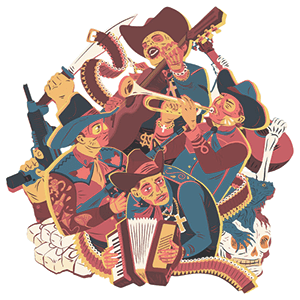
A Narcocorrido [nahr-koh-koh-ree-doh] is a type of Mexican music and song tradition which evolved out of the norteño folk corrido tradition. This type of music is heard on both sides of the US–Mexican border. It uses a danceable, accordion-based polka as a rhythmic base. The first corridos that focus on drug smugglers dated to the 1930s. Early corridos (non-narco) go back as far to the Mexican Revolution of 1910, telling the stories of revolutionary fighters. Music critics have compared narcocorrido music to gangster rap. Narcocorrido lyrics refer to particular events and include real dates and places. The lyrics tend to speak approvingly of illegal criminal activities such as murder, torture, racketeering, extortion, drug smuggling, illegal immigration, and sometimes political protest due to government corruption.
Among the earliest exponents of narcocorrido music were Los Alegres de Teran, who recorded many. In the 1980s, Rosalino ‘Chalino’ Sánchez contributed to narcocorridos. Known throughout Mexico as ‘l Pelavacas’ (‘Cow Skin Peeler’), El Indio (The Indian, from his corrido ‘El Indio Sánchez’), and ‘Mi Compa’ (‘My Friend’), Sánchez was a Mexican immigrant living in Los Angeles. He then began distributing his music. His lyrics composed of heartbreak, revolution, and socioeconomic issues. Soon he was selling mass copies. Chalino Sánchez was murdered in 1992 after a concert in Culiacán. In death, he became a legend and one of the most influential musicians to emerge from California, he was known throughout Mexico and United States as El Rey del Corrido (‘The King of the Corrido’).
Posted in Art, Death, Drugs |
1 Comment »
April 12, 2012

A stand-your-ground law states that a person may use force in self-defense when there is reasonable belief of a threat, without an obligation to retreat first. In some cases, a person may use deadly force in public areas without a duty to retreat. Under these legal concepts, a person is justified in using deadly force in certain situations and the ‘stand your ground’ law would be a defense or immunity to criminal charges and civil suit. The difference between immunity and a defense is that an immunity bars suit, charges, detention, and arrest. A defense permits a plaintiff or the state to seek civil damages or a criminal conviction.
More than half of the states in the United States have adopted the Castle doctrine, stating that a person has no duty to retreat when their home is attacked. Some states go a step further, removing the duty of retreat from any location. ‘Stand Your Ground,’ ‘Line In The Sand,’ or ‘No Duty To Retreat’ laws thus state that a person has no duty or other requirement to abandon a place in which he has a right to be, or to give up ground to an assailant. Under such laws, there is no duty to retreat from anywhere the defender may legally be. Other restrictions may still exist; when in public, a person must be carrying the firearm in a legal manner, whether concealed or openly.
read more »
Posted in Death, Politics |
Leave a Comment »
April 12, 2012

A Castle Doctrine is an American legal doctrine that designates a person’s abode (or, in some states, any place legally occupied, such as a car or place of work) as a place in which the person has certain protections and immunities and may in certain circumstances attack an intruder without becoming liable to prosecution. Typically deadly force is considered justified, and a defense of justifiable homicide applicable, in cases ‘when the actor reasonably fears imminent peril of death or serious bodily harm to himself or another.’ The doctrine is not a defined law that can be invoked, but a set of principles which is incorporated in some form in the law of most states.
The term derives from the historic English common law dictum that ‘an Englishman’s home is his castle.’ This concept was established as English law by 17th century jurist Sir Edward Coke, in his ‘The Institutes of the Laws of England’ (1628). This was carried by colonists to the New World, who later removed ‘Englishman’ from the phrase, which thereby became simply the Castle Doctrine. The term has been used to imply a person’s absolute right in England to exclude anyone from their home, although this has always had restrictions, and since the late twentieth century police have also had increasing powers of entry.
read more »
Posted in Death, Politics, World |
Leave a Comment »
April 4, 2012


Gun fu, a portmanteau of ‘gun’ and ‘kung fu,’ is the style of sophisticated close-quarters gunplay seen in Hong Kong action cinema and in Western films influenced by it. It often resembles a martial arts battle played out with firearms instead of traditional weapons. It may also be described by other terms such as ‘bullet ballet,’ ‘gun kata,’ or ‘gymnastic gunplay.’
The focus of gun fu is both style and the usage of firearms in ways that they were not designed to be used. Shooting a gun from each hand, shots from behind the back, as well as the use of guns as melee weapons are all common. Other moves can involve shotguns, Uzis, rocket launchers, and just about anything else that can be worked into a cinematic shot. It is often mixed with hand-to-hand combat maneuvers. Gun fu has become a staple factor in modern action films due to its visually appealing nature (regardless of its actual practicality in a real-life combat situation). This is a contrast to American action movies of the 1980s which focused more on heavy weaponry and outright brute-force in firearm-based combat.
read more »
Posted in Art, Death |
Leave a Comment »


 The Daily Omnivore