February 12, 2012
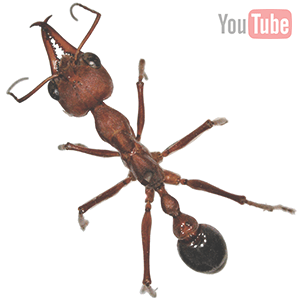
Myrmecia, often called bull ants, is a genus of ants found almost exclusively in Australia. These ants are well-known for their aggressive behavior and powerful stings. The venom of these ants has the potential to induce anaphylactic shock in allergic sting victims. As with most severe allergic reactions, if left untreated the reaction may be lethal. Bull ants eat small insects, honeydew (a sweet, sticky liquid found on leaves, deposited from various insects), seeds, fruit, fungi, gums, and nectar. They have larger eyes, and hence better vision, than most ants.
The bull ant famously appears in the philosopher Arthur Schopenhauer’s major work, ‘The World as Will and Representation,’ as a paradigmatic example of strife and constant destruction endemic to the ‘will to live.’ ‘But the bulldog-ant of Australia affords us the most extraordinary example of this kind; for if it is cut in two, a battle begins between the head and the tail. The head seizes the tail in its teeth, and the tail defends itself bravely by stinging the head: the battle may last for half an hour, until they die or are dragged away by other ants. This contest takes place every time the experiment is tried.’
Posted in Death, Philosophy, Science |
Leave a Comment »
February 8, 2012
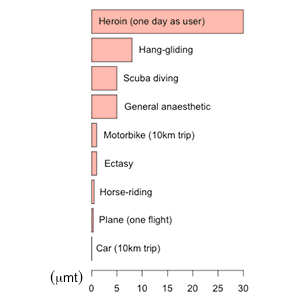
A micromort is a unit of risk measuring a one-in-a-million probability of death (from micro- and mortality). Micromorts can be used to measure riskiness of various day-to-day activities. A microprobability is a one-in-a million chance of some event; thus a micromort is the microprobability of death. The micromort concept was introduced by Ronald A. Howard who pioneered the modern practice of decision analysis.
An application of micromorts is measuring the value that humans place on risk: for example, one can consider the amount of money one would have to pay a person to get him or her to accept a one-in-a-million chance of death (or conversely the amount that someone might be willing to pay to avoid a one-in-a-million chance of death).
read more »
Posted in Death, Health, Money |
2 Comments »
January 30, 2012
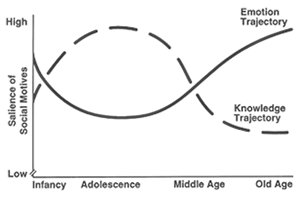
Socioemotional Selectivity Theory, developed by Stanford psychologist, Laura Carstensen, a life-span theory of motivation, maintains that as time horizons shrink, as they typically do with age, people become increasingly selective, investing greater resources in emotionally meaningful goals and activities.
According to the theory, motivational shifts also influence cognitive processing. Aging is associated with a relative preference for positive over negative information in attention and memory (called the ‘positivity effect’).
read more »
Posted in Death, Health, Science |
Leave a Comment »
January 2, 2012
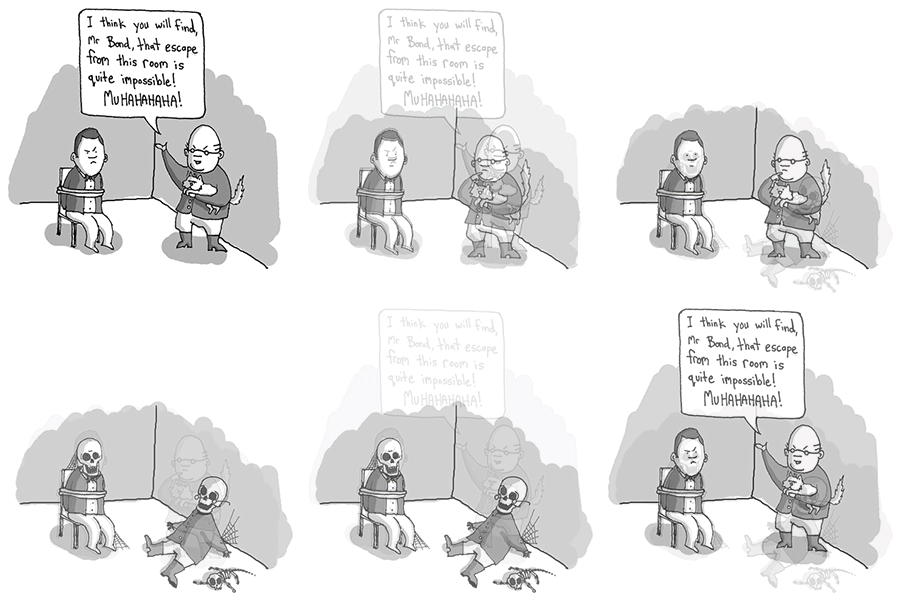
A deathtrap is a literary and dramatic plot device in which a villain, who has captured the hero or another sympathetic character, attempts to use an elaborate and usually sadistic method of murdering him/her. It is often used as a means to create dramatic tension in the story and to have the villain reveal important information to the hero, confident that the hero will shortly not be able to use it. It may also be a means to show the hero’s resourcefulness in escaping, or the writer’s ingenuity at devising a last-minute rescue or deus ex machina.
This plot device is generally believed to have been popularized by movie serials and 19th century theatrical melodramas. A well known example is the cliché of the moustache-twirling villain leaving the heroine tied to railroad tracks. Its use in the James Bond film series and superhero stories is well known.
read more »
Posted in Death, Humor, Language |
1 Comment »
December 30, 2011

The Voluntary Human Extinction Movement, or VHEMT (pronounced ‘vehement’), is a movement which calls for the voluntary gradual self-extinction of the human species through abstaining from reproduction. VHEMT’s motto is ‘May we live long and die out.’ Proponents of VHEMT concepts are characterized either as supporters, or as volunteers (extinctionists).
Les U. Knight of Portland, Oregon is generally cited as founding VHEMT in 1991, although he does not take credit for it. Knight is the owner of vhemt.org and acts as a spokesman for the movement. In his mid-twenties, he underwent a vasectomy in support of his conviction that, ‘It’s obvious that the intentional creation of another [human being] by anyone anywhere can’t be justified today.’ During the 1970s, he joined the organization Zero Population Growth.
read more »
Posted in Death, Politics |
1 Comment »
December 23, 2011
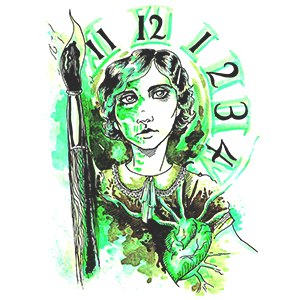
The Radium Girls were female factory workers who contracted radiation poisoning from painting watch dials with glow-in-the-dark paint at the United States Radium factory in Orange, New Jersey around 1917.
The women, who had been told the paint was harmless, ingested deadly amounts of radium by licking their paintbrushes to sharpen them. Some also painted their fingernails and teeth with the glowing substance. Five of the women challenged their employer in a court case that established the right of individual workers who contract occupational diseases to sue their employers.
read more »
Posted in Death, Money, Politics |
1 Comment »
December 14, 2011
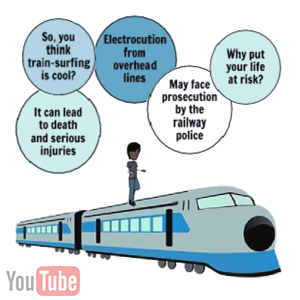
Train surfing is riding or climbing on the outside of a moving train. This activity is illegal in many countries, but is a common and usual way to ride trains in India, Indonesia, and South Africa. Individuals may train surf to avoid the cost of a ticket or as a recreational activity. With the creation of the internet, the practice of filming the act and posting online videos of it is on the increase worldwide.
The London Underground is now running an advertising campaign against ‘tube surfing.’ The advertisements now at most underground stations show a female figure with one arm and the caption ‘she was lucky’ next to it. In Germany, the practice was made popular on TV in the 1990s. There it was called ‘S-Bahn Surfing.’ Slowly, the former train surfing culture changed and integrated into the German graffiti culture. The phenomenon was forgotten until the millennium, but in 2005 it was rediscovered by a group from Frankfurt. The leader of the crew who calls himself ‘the trainrider’ famously surfed the InterCityExpress, the fastest train in Germany.
Posted in Death, Games, World |
Leave a Comment »
December 14, 2011

Elevator surfing is an activity involving moving around on top of elevators, or jumping between moving elevators where possible. The activity is illegal in most locations and several people have died or been injured attempting it. Surfers can be crushed between the elevator and the top, sides, or bottom of the shaft, be struck by the counterweight, or simply slip or be knocked off and fall to their deaths. Elevator surfing typically occurs in skyscrapers or on college campuses, especially those with tall buildings. Most large buildings have groups of elevators close together, which are most commonly used.
To begin, participants will usually go into such a building early in the morning, before too many people arrive to use the elevators. Once in an elevator, they hold the elevator between floors and open the safety hatch. They then climb on top, release the emergency switch, and pull the last person out. Another method of entry involves opening the exterior doors on the floor above the elevator, and jumping on from there. Doors are either forced or opened with an elevator key. While easier to execute, this is uncommon unless no others are nearby. Accomplices will sometimes press buttons on the inside of the elevators to provide the movement. Movement can also be provided by means of service controls located on top of the elevator car.
Posted in Death, Games |
1 Comment »
December 14, 2011


Blood sport is any sport or entertainment that involves violence against animals, such as coursing or beagling (the pursuit of game by dogs), and combat sports such as cockfighting and dogfighting. The earliest use of the term is in reference to mounted hunting, where the quarry would be actively chased, as in fox hunting or hare coursing. Before firearms a hunter using arrows or a spear might also wound an animal, which would then be chased and perhaps killed at close range, as in medieval boar hunting. Later, the term seems to have been applied to various kinds of baiting and forced combat: bull-baiting, bear-baiting, cockfighting and later developments such as rat-baiting. The animals were specially bred, confined and forced to fight.
In the Victorian era, social reformers began a vocal opposition to such activities, claiming grounds of ethics, morality and animal welfare. Limitations on blood sports have been enacted in much of the world, through sports remain legal under varying degrees of control in certain locations (e.g., bullfighting and cockfighting) but have declined in popularity almost everywhere else. Proponents of blood sports are widely cited to believe that they are traditional within the culture. Bullfighting aficionados, for example, do not regard bullfighting as a sport but as a cultural activity. It is sometimes called a tragic spectacle, because in many forms of the sport the bull is invariably killed, and the bullfighter is always at risk of death.
Posted in Death, Games, Politics |
Leave a Comment »
November 25, 2011

The fascination with death extends far back into human history. Throughout time, people have had obsessions with death and all things related to death and the afterlife. In past times, people would form cults around death gods and figures. Famously, Anubis, Osiris, and Hades have all had large cult followings.
La Santa Muerte (Saint Death), or the personification of death, is currently worshiped by many in Mexico and other countries in Central America. Day of the Dead, November 2, is a celebration for the dead.
read more »
Posted in Death, Philosophy |
Leave a Comment »
October 28, 2011
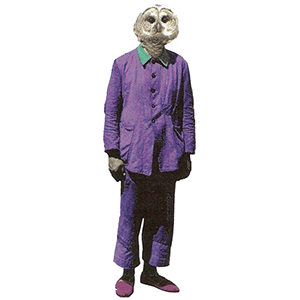
The Obscene Bird of Night (El obsceno pájaro de la noche, 1970) is the most acclaimed novel by the Chilean writer José Donoso (1924-1996). Donoso was a member of the Latin American literary boom and the literary movement known as magical realism. The novel explores the cyclical nature of life and death, in that our fears and fantasies of childhood resurface in adulthood and old age. It is about the deconstruction of self – to the extreme of trying ‘to live’ in non-existence.
The Imbunche myth is a major theme in the novel. According to legend, the Imbunche was a male child kidnapped by, or sold by his parents to a sorcerer who turns the child into a monster to guard his lair. It symbolizes the process of implosion of the physical and/or intellectual self, turning the living being into a thing or object incapable of interacting with the outside world, and depriving it of its individuality and even of its name. This can either be self-inflicted or forced upon by others.
read more »
Posted in Death, Language, Philosophy |
Leave a Comment »
October 19, 2011

Joshua Milton Blahyi (b. 1971), better known by his nom de guerre General Butt Naked, is a former leader for the Liberian warlord Roosevelt Johnson in the First Liberian Civil War known for his fierce, violent and eccentric measures in the first half of the 1990s. He was originally a tribal priest, and has returned to preaching after the war. Blahyi’s nom de guerre was appropriated for comical effect by the creators of the Broadway musical ‘The Book of Mormon’ as their fictional Ugandan warlord ‘General Butt Fucking Naked.’
Blahyi got his nickname, ‘General Butt Naked,’ from his nakedness which was supposedly demanded by the Devil. In his account of a typical battle Blahyi claimed, ‘So, before leading my troops into battle, we would get drunk and drugged up, sacrifice a local teenager, drink their blood, then strip down to our shoes and go into battle wearing colorful wigs and carrying dainty purses we’d looted from civilians. We’d slaughter anyone we saw, chop their heads off and use them as soccer balls. We were nude, fearless, drunk and homicidal. We killed hundreds of people – so many I lost count.’ Blahyi also purported that during that period he had ‘magical powers that made him invisible’ and a ‘special power’ to capture a town singlehandedly, then call in his troops afterwards to ‘clean up.’
read more »
Posted in Death, War, World |
1 Comment »


 The Daily Omnivore