September 19, 2011

Trichomes [trik-ohm] (from the Greek word ‘trikhoma’ meaning ‘growth of hair’) are structures on plants that look like hairs. Glandular trichomes have chemicals in them. They break when the plant is touched. For example, trichomes on poison ivy leaves have a chemical that causes a rash. Cannabis trichomes produce a psychoactive resin. It is likely that in many cases, plant hairs interfere with the feeding of herbivores. Hairs on plants growing in areas subject to frost keep the frost away from the living surface cells. In windy locations, hairs break-up the flow of air across the plant surface, reducing evaporation. Dense coatings of hairs reflect solar radiation, protecting the more delicate tissues underneath in hot, dry, open habitats. And in locations where much of the available moisture comes from cloud drip, hairs appear to enhance this process.
They occur only on plants and certain protists (a type of single-celled organism). Certain algae, have their terminal cell shaped into an elongate ‘hair-like’ structure called a trichome. The same term is applied to such structures in some cyanobacteria (bacterium which rely on photosynthesis). Trichomes on plants are epidermal outgrowths of various kinds. The terms ’emergences,’ ‘thorns,’ ‘spines,’ and ‘prickles’ refer to outgrowths that involve more than the epidermis (the outermost layer of the plant). See for example, the ‘wait-a-minute tree,’ which has numerous hooked thorns with the shape and size of a cat’s claw, that tend to hook onto passers-by; the hooked person must stop (‘wait a minute’) to remove the thorns carefully to avoid injury.
Posted in Drugs, Language, Science |
Leave a Comment »
August 4, 2011
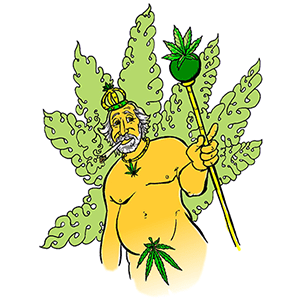
Jack Herer (1939 – 2010) was an American cannabis activist and the author of ‘The Emperor Wears No Clothes,’ a book which has been used in efforts to decriminalize cannabis. A former Goldwater Republican, he believed that the cannabis plant should be decriminalized because it has been shown to be a renewable source of fuel, food, and medicine that can be grown in virtually any part of the world. A specific strain of cannabis has been named after Herer that has won several awards, including the 7th High Times Cannabis Cup. He ran for US President twice, in 1988 (1,949 votes) and 1992 (3,875 votes) as the Grassroots Party candidate. In July 2000, he suffered a minor heart attack and a major stroke, resulting in difficulties speaking and moving the right side of his body. He mostly recovered, and claimed in 2004 that treatment with amanita muscaria, a psychoactive mushroom had cured him. He died six years later, aged 70.
European experts on hemp, like Dr. Hayo Van der Werf and Dr. Ivan Bûcsa, criticized Herer’ for making unrealistic claims regarding the potential of hemp, for example: Herer claimed that hemp produces higher yields than other crops. Van der Werf argue that is simply wrong. Under most favorable growing conditions, other crops such as maize, sugar beet or potato produced similar dry matter yields. Herer also claimed that hemp hurds, which make up 60 to 80 % of the stem dry weight, contain 77 % cellulose. Van der Werf argue that is wrong. Cellulose content of hemp hurds has been found to vary between 32 and 38 %. Possibly, Herer confused the hurds, which form the woody core of the hemp stem, with the bark, which forms the outer layer of the hemp stem. The bark contains the long bast fibers which are used in textile manufacturing.
Posted in Drugs, Money, Politics |
1 Comment »
August 3, 2011

The Acid Tests were a series of parties held by Ken Kesey in the San Francisco Bay Area during the mid 1960s, centered entirely around the use of, experimentation with, and advocacy of, the psychedelic drug LSD, also known as ‘acid.’ The name ‘Acid Test’ was coined by Kesey, after the term ‘acid test’ used by gold miners in the 1850s.
He advertised the parties with posters that read, ‘Can YOU Pass The Acid Test?,’ and the name was later popularized in Tom Wolfe’s 1968 book, ‘The Electric Kool-Aid Acid Test.’ Musical performances by the Grateful Dead were commonplace, along with black lights, strobe lights, and fluorescent paint. The Acid Tests are notable for their influence on the LSD-based counterculture of the San Francisco area and subsequent transition from the beat generation to the hippie movement.
Posted in Drugs, Games, Humor |
Leave a Comment »
August 3, 2011

The Electric Kool-Aid Acid Test is a work of literary journalism by Tom Wolfe, published in 1968. Using techniques from the genre of hysterical realism and pioneering new journalism, the ‘nonfiction novel’ tells the story of Ken Kesey and his band of Merry Pranksters.
The book follows the Pranksters across the country driving in a psychedelic painted school bus dubbed ‘Furthur,’ reaching what they considered to be personal and collective revelations through the use of LSD and other psychedelic drugs. The book also describes the Acid Tests, early performances by The Grateful Dead, and Kesey’s exile to Mexico.
Posted in Art, Drugs, Language |
Leave a Comment »
July 29, 2011

The Full Moon Party is an all-night beach rave that takes place in Haad Rin on the island of Ko Pha Ngan, Thailand on the night before or after every full moon. The first Full Moon Party was improvised at a wooden disco not far from the beach in 1985 for giving thanks to about 20-30 travelers. They quickly gained fame through word of mouth, and the event now draws a crowd about 20,000-30,000 every full moon evening.
The party carries on until the sun rises the next day. The bars on the sunrise beach of Haad Rin town stay open and play music such as R&B, drum and bass, house, dance and reggae. The modern event is characterized by unruly and potentially dangerous attractions such as fire skipping ropes, wildly variable alcohol strength ‘buckets,’ and a drug culture. It is seen by many as the ‘ultimate party experience,’ although drug laws are still strictly enforced.
Posted in Drugs, World |
Leave a Comment »
July 22, 2011

Nepeta [neh-puh-ta] is a genus of about 250 species of flowering plants in the family Lamiaceae, commonly known as ‘catnip’ because of their attractant effect on cats—the nepetalactone contained in nepeta binds to the olfactory receptors of cats, typically resulting in temporary euphoria. Catmints are also used in herbal medicine for their mild sedative effect on humans.
Nepetalactone is an organic compound, first reported in 1941 after it was isolated by steam distillation of catnip. The compound is also present in the wood of tartarian honeysuckle (Lonicera tatarica), shavings of which are often used in cat toys. Around 80% of cats are affected and susceptibility is gene-linked. The chemical interacts as a vapor at the olfactory epithelium. Nepetalactone has effects on some insects: it repels cockroaches and mosquitoes.
Posted in Drugs, Science, Sex |
1 Comment »
July 14, 2011
Cyberdelic refers to immersion in cyberspace as a psychedelic experience; the fusion of cyberculture and the psychedelic subculture; psychedelic art created by calculating fractal objects; and trance music parties. Timothy Leary, an advocate of psychedelic drug use who became a cult figure of the hippies in the 1960s, reemerged in the 1980s as a spokesperson of the cyberdelic counterculture, whose adherents called themselves ‘cyberpunks,’ and became one of the most philosophical promoters of personal computers, the Internet, and immersive virtual reality. Leary proclaimed that the ‘PC is the LSD of the 1990s’ and admonished bohemians to ‘turn on, boot up, jack in.’
In contrast to the hippies of the 60s who were decidedly antiscience and antitechnology, the cyberpunks of the 80s and 90s ecstatically embraced technology and the hacker ethic. They believed that high technology (and smart drugs) could help human beings overcome all limits, that it could liberate them from authority and even enable them to transcend space, time, and body. They often expressed their ethos and aesthetics through cyberart and reality hacking.
Posted in Drugs, Language, Technology |
1 Comment »
July 14, 2011
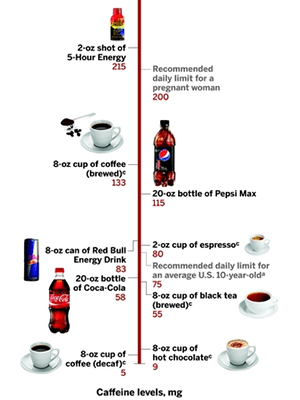
Energy shots are a specialized kind of energy drink. Sold in 59ml (2 fluid oz.) bottles, energy shots normally contain the same amount of caffeine, vitamins or other functional ingredients as their larger siblings, and therefore they may be considered concentrated forms of energy drinks. Also similar to energy drinks, energy shots contain caffeine, vitamins, and herbs such as guarana, ginseng or ginkgo biloba, taurine, maltodextrin, inositol, carnitine, creatine or glucuronolactone. Most energy shots contain sugar; however, many brands also offer artificially-sweetened ‘diet’ versions. The central ingredient in most energy shots is caffeine, the same stimulant found in coffee or tea. The average 50ml energy shot has about 80 mg of caffeine. This is approximately equivalent to a cup of coffee.
The idea of energy shots started decades ago in the Far East, notably in Japan, where small ‘tonics’ became very popular among consumers; they were highly concentrated and without carbonation. In 2004 the first suppliers, like 5-Hour Energy, Nitro2Go, and ZipFizz, took up the idea and launched these energy shots in the US, opening up a sub-segment in the energy drink market. Although originally marketed in the US, energy shots are becoming more popular in other parts of the world, like Europe, Asia and Australia.
Posted in Drugs, Health, Money |
Leave a Comment »
July 13, 2011


A form constant is one of several geometric patterns which are recurringly observed during hallucinations and altered states of consciousness. In 1926, psychologist Heinrich Klüver systematically studied the effects of mescaline on the subjective experiences of its users. In addition to producing hallucinations characterized by bright, ‘highly saturated’ colors and vivid imagery, Klüver noticed that mescaline produced recurring geometric patterns in different users. He called these patterns ‘form constants’ and categorized four types: lattices (including honeycombs, checkerboards, and triangles), cobwebs, tunnels, and spirals.
Klüver’s form constants have appeared in other drug-induced and naturally-occurring hallucinations, suggesting a similar physiological process underlying hallucinations with different triggers. Klüver’s form constants also appear in near-death experiences and sensory experiences of those with synesthesia. Other triggers include psychological stress, threshold consciousness(hypnagogia), insulin hypoglycemia, the delirium of fever, epilepsy, psychotic episodes, advanced syphilis, sensory deprivation, photostimulation, electrical stimulation, crystal gazing, migraine headaches, dizziness and a variety of drug-induced intoxications. These shapes may appear on their own or with eyes shut in the form of phosphenes, especially when exerting pressure against the closed eyelid.
Posted in Drugs, Health, Language |
Leave a Comment »
July 13, 2011

Hunter S. Thompson (1937 – 2005) was an American journalist and author. He is credited as the creator of Gonzo journalism, a style of reporting where reporters involve themselves in the action to such a degree that they become central figures of their stories.
He is known also for his unrepentant lifelong use of alcohol, LSD, mescaline, and cocaine (among other substances); his love of firearms; his inveterate hatred of Richard Nixon; and his iconoclastic contempt for authoritarianism. While suffering a bout of health problems, he committed suicide in 2005, at the age of 67.
read more »
Posted in Drugs, Humor, Language |
Leave a Comment »
July 13, 2011

Raoul Duke is the fictional character and antihero based on Hunter S. Thompson in his autobiographical novel ‘Fear and Loathing in Las Vegas.’ The book was originally written under the name Raoul Duke. He is the main character and narrator of many of Thompson’s stories, novels, and articles, often taking part of events in Thompson’s life in Thompson’s place.
He is portrayed as a cynical, eccentric hedonist. He is in a near-perpetual state of intoxication on whatever drugs happen to be available, ranging from marijuana to amyl nitrite to adrenochrome. He usually obtains and consumes these substances in the company of his attorney, Gonzo, a half-crazed 300 pound Samoan, whose drug-induced frenzies give even Duke pause. Thompson based Gonzo on his friend the civil rights lawyer Oscar Zeta Acosta.
read more »
Posted in Drugs, Humor, Language |
Leave a Comment »
July 12, 2011

Purple drank is a slang term for a recreational drug popular in the hip hop community in the southern United States, originating in Houston, Texas. Its main ingredient is prescription-strength cough syrup containing codeine and promethazine. Cough syrup is typically mixed with ingredients such as Sprite soft drink or Mountain Dew and pieces of Jolly Rancher candy. The purplish hue of purple drank comes from dyes in the cough syrup. Producer DJ Screw popularized the concoction in the 1990s, which is widely attributed as a source of inspiration for the ‘chopped and screwed’ style of hip hop music. However, musician Big Hawk claims it was consumed as early as the 1960s and 1970s.
DJ Screw died of a codeine-promethazine-alcohol overdose in 2000. Purple drank is confirmed or suspected to have caused the deaths of several prominent users. Respiratory depression is a potentially serious or fatal adverse drug reaction associated with the use of codeine, but mainly the danger lies in the much more potent and CNS-depressing phenothiazine-related antihistamine promethazine.
Posted in Drugs, Health, Language |
Leave a Comment »




 The Daily Omnivore