April 13, 2011

The 27 Club is a group of influential rock and blues musicians who all died at the age of 27, including Blues musician Robert Johnson, Brian Jones of the Rolling Stones, Jimi Hendrix, Janis Joplin, Jim Morrison, Kurt Cobain, and Amy Winehouse. Most members of the ‘club’ died as a result of drug and alcohol abuse, or other violent means such as homicide or suicide.
read more »
Posted in Art, Death, Drugs |
Leave a Comment »
April 11, 2011


The Amethyst Initiative is an organization made up of U.S. college presidents and chancellors that in 2008 launched a movement calling for the reconsideration of U.S. drinking age laws, particularly the minimum age of 21 as established nationally by the National Minimum Drinking Age Act of 1984. The initiative is currently supported by 135 college presidents.
According to Greek and Roman legend, amethysts protected their owners from drunkenness.
Posted in Drugs, Health, Politics |
Leave a Comment »
April 7, 2011

The blue hour comes from the French expression l’heure bleue, which refers to the period of twilight each morning and evening where there is neither full daylight nor complete darkness. The time is considered special because of the quality of the light at this time of day. The phrase is also used to refer to Paris immediately prior to World War I, which was considered to be a time of relative innocence.
In English culture the term was used to describe the period of inactivity and uselessness a drinker encounters when Pubs and other licensed premises have closed after the lunch-time session (typically 15:30 hrs) and will not open for the evening session until (typically 18:30 hrs).
Posted in Art, Drugs, Language |
Leave a Comment »
April 7, 2011

Martini Shot is a Hollywood term that describes the final shot set-up of the day, so named because ‘the next shot is out of a glass,’ referring to a post-wrap drink.
Posted in Art, Drugs, Humor |
Leave a Comment »
April 7, 2011

The Martini is a cocktail made with gin (or vodka) and vermouth. All ingredients are poured into a mixer with ice cubes. The ingredients are mixed then strained and served ‘straight up’ (without ice) in a chilled cocktail glass and garnished with either a green olive or a twist of lemon (a strip of the peel, usually squeezed or twisted to express volatile oils onto the surface of the drink).
Garnishing with a pickled onion instead makes it a Gibson. The dryness of a martini refers to the amount of vermouth used in the drink, with a very dry Martini having little or no Vermouth.
read more »
Posted in Drugs, Food, Language |
Leave a Comment »
April 5, 2011
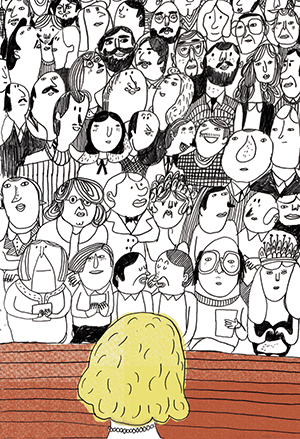
Stage fright or performance anxiety is the anxiety aroused by the requirement to perform in front of an audience, whether actually or potentially (for example, when performing before a camera). In the context of public speaking, this fear is termed glossophobia, one of the most common of phobias. Such anxiety may precede or accompany participation in any activity involving public self-presentation.
In some cases stage fright may be a part of a larger pattern of social phobia or social anxiety disorder, but many people experience stage fright without any wider problems. Quite often, stage fright arises in a mere anticipation of a performance, often a long time ahead. It has numerous manifestations: fluttering or pounding heart, tremor in the hands and legs, sweaty hands, diarrhea, facial nerve tics, dry mouth, and erectile dysfunction.
read more »
Posted in Art, Drugs, Health |
Leave a Comment »
April 3, 2011

‘Dark Side of the Rainbow‘ refers to the pairing of the 1973 Pink Floyd music album ‘The Dark Side of the Moon’ with the visual portion of the 1939 film ‘The Wizard of Oz.’ This produces moments where the film and the album appear to correspond with each other.
Band members and others involved in the making of the album state that any relationship between the two works of art is merely a coincidence.
read more »
Posted in Art, Drugs |
Leave a Comment »
March 30, 2011
Liquid light shows or psychedelic light shows surfaced in the mid 1960s and early 1970s in America and Europe. They were an integral part of the Progressive music scene well into the seventies. Shows could be as simple as a single operator and two or three modified slide or overhead projectors and a couple of color wheels or as complex as shows with ten or more operators, 70 plus projectors (including liquid slide, liquid overhead, movie and still image models plus a vast array of highly advanced (for the time) special effects equipment).
read more »
Posted in Art, Drugs, Technology |
Leave a Comment »
March 21, 2011
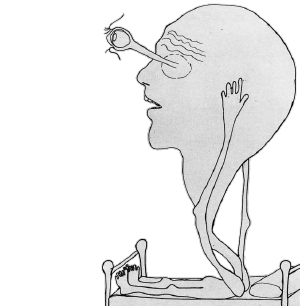
Alice in Wonderland syndrome (AIWS), also known as Todd’s syndrome, is a disorienting neurological condition which affects human perception. Sufferers may experience visual and other sensory distortions. A temporary condition, it is often associated with migraines, brain tumors, and the use of psychoactive drugs.
It can also present as the initial sign of the Epstein-Barr Virus. Anecdotal reports suggests that the symptoms of AIWS are fairly common in childhood, with many people growing out of them in their teens. It appears that AIWS is also a common experience at sleep onset.
Posted in Drugs, Health |
Leave a Comment »
March 14, 2011

A placebo is a sham or simulated medical intervention. Sometimes patients given a placebo treatment will have a perceived or actual improvement in a medical condition, a phenomenon commonly called the placebo effect. In medical research, placebos are given as control treatments and depend on the use of measured deception. Common placebos are inert tablets, sham surgery, and other procedures based on false information. Since the publication of Henry K. Beecher’s ‘The Powerful Placebo’ in 1955 the phenomenon has been considered to have clinically important effects.
The word ‘placebo,’ Latin for ‘I will please,’ dates back to a Latin translation of the Bible. In 1785 it was defined as a ‘commonplace method or medicine’ and in 1811 it was defined as ‘any medicine adapted more to please than to benefit the patient,’ sometimes with a derogatory implication but not with the implication of no effect. Placebos were widespread in medicine until the 20th century, and they were sometimes endorsed as necessary deceptions.
read more »
Posted in Drugs, Health, Science |
Leave a Comment »
March 13, 2011
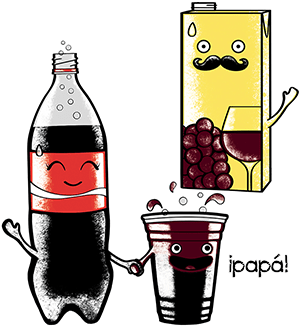
Kalimotxo [kal-ee-moht-cho] is a drink consisting of approximately 50% red wine and 50% cola-based soft drink.
read more »
Posted in Drugs, Food, World |
2 Comments »
March 10, 2011

Beer head is the frothy foam on top of beer after it is poured in a glass. It is produced by bubbles of carbon dioxide rising to the surface. The density and longevity of the head will be determined by the type of malt and adjunct from which the beer was fermented. In general, wheat tends to produce larger and longer lasting heads than barley.
The carbon dioxide may be produced naturally through the activity of brewer’s yeast, or artificially by dissolving carbon dioxide under pressure into the liquid. The beer head is created by the carbon dioxide produced as a byproduct of the metabolism of brewer’s yeast acting upon starches and sugars found in the wort.
read more »
Posted in Drugs, Food, Science |
Leave a Comment »




 The Daily Omnivore