January 31, 2011

The Wire is an American television drama series set and produced in and around Baltimore, Maryland. Created and primarily written by author and former police reporter David Simon. The series was broadcast by HBO from 2002 – 2008, comprising sixty episodes over five seasons. The show is recognized for its realistic portrayal of urban life, its literary ambitions, and its uncommonly deep exploration of sociopolitical themes. Each season focuses on a different facet of the city of Baltimore. They are, in chronological order: the illegal drug trade, the seaport system, the city government and bureaucracy, the school system, and the print news media.
The large cast consists mainly of character actors who are little known for their other roles. Simon has said that despite its presentation as a crime drama, the show is ‘really about the American city, and about how we live together. It’s about how institutions have an effect on individuals. Whether one is a cop, a longshoreman, a drug dealer, a politician, a judge or a lawyer, all are ultimately compromised and must contend with whatever institution they are committed to.’
Posted in Art, Drugs, Politics |
1 Comment »
January 31, 2011

Miracle fruit refers to any of three plants that share the same common name: Synsepalum dulcificum, source of a berry that increases the perceived sweetness of foods; Gymnema sylvestre, source of an herb that reduces the perceived sweetness of foods; and Thaumatococcus daniellii, source of a spice that has an intensely sweet flavor. Recently, this phenomenon has enjoyed some revival in food-tasting events, referred to as ‘flavor-tripping parties.’ Tasters consume sour and bitter foods, such as lemons, radishes, pickles, hot sauce, and beer, to experience the taste changes that occur.
Synsepalum dulcificum produces berries that, when eaten, cause sour foods (such as lemons and limes) subsequently consumed to taste sweet. The berry itself has a low sugar content. This effect is due to a chemical called miraculin, which is used commercially as a sugar substitute. While the exact cause for this change is unknown, one theory is that miraculin works by distorting the shape of sweetness receptors so that they become responsive to acids, instead of sugar and other sweet things for 15–60 minutes.
Posted in Drugs, Food |
Leave a Comment »
January 29, 2011


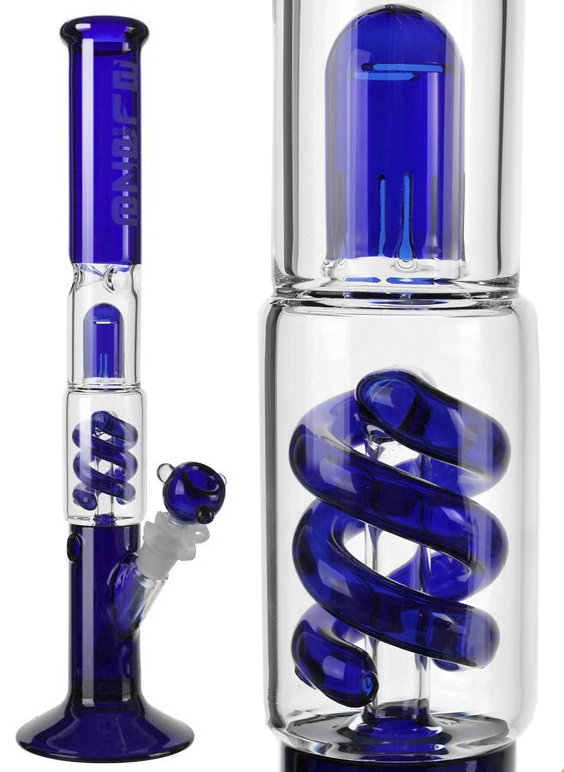
A water pipe percolator a sub chamber within the shaft of a water pipe (or other smoking instrument) that provides smoke-water interaction via heat exchange and dissolution. Percolators come in different forms, such as dome, pedestal, tree, and double helix. Depending upon the form of the percolator, it may or may not be diffused. However, the primary purpose of the percolator is to act as an extra chamber to filter smoke through water. As diffusers can mostly be found on male downstems, the only percolator that diffuses smoke is the tree percolator.
A diffuser works by utilizing a pressure differential between its bottom and top in/outlets. Reduced pressure at the outlet end is usually provided by the users lungs. The fluid at the inlet (i.e.: a smoke, vapor, and air mixture) is directed to the bottom of a column of water, where the pressure differential causes the inlet fluid to pass through the water in small pockets (liquid bubbles), and then rise to the outlet. In short, diffusers make smoke cooler, and rise evenly through the pipe, due to the water bubbles hitting the surface simultaneously.
Posted in Drugs, Health, Technology |
Leave a Comment »
January 28, 2011

A Mickey Finn (or simply Mickey) is a slang term for a drink laced with a drug (especially chloral hydrate) given to someone without their knowledge in order to incapacitate them. Serving someone a Mickey Finn is most commonly referred to as ‘slipping a mickey.’ The practice is most likely named for the bartender of a Chicago establishment, the Lone Star Saloon and Palm Garden Restaurant.
In December 1903, several newspapers document that a Michael ‘Mickey’ Finn managed the Lone Star Saloon and was accused of using knockout drops to incapacitate and rob some of his customers. Moreover, the first known written example (according to the Oxford English Dictionary) of the use of the term Mickey Finn is in 1915, twelve years after his trial, lending credence to this theory of the origination of the phrase.
Posted in Drugs, Health, Language |
Leave a Comment »
January 26, 2011


Henry Charles Bukowski (1920 – 1994) was a German-American poet, novelist and short story writer.
His writing was influenced by the social, cultural and economic ambience of his home city of Los Angeles. It is marked by an emphasis on the ordinary lives of poor Americans, the act of writing, alcohol, relationships with women and the drudgery of work. Bukowski wrote thousands of poems, hundreds of short stories and six novels, eventually having over 60 books in print. In 1986 Time called Bukowski a ‘laureate of American lowlife.’
read more »
Posted in Art, Drugs, Language |
1 Comment »
January 26, 2011

Henry Charles ‘Hank’ Chinaski is a semi-autobiographical protagonist of several works by the American writer Charles Bukowski. He appears in five of Bukowski’s novels, a number of his short stories and poems, the 1987 film ‘Barfly’ (played by Mickey Rourke and featuring a script written by Bukowski), and the 2005 film ‘Factotum’ (portrayed by Matt Dillon).
The works featuring him are ‘Confessions of a Man Insane Enough to Live With the Beasts’ (1965), ‘Post Office’ (1971), ‘South of No North’ (1973), ‘Factotum’ (1975), ‘Women’ (1978), ‘Ham on Rye’ (1982), ‘Hot Water Music’ (1983), ‘Hollywood’ (1989), and ‘Septuagenarian Stew’ (1990). He is also mentioned briefly in the beginning of Bukowski’s last novel, ‘Pulp.’
Posted in Art, Drugs, Language |
Leave a Comment »
January 20, 2011

Resveratrol is a chemical produced naturally by several plants when under attack by pathogens such as bacteria or fungi. It is found in the skin of red grapes and is a constituent of red wine, but apparently not in sufficient amounts to explain the French Paradox. Resveratrol is currently a topic of numerous animal and human studies into its effects.
Posted in Drugs, Food, Health |
Leave a Comment »
January 18, 2011

The Union: The Business Behind Getting High is a 2007 documentary film by Canadian filmmaker Brett Harvey. The film explores the illegal growth, sale and trafficking of marijuana. The film follows host Adam Scorgie as he examines the underground market, interviewing growers, police officers, criminologists, economists, doctors, politicians and pop culture icons, revealing how the industry can function despite being a criminal enterprise.
The history of marijuana and the reasons for its present prohibition are discussed, often comparing it to the prohibition of alcohol in the United States in the 1920s, suggesting that gang drug warfare and other negative aspects associated with marijuana are a result of prohibition, not the drug itself. The gangs that grow and traffic the drugs are likened to those that appeared in major U.S. cities during the Prohibition, with the intention of profiting from the sale of illegal alcohol.
Posted in Drugs, Money, Politics |
Leave a Comment »
January 17, 2011

A narco submarine (also called a Bigfoot submarine) is a type of custom-made ocean-going self-propelled semi-submersible (SPSS) vessel built by drug traffickers to smuggle drugs. They are especially known to be used by Colombian drug cartel members to export cocaine from Colombia to Mexico, which is often then transported overland to the United States. First detected in 1993, they are popularly called submarines, though typically they are semi-submersibles since they cannot dive; most of the craft is submerged with little more than the cockpit and the exhaust gas pipes above the water.
However, in 2010 Ecuadorian authorities seized a fully functional, completely submersible submarine in the jungles bordering Ecuador and Colombia. This diesel electric submarine had a cylindrical fiberglass hull of 31 meters (102 ft) long, a 3 meter conning tower with periscope, and air conditioning. The vessel had the capacity for about 10 metric tons of cargo, a crew of five or six people, the ability to fully submerge down to 65 feet (20 m), and capable of long-range underwater operation.
Posted in Drugs, Politics, Technology |
Leave a Comment »
January 13, 2011


Decaffeination is the act of removing caffeine from coffee beans, cocoa, or tea leaves. Decaffeinated drinks still have around 1-2% of the original caffeine remaining in them. In the case of coffee, the process is usually performed on unroasted (green) beans, and starts with steaming of the beans. They are then rinsed with a solvent that extracts the caffeine while leaving the other essential chemicals in the coffee beans. The process is repeated anywhere from 8 to 12 times until it meets either the international standard of having removed 97% of the caffeine in the beans or the EU standard of having the beans 99.9% caffeine-free by mass.
The first commercially successful decaffeination process was invented by Ludwig Roselius and Karl Wimmer in 1903. It involved steaming coffee beans with a salt water solution and then using benzene as a solvent to remove the caffeine. Coffee decaffeinated this way was sold as Kaffee HAG in most of Europe, as Café Sanka in France and later as Sanka brand coffee in the U.S. Due to health concerns regarding benzene, this process is no longer used commercially and Coffee Hag and Sanka are produced using a different process. Coffee contains over 400 chemicals important to the taste and aroma of the final drink: it is therefore challenging to remove only caffeine while leaving the other chemicals at their original concentrations.
Posted in Drugs, Food, Science |
1 Comment »
January 11, 2011
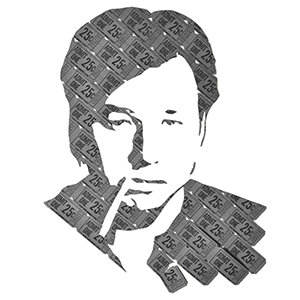
Bill Hicks (1961 – 1994) was an American stand-up comedian whose humor challenged mainstream beliefs, aiming to ‘enlighten people to think for themselves.’ Hicks used a ribald approach to express his material, describing himself as ‘Chomsky with dick jokes,’ while conceding that his humor was ‘caring.’ His material largely consisted of general discussions about society, religion, politics, philosophy, and personal issues. He was often controversial and his routine was steeped in dark comedy.
In both his stand-up performances and during interviews he criticized consumerism, superficiality, mediocrity, and banality within the media and popular culture, describing them as oppressive tools of the ruling class, meant to ‘keep people stupid and apathetic.’ Hicks died of pancreatic cancer in 1994 at the age of 32. In the years after his death, his work and legacy achieved the significant admiration and acclaim of numerous humorists.
read more »
Posted in Drugs, Humor, Politics |
Leave a Comment »
January 1, 2011

Free Beer, formerly known as ‘Our Beer,’ is the first brand of Danish beer with a ‘free’ recipe – free as in ‘freedom,’ taken after the term ‘free software.’ The name ‘Free Bee’ is a play on Richard Stallman’s common explanation that free software is ‘free as in speech, not free as in beer.’ The recipe is published under a Creative Commons license, specifically the Attribution-ShareAlike license. The beer was created by students at the IT-University in Copenhagen together with Superflex, a Copenhagen-based artist collective, to illustrate how concepts of the free software movement might be applied outside the digital world.
Initially, much of the homebrewing community spoke out against the quality and comprehensiveness of the recipe. Making reference to the technical problems of when software instructions (‘source code’) cannot be made into a functioning program, several people commented that if the recipe were source code, it would not compile (a compiler is a program that takes ‘source code’ from a high-level language and changes it to a target language, mostly machine code, the lowest level language). Since then the recipe went through several iterations and has now reached version 4.0, which corrects most of the early mistakes. The quality of the beer also improved, and the amount of sugar in it decreased by 90%.
Posted in Drugs, Food, Philosophy |
Leave a Comment »




 The Daily Omnivore