October 18, 2010


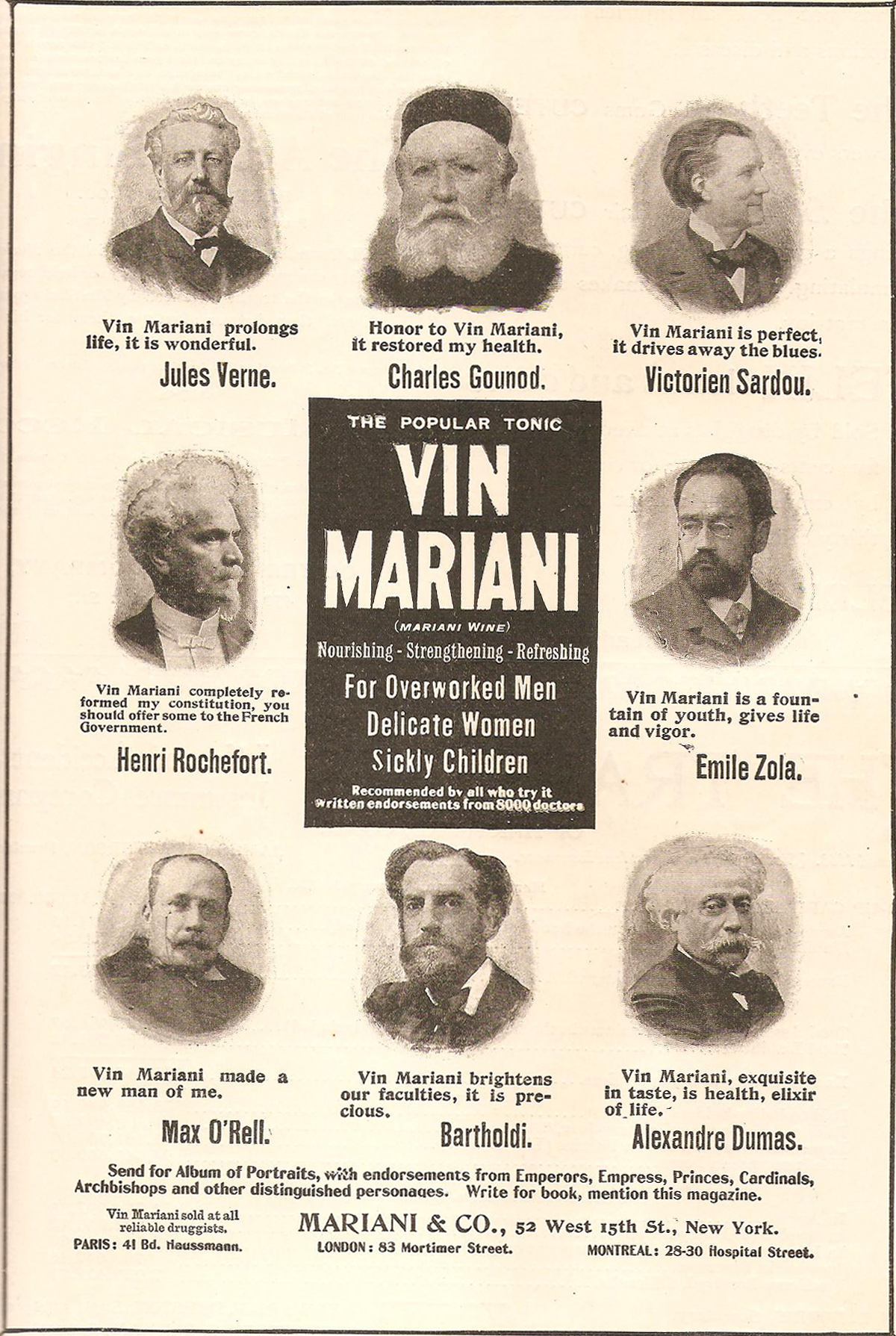
Vin Mariani (French: Mariani’s wine) was a tonic and patent medicine created circa 1863 by Angelo Mariani, a chemist who became intrigued with coca and its economic potential after reading Paolo Mantegazza’s paper on coca’s effects. Mariani started marketing a wine called Vin Tonique Mariani (à la Coca du Pérou) which was made from Bordeaux wine treated with coca leaves.
The ethanol in the wine acted as a solvent and extracted the cocaine from the coca leaves, altering the drink’s effect. It originally contained 6 mg of cocaine per fluid ounce of wine, but Vin Mariani which was to be exported contained 7.2 mg per ounce in order to compete with the higher cocaine content of similar drinks in the United States. Ads for Vin Mariani claimed that it would restore health, strength, energy, and vitality.
read more »
Posted in Drugs, Food, Money |
Leave a Comment »
October 11, 2010
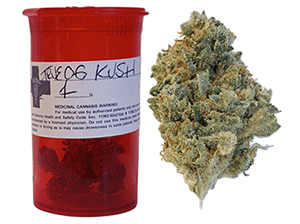

Kush [koosh] refers to a subset of strains of indica cannabis. The origins of Kush cannabis are from landrace plants mainly in Afghanistan, but are also from Iran, Pakistan, and Northern India. The name derives from the Hindu Kush mountain range. Kush strains of cannabis were brought to the United States in the mid-to-late 1970s and continue to be available. Kush strains were among those cultivated by the British firm GW Pharmaceuticals for its legally licensed commercial trial of medicinal cannabis.
Congressman Mark Kirk, a Republican member of the House of Representatives from Illinois, introduced legislation to increase the penalties for selling kush: The High-Potency Marijuana Sentencing Enhancement Act of 2009 (H.R. 2848). Kirk said that as kush may sell for up to $600 per ounce increases penalties are justified, saying that ‘if you can make as much money selling pot as cocaine, you should face the same penalties.’
Posted in Drugs, World |
Leave a Comment »
September 23, 2010

Ego death is the perceived loss of boundaries between self and environment, often brought on by psychedelic drugs such as LSD, psilocybin, mescaline, or DMT. Many other methods, practices, or experiences may also induce this state, including prayer, sleep deprivation, fasting, meditation practice, or through the use of an isolation tank. It’s often described as, ‘becoming one with the universe.’
It is an experience that purportedly reveals the illusory aspect of the ego, and is undergone by psychonauts, mystics, shamans, monks, psychologists, and others interested in exploring the depths of the mind. The practice of ego death as a deliberately sought ‘mystical experience’ in some ways overlaps, but is nevertheless distinct from, traditional teachings concerning enlightenment/’Nirvana’ (in Buddhism) or ‘Moksha’ (in Hinduism and Jainism), which might perhaps be better understood as transcendence of the notion that one even has any actual, non-illusory ‘ego’ with which to experience ‘death’ in the first place.
Posted in Death, Drugs, Philosophy |
1 Comment »
September 19, 2010

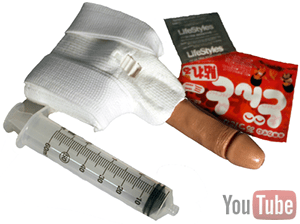
The Original Whizzinator is a product intended to fraudulently defeat drug tests. The Whizzinator comes as a kit complete with dried urine and syringe, heater packs (to keep the urine at body temperature), a false penis (available in several skin tones including white, tan, latino, brown, and black) and an instruction manual. The company also offered a female version of the Whizzinator, called ‘Number One.’
The device received media coverage in 2005 after Onterrio Smith, a former Minnesota Vikings running back, was caught with one at the Minneapolis-St. Paul International Airport, which resulted in his suspension. Actor Tom Sizemore was also caught with a Whizzinator that year. In 2008, federal prosecutors in Pittsburgh won a 19-count indictment against Puck Technology, maker of the Whizzinator, and its owners for fraud and selling drug paraphernalia. As of 2011, the Whizzinator-XXX is being marketed by Alternative Lifestyle Systems for $139.95 through ‘High Times’ magazine as a strap-on ‘wet sex simulator’ containing ‘synthetic urine,’ ostensibly for synthetic watersports activity.
Posted in Drugs, Politics, Sex |
Leave a Comment »
August 24, 2010
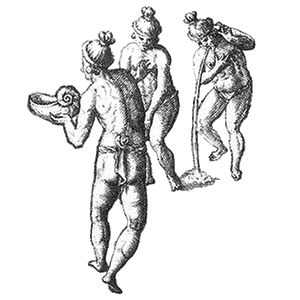
Black drink was the name given by colonists to a ritual beverage called Asi, brewed by Native Americans in the Southeastern United States. It was prepared from the roasted leaves and stems of the Yaupon Holly, native to the Atlantic and Gulf Coasts. The active ingredient in the drink was caffeine. The beverage was often used as a substitute for coffee and tea by colonists under the name cassine or cassina.
Prior to the 19th century, the black drink was consumed during the daily deliberations of the village councils and at all other important council meetings. Caddo, Creeks, Cherokees, Choctaws, and others believed it purified the drinker and purged him of anger and falsehoods. Black drink was prepared by special village officials and served in large communal cups, frequently made of whelk shell. The men in council were served in order of precedence, starting with important visitors. They consumed large quantities at a sitting. Afterward, they purged themselves by vomiting.
Posted in Drugs, Food, World |
Leave a Comment »
August 24, 2010
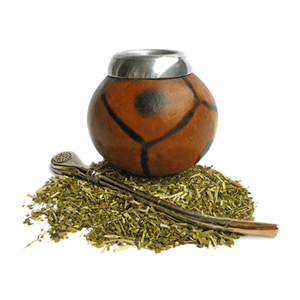
Mate [mah-tey], also known as chimarrão or cimarrón, is a traditional South American infused drink particularly popular in Argentina. It is prepared by steeping dried leaves of the yerba mate plant in hot water. Mate is served with a metal straw, called a bombilla, from a hollow calabash gourd, called a mate.
As with other brewed herbs, yerba mate leaves are dried, chopped, and ground into a powdery mixture called yerba. The bombilla acts as both a straw and a sieve. The submerged end is flared, with small holes or slots that allow the brewed liquid in, but block the chunky matter that makes up much of the mixture.
read more »
Posted in Drugs, Food, World |
Leave a Comment »
August 16, 2010

A chipper is an occasional drug user who does not use drugs with the regularity or frequency typical of addicts. It is used particularly to refer to opiate users and tobacco smokers. Above a certain threshold they develop regular cravings and become addicted. The term dates at least to the 1970s, where it is used in reference to opiate use and was used notably in reference to tobacco by psychologist Saul Shiffman and journalist Malcolm Gladwell.
Posted in Drugs, Health, Science |
Leave a Comment »
August 11, 2010
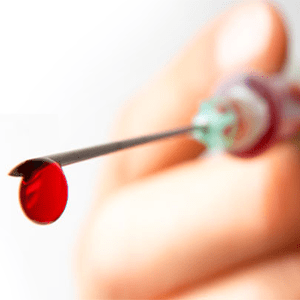
Flashblood (also called Flushblood) is a technique employed by drug users in which an addict injects himself with blood extracted from another drug user, most commonly one who has injected heroin. After injecting themselves with heroin using a syringe, the user will extract approximately one teaspoon of blood from the vein. Another user will then inject the withdrawn blood into themselves. It is unclear if there is enough heroin in the injected blood to get high or if the high that many users claim is a result of traces of the heroin that had been injected by the user, or if the high is simply the result of the placebo effect.
Posted in Drugs, Health |
1 Comment »
July 22, 2010

Solar puffing refers to the act of using a magnifying lens to heat cannabis for consumption. Utilization of this method avoids residues left by butane or other propellants used in lighters and matches, and a greater amount of THC is extracted due to a lower heating temperature as opposed to that of combustion. This method is similar to that of vaporization.
Posted in Drugs |
Leave a Comment »
July 11, 2010

The word spoof was coined by English comedian Arthur Roberts and popularized by a card game that he invented called Spoof, which involved trickery and nonsense. The first recorded reference to the game is in 1884. Soon the word took on the general meaning of ‘nonsense, trickery,’ first recorded in 1889. The verb spoof is first recorded in 1889 as well, in the sense ‘to deceive.’ These senses are now less widely used than the noun meaning of ‘a light parody or satirical imitation,’ first recorded in 1958, and the verb sense ‘to satirize gently,’ first recorded in 1927.
In the context of network security, a spoofing attack is a situation in which one person or program successfully masquerades as another by falsifying data and thereby gaining an illegitimate advantage. Another kind of spoofing is ‘webpage spoofing,’ also known as phishing. In this attack, a legitimate web page such as a bank’s site is reproduced in ‘look and feel’ on another server under control of the attacker. The main intent is to fool the users into thinking that they are connected to a trusted site, for instance to harvest user names and passwords. Spoof is also the name for an object used to mask the odor of marijuana or tobacco smoke. It is most commonly made of a paper towel roll tube stuffed with dryer sheets through which the smoke is blown.
Posted in Drugs, Humor, Language |
Leave a Comment »
July 11, 2010

Qat, or khat [kaht] is a flowering plant native to tropical East Africa and the Arabian Peninsula. Qat contains an alkaloid called cathinone, an amphetamine-like stimulant stimulates the release of dopamine and can cause excitement, loss of appetite and euphoria.
In 1980 the World Health Organization classified qat as a drug of abuse that can produce mild to moderate psychological dependence. It is a controlled or illegal substance in many countries, but has been grown for use as a stimulant for centuries in the Horn of Africa and the Arabian Peninsula. There, chewing qat predates the use of coffee and is used in a similar social context.
Posted in Drugs, World |
1 Comment »
July 11, 2010

Baijiu is a Chinese liquor made from distilled sorghum, a tropical grass, or other grains. The name baijiu literally means ‘white liquor’ or ‘white spirit,’ and it is generally about 80 to 120 proof, or 40-60% alcohol by volume (ABV). Because of its clarity, baijiu can appear similar to several other liquors, but generally has a significantly higher ABV than, for example, vodka (35-50%), Japanese shōchū (25%), or Korean soju (20-45%), and its flavour is distinctive and unique. In 2008 baijiu was the world’s most consumed spirit, with annual sales of 520 million 9-liter cases compared to vodka with 497 million 9-liter cases.
Wuliangye is the most popular brand, followed by Maotai.
Posted in Drugs, Food, World |
Leave a Comment »





 The Daily Omnivore