May 10, 2011

‘A Briefer History of Time‘ is a popular-science book published in 2005 from the English physicist Stephen Hawking and the American physicist Leonard Mlodinow. It is an update and rewrite of Hawking’s 1988 ‘A Brief History of Time.’
In this book Hawking and Mlodinow present quantum mechanics, string theory, the big bang theory, and other topics in a more accessible fashion to the general public. The book is updated with newly discovered topics, and informs of recurring subjects throughout the book in greater detail.
Posted in Education, Language, Science |
Leave a Comment »
May 10, 2011
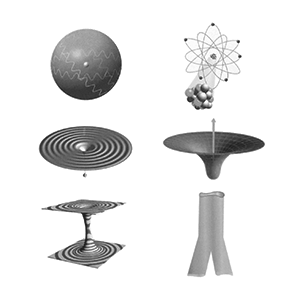
‘A Brief History of Time: From the Big Bang to Black Holes’ is a 1988 popular science book written by English theoretical physicist Stephen Hawking, which attempts to explain a range of subjects in cosmology (e.g. the Big Bang, black holes, and light cones) to the nonspecialist reader.
Its main goal is to give an overview of the subject but, unusual for a popular science book, it also attempts to explain some complex mathematics. The author notes that an editor warned him that for every equation in the book the readership would be halved, hence it includes only a single equation: E=mc2.
read more »
Posted in Education, Language, Science |
Leave a Comment »
April 26, 2011

A pizza farm is an educational visitor attraction consisting of a small farm on a circular region of land partitioned into plots shaped like pizza wedges.
The farm’s segments produce ingredients that can be used in pizza, such as wheat for the crust, tomatoes or herbs, pork for pepperoni, dairy cows for cheese, and even trees for pizza oven firewood. Certain farms may even have access to coal or natural gas deposits that can be used as alternative pizza oven heating fuels.
Posted in Education, Food, Money |
Leave a Comment »
April 6, 2011
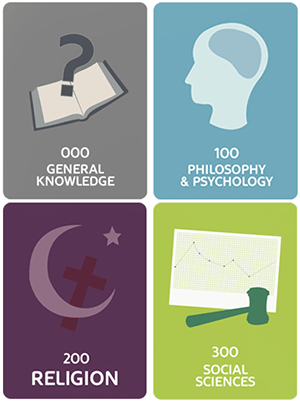
The Dewey Decimal System is a way to sort books. It’s usually used in public libraries and schools. It sorts the books by subject using numbers from 000 to 999. Each subject is broken up into 10 smaller, more specific categories, and has its own set of numbers. The system was created by American librarian Melvil Dewey in 1876.
Posted in Education, Language, Science |
Leave a Comment »
April 3, 2011

Speed reading refers to a number of ways to increase the speed at which a text can be read where the important facts are still understood. A trained reader is able to read and understand between 200 and 300 words per minute of basic text. Better training can improve this speed to over 1000 words per minute.
With a lot of exercise it’s possible to increase reading speed further; the best readers can read between 3000 and 4000 words per minute, and understand about 80% of them (at that speed a short novel can be read in under 20 minutes).
read more »
Posted in Education, Games, Language |
Leave a Comment »
March 25, 2011

The intelligence of the Ashkenazi [ahsh-kuh-nah-zee] Jews has been the subject of studies which report higher a average intelligence quotient than among the general population. They are greatly overrepresented in occupations and fields with the high cognitive demands. During the 20th century, Ashkenazi Jews made up about 3% of the US population but won 27% of the US science Nobel Prizes, and half of the world’s chess champions were among their ranks.
read more »
Posted in Education, Philosophy, Science |
Leave a Comment »
March 15, 2011
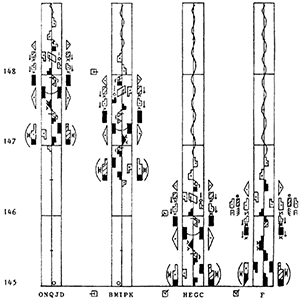

Laban [ley-buhn] Movement Analysis is a way and language for interpreting, describing, visualizing and notating all ways of human movement. Created by Rudolf Laban, LMA draws on his theories of effort and shape to describe, interpret and document human movement. Used as a tool by dancers, athletes, physical and occupational therapists, it is one of the most widely used systems of human movement analysis.
Rudolf Laban (1879–1958) was a dance artist and theorist whose work laid the foundations for dance notation. He is considered to be one of the most important figures in the history of dance and fencing.
Posted in Art, Education, Games |
Leave a Comment »
February 23, 2011

Here Comes Science is a 2009 children’s album from Brooklyn-based band They Might Be Giants, packaged as a CD/DVD set. The album is the third in their line of educational albums, following 2005’s Here Come the ABCs and 2008’s Here Come the 123s. It is the band’s 14th studio album and fourth children’s album.
Posted in Art, Education, Science |
Leave a Comment »
February 13, 2011

Algebraic geometry is a branch of mathematics which combines techniques of abstract algebra, especially commutative algebra, with the language and the problems of geometry. Initially a study of systems of polynomial equations in several variables, the subject of algebraic geometry starts where equation solving leaves off, and it becomes even more important to understand the intrinsic properties of the totality of solutions of a system of equations, than to find some solution; this leads into some of the deepest waters in the whole of mathematics, both conceptually and in terms of technique.
Posted in Education, Science |
Leave a Comment »
January 28, 2011

To grok is to share the same reality or line of thinking with another physical or conceptual entity. Author Robert A. Heinlein coined the term in his best-selling 1961 book ‘Stranger in a Strange Land.’ Grokking is the intermingling of intelligence that necessarily affects both the observer and the observed. According to the novel: ‘Grok means to understand so thoroughly that the observer becomes a part of the observed—to merge, blend, intermarry, lose identity in group experience. It means almost everything that we mean by religion, philosophy, and science—and it means as little to us (because of our Earthly assumptions) as color means to a blind man.’
To grok something is both to comprehend (relate intellectually) and to apprehend (relate emotionally and spiritually) its quiddity, its essence, its being. In an ideological context, a grokked concept becomes part of the person who contributes to its evolution by improving the doctrine, perpetuating the myth, espousing the belief, adding detail to the social plan, refining the idea or proving the theory.
Posted in Education, Language, Philosophy |
Leave a Comment »
January 24, 2011

A forest kindergarten is a type of preschool education for children between the ages of three and six that is held almost exclusively outdoors. Whatever the weather, children are encouraged to play, explore and learn in a forest or natural environment. The adult supervision is meant to assist rather than lead. It is also known as Waldkindergarten (in German), outdoor nursery, nature kindergarten, or nature preschool.
read more »
Posted in Education, World |
Leave a Comment »
January 24, 2011

Helicopter parent is a colloquial, early 21st-century term for a parent who pays extremely close attention to his or her child’s or children’s experiences and problems, particularly at educational institutions. The term was originally coined by Foster W. Cline, M.D. and Jim Fay in their 1990 book ‘Parenting with Love and Logic.’
Helicopter parents are so named because, like helicopters, they hover closely overhead, rarely out of reach, whether their children need them or not. They try to resolve their child’s problems, and try to stop them coming to harm by keeping them out of dangerous situations.
read more »
Posted in Education, Language, Politics |
2 Comments »



 The Daily Omnivore