November 25, 2012

Machine learning, a branch of artificial intelligence, is a scientific discipline concerned with the development of algorithms that take as input empirical data (from sensors or databases), identify complex relationships, and employ these identified patterns to make predictions. The algorithm studies a portion of the observed data (called ‘training data’) to capture characteristics of interest. Optical character recognition, in which printed characters are recognized automatically based on previous examples, is a classic engineering example of machine learning.
In 1959, AI pioneer Arthur Samuel defined machine learning as a ‘Field of study that gives computers the ability to learn without being explicitly programmed.’ Computer scientist Tom M. Mitchell provided a widely quoted, more formal definition: ‘A computer program is said to learn from experience E with respect to some class of tasks T and performance measure P, if its performance at tasks in T, as measured by P, improves with experience E.’
read more »
Posted in Education, Technology |
Leave a Comment »
November 17, 2012

Presentism [prez-ent-iz-uhm] is a mode of literary or historical analysis in which present-day ideas and perspectives are anachronistically introduced into depictions or interpretations of the past. Some modern historians seek to avoid presentism in their work because they believe it creates a distorted understanding of their subject matter.
The practice of presentism is a common fallacy in historical writings. Historian David Hackett Fischer identifies presentism as a fallacy also known as the ‘fallacy of nunc pro tunc’ (‘now for then,’ a court ruling applied retroactively to correct an earlier ruling). He has written that the ‘classic example’ of presentism was the so-called ‘Whig history,’ in which certain eighteenth- and nineteenth-century British historians wrote history in a way that used the past to validate their own political beliefs.
read more »
Posted in Education, Language, Philosophy |
Leave a Comment »
November 1, 2012

The strong programme or Strong Sociology is a variety of the sociology of scientific knowledge (SSK) particularly associated with David Bloor, Barry Barnes, Harry Collins, Donald A. MacKenzie, and John Henry. SSK is the study of science as a social activity, especially dealing with ‘the social conditions and effects of science, and with the social structures and processes of scientific activity.’
The strong programme’s influence on Science and Technology Studies (the study of how social, political, and cultural values affect scientific research and technological innovation, and how these, in turn, affect society, politics and culture) is credited as being unparalleled. The largely Edinburgh-based school of thought has illustrated how the existence of a scientific community, bound together by allegiance to a shared paradigm, is a pre-requisite for normal scientific activity.
read more »
Posted in Education, Science |
Leave a Comment »
November 1, 2012

Science studies is an interdisciplinary research area that seeks to situate scientific expertise in a broad social, historical, and philosophical context. It is concerned with the history of scientific disciplines, the interrelationships between science and society, and the alleged covert purposes that underlie scientific claims. While it is critical of science, it holds out the possibility of broader public participation in science policy issues.
The word ‘science’ is used in the sense of natural, social and formal sciences – areas of research that tend toward positivism (‘all true knowledge is scientific’). The word ‘science’ thus explicitly excludes the humanities and cultural studies, which tend toward relativism (‘the truth of a statement is based on conditions’). Thus, while the topic of research in ‘science studies’ is the sciences, the main approaches to research come from the humanities (e.g. history) (hence the word ‘study’ in the title, rather than for example ‘theory’). Science studies scholars study (investigate) specific phenomena such as technological milieus, laboratory culture, science policy, and the role of the university.
read more »
Posted in Education, Science, Technology |
Leave a Comment »
November 1, 2012
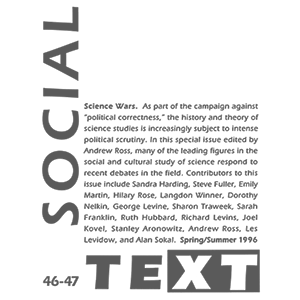
The science wars were a series of intellectual exchanges, between scientific realists and postmodernist critics, about the nature of scientific theory which took place principally in the United States in the 1990s. The postmodernists questioned scientific objectivity, and critiqued the scientific method and scientific knowledge in cultural studies, cultural anthropology, feminist studies, comparative literature, media studies, and science and technology studies. The scientific realists countered that objective scientific knowledge is real, and accused postmodernist critics of having little understanding of the science they were criticizing.
Until the mid-20th century, the philosophy of science had concentrated on the viability of scientific method and knowledge, proposing justifications for the truth of scientific theories and observations and attempting to discover on a philosophical level why science worked. Already Karl Popper had begun to attack this view. Popper denied outright that justification existed for such concepts as truth, probability or even belief in scientific theories, thereby laying fertile foundations for the growth of postmodernist attitudes.
read more »
Posted in Education, Language, Science |
Leave a Comment »
October 29, 2012

The Ig Nobel Prizes are a satirical award given each year in early October for ten unusual or trivial achievements in scientific research. The stated aim of the prizes is to ‘first make people laugh, and then make them think.’
Organized by the scientific humor magazine ‘Annals of Improbable Research’ (AIR), they are presented by a group that includes Nobel Laureates at a ceremony at Harvard University’s Sanders Theater, and they are followed by a set of public lectures by the winners at MIT. The name is a play on the words ‘ignoble’ (‘characterized by baseness, lowness, or meanness’) and the Nobel Prize. The pronunciation used during the ceremony is [ig-noh-bel], not like the word ‘ignoble.’
read more »
Posted in Education, Humor, Science |
Leave a Comment »
October 29, 2012

Gamification is the use of game mechanics and game design techniques in non-game contexts. Typically gamification applies to non-game applications and processes, in order to encourage people to adopt them, or to influence how they are used.
Gamification’s proponents argue that it works by making technology more engaging, by encouraging users to engage in desired behaviors, by showing a path to mastery and autonomy, by helping to solve problems and being more engaging, and by taking advantage of humans’ psychological predisposition to engage in gaming. Available data from gamified websites, applications, and processes indicate potential improvements in areas such as user engagement, ROI, data quality, timeliness, and learning.
read more »
Posted in Education, Games, Money |
Leave a Comment »
October 29, 2012
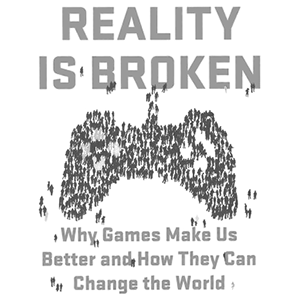
Game studies or ‘gaming theory’ is an academic discipline that deals with the critical study of games. More specifically, it focuses on game design, players, and their role in society and culture.
Game studies is an interdisciplinary field with researchers and academics from a multitude of other areas such as computer science, psychology, sociology, anthropology, philosophy, arts and literature, media studies, communication, theology, and more. Like other media disciplines, such as television studies and film studies, game studies often involves textual analysis and audience theory. Game studies tends to employ more diverse methodologies than these other branches, however, drawing from both social science and humanities approaches.
read more »
Posted in Education, Games, Technology |
1 Comment »
October 29, 2012

Numerous researchers have proposed potential positive effects of video games on aspects of social and cognitive development and psychological well-being. It has been shown that action video game players have better hand-eye coordination and visuo-motor skills, such as their resistance to distraction, their sensitivity to information in the peripheral vision and their ability to count briefly presented objects, than non-players.
With the development of the PlayStation Move, Kinect and Wii, video games can also help develop motor skills through full body movement. Video games also develop the individual’s intelligence, and in social games develop the social capabilities of the individual. Another way in which the usage of video games might provide a benefit is in the relief of stress.
read more »
Posted in Education, Games, Health |
1 Comment »
October 28, 2012

‘Understanding Media: The Extensions of Man’ is a 1964 book by Marshall McLuhan. A pioneering study in media theory, it proposes that media themselves, not the content they carry, should be the focus of study. McLuhan suggests that a medium affects the society in which it plays a role not by the content delivered through it, but by the characteristics of the medium itself.
McLuhan pointed to the light bulb as an example. A light bulb does not have content in the way that a newspaper has articles or a television has programs, yet it is a medium that has a social effect; that is, a light bulb enables people to create spaces during nighttime that would otherwise be enveloped by darkness. He describes the light bulb as a medium without any content. McLuhan states that ‘a light bulb creates an environment by its mere presence.’
read more »
Posted in Education, Language, Technology |
Leave a Comment »
October 24, 2012
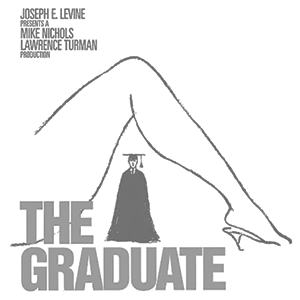
The quarterlife crisis is a period of life following the major changes of adolescence, usually ranging from the late teens to the early thirties, in which a person begins to feel doubtful about their own lives, brought on by the stress of becoming an adult. The term was coined by analogy with mid-life crisis. It occurs shortly after a young person enters the ‘real world.’ Austrian psychologist Erik H. Erikson, who described eight crises that humans face during their development, proposed the existence of a life crisis occurring at this age.
The conflict he associated with young adulthood is the ‘Intimacy vs. Isolation’ crisis. According to him, after establishing a personal identity in adolescence, young adults seek to form intense, usually romantic relationships with other people. The notion of the quarter-life crisis is explored by the 1967 film ‘The Graduate,’ one of the first film depictions of this issue. Other notable films that also do so are ‘Garden State,’ ‘High Fidelity,’ and ‘Lost in Translation.’ The 2008 web series ‘Quarterlife’ was so named for the phenomenon.
Posted in Education, Health |
Leave a Comment »
October 21, 2012

The Closing of the American Mind is a 1987 book by American philosopher Allan Bloom. It describes ‘how higher education has failed democracy and impoverished the souls of today’s students.’ He focuses especially upon the ‘openness’ of relativism as leading paradoxically to the great ‘closing’ referenced in the book’s title.
Bloom argues that ‘openness’ and absolute understanding undermines critical thinking and eliminates the ‘point of view’ that defines cultures. According to Bloom: ‘Education in our times must try to find whatever there is in students that might yearn for completion, and to reconstruct the learning that would enable them autonomously to seek that completion.’
read more »
Posted in Education, Philosophy, Politics |
Leave a Comment »


 The Daily Omnivore