January 24, 2011
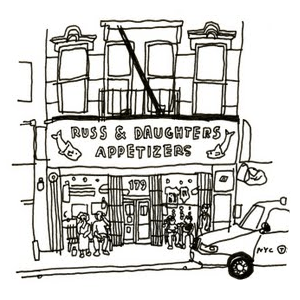
An appetizing store, typically in reference to Jewish cuisine, is best understood as a store that sells ‘the foods one eats with bagels’ ‘Appetizing’ is used as a noun by itself to refer to these type of foods. Appetizing stores includes both dairy and ‘parve’ (neither dairy nor meat) food items such as lox (smoked salmon), whitefish, and cream cheese spreads. These foods are typically eaten for breakfast or lunch and, based on Jewish kashrut dietary laws, include no meat products (kosher fish products are not considered meat).
The simplest distinction is that an appetizing store is a place that sells fish and dairy products, whereas a delicatessen sells meats. It can also can be described as ‘appy table,’ ‘appetizing table,’ or just ‘appy’ (short for ‘appetizing’ in the way ‘deli’ is short for ‘delicatessen.’ The term is used typically among American Jews, especially those in the New York City area. Pareve and dairy restaurants in Toronto, Canada, also have ‘Appetizers’ as part of their name who are both Kosher and Kosher style.
Posted in Food, Language, Money |
Leave a Comment »
January 21, 2011

An Urban chicken or backyard chicken is a chicken kept in a city. The primary reasons for keeping chickens are the food and income made by selling the eggs and meat. Other reasons include use in ceremonies and as gifts or even as pets. Keeping chickens in an urban environment is associated with the ‘Urban Agriculture Movement,’ which is the growing practice of cultivating, processing and distributing food in cities.
read more »
Posted in Food, Health, World |
Leave a Comment »
January 20, 2011

The French Paradox is the observation that French people suffer a relatively low incidence of coronary heart disease, despite having a diet relatively rich in saturated fats. The term French Paradox was coined by Dr. Serge Renaud, a scientist from Bordeaux University in France. It has been suggested that France’s high red wine consumption is a primary factor in the trend.
This hypothesis was expounded in a 60 Minutes broadcast in 1991. It is believed that one of the components of red wine potentially related to this effect is resveratrol. Statistics collected by the WHO from 1990–2000 show that the incidence of heart disease in France may have been underestimated, and may in fact be similar to that of neighboring countries.
Posted in Food, Health, World |
Leave a Comment »
January 20, 2011

Resveratrol is a chemical produced naturally by several plants when under attack by pathogens such as bacteria or fungi. It is found in the skin of red grapes and is a constituent of red wine, but apparently not in sufficient amounts to explain the French Paradox. Resveratrol is currently a topic of numerous animal and human studies into its effects.
Posted in Drugs, Food, Health |
Leave a Comment »
January 20, 2011

Whisky production in Japan began around 1870, but the first commercial production was in 1924 upon the opening of the country’s first distillery, Yamazaki. Broadly speaking the style of Japanese whisky is more similar to that of Scotch whisky than Irish whiskey, and thus the spelling typically follows the Scottish convention (omitting the letter ‘e’).
There are several companies producing whisky in Japan. Perhaps the two most well known are Suntory and Nikka. Both produce blended as well as single malt whiskies.
Posted in Food, World |
Leave a Comment »
January 19, 2011

A supertaster is a person who experiences the sense of taste with far greater intensity than average. Women are more likely to be supertasters, as are Asians and Africans. The cause of this heightened response is currently unknown, although it is thought to be, at least in part, due to an increased number of fungiform papillae (small mushroom-like structures on the tongue that house taste buds). Supertasters contrast with nontasters who have a decreased sense. The term originates with experimental psychologist Linda Bartoshuk who has spent much of her career studying genetic variation in taste perception.
In some environments, heightened taste response, particularly to bitterness, would represent an important advantage in avoiding potentially toxic plant alkaloids. However, in other environments, increased response to bitter may have limited the range of palatable foods. In a modern, energy-rich environment, supertasting may be cardioprotective, due to decreased liking and intake of fat.
Posted in Food, Language, Science |
Leave a Comment »
January 19, 2011

OK Soda was a soft drink created by Coca-Cola in 1993 that aggressively courted the Generation X demographic with unusual advertising tactics, including endorsements and even outright negative publicity. It did not sell well in select test markets and was officially declared out of production in 1995 before reaching nation-wide distribution.
The drink’s slogan was ‘Things are going to be OK.’ The project was cancelled by Coca-Cola just seven months after its kickoff, and the soft drink was never widely released to the public.
read more »
Posted in Food, Money, Politics |
1 Comment »
January 19, 2011
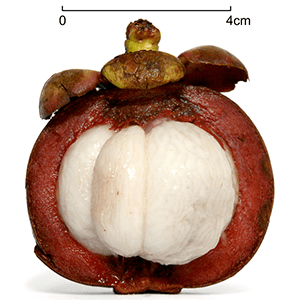
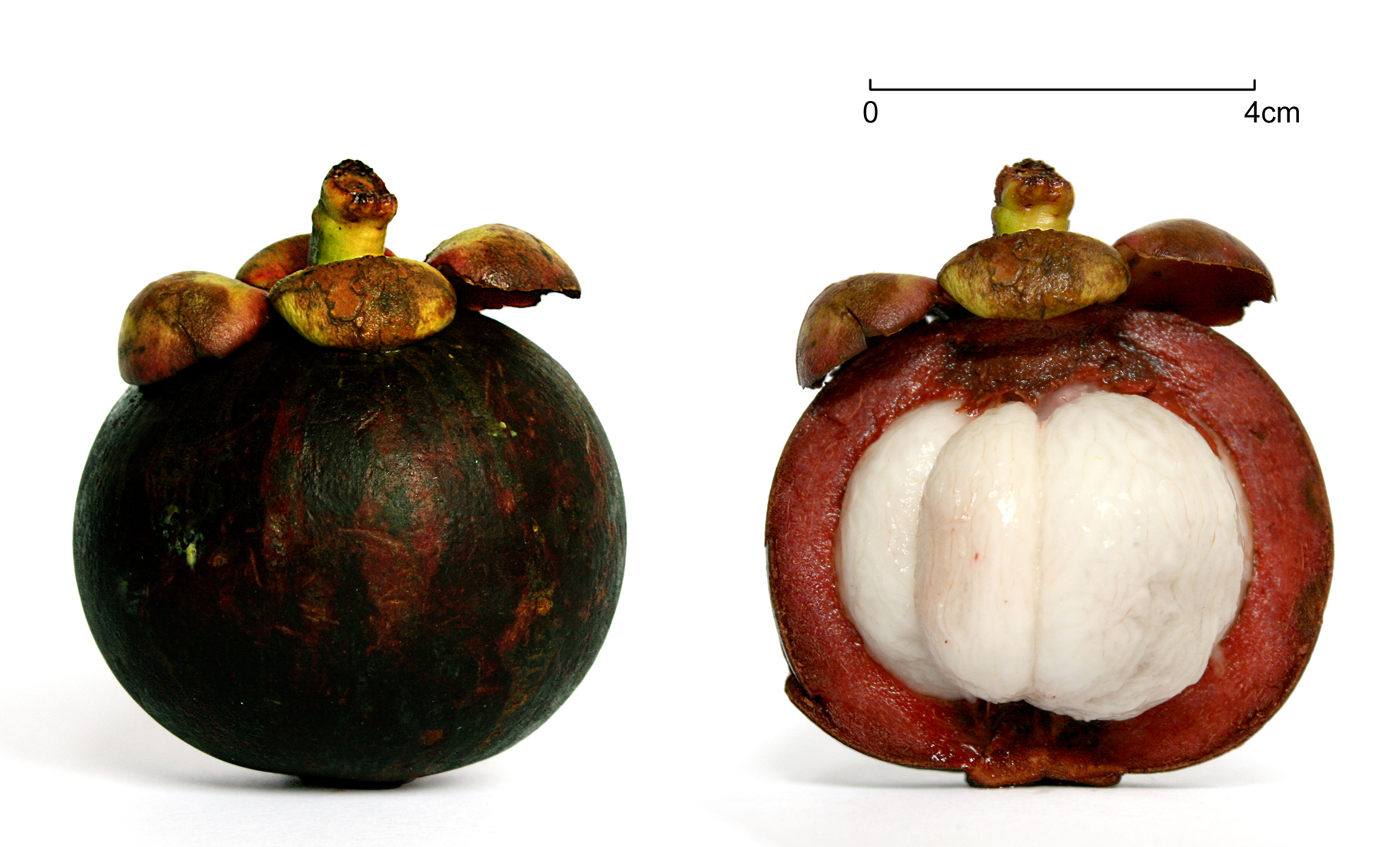
The purple mangosteen [mang-guh-steen] is a tropical evergreen tree believed to have originated in Indonesia. The rind (exocarp) of the edible fruit is deep reddish purple when ripe. Botanically an aril (like pomegranate fruit), the fragrant edible flesh can be described as sweet and tangy, citrusy with a flavour and texture similar to a peach. It is sometimes called the ‘Queen of Fruit,’ owing to an apocryphal legend of Queen Victoria offering a reward of 100 pounds sterling to anyone who could deliver to her a fresh mangosteen. An ultratropical tree, the mangosteen must be grown in consistently warm conditions, as exposure to temperatures below freezing for prolonged periods will generally kill a mature plant. Experienced horticulturists have grown this species outdoors, and brought them to fruit in extreme South Florida.
Due to restrictions on imports, mangosteen is not readily available in certain countries. Although available in Australia, for example, they are still rare in the produce sections of grocery stores in North America and Europe. Beginning in 2007 for the first time, fresh mangosteens were sold from specialty produce stores in New York City for as high as $45 per pound, but wider availability and lower prices have become common in the United States and Canada. Before ripening, the mangosteen shell is fibrous and firm, but becomes soft and easy to pry open when the fruit ripens.
Posted in Food, Money |
Leave a Comment »
January 19, 2011
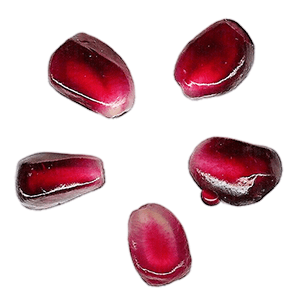
An aril [ar-il] is any specialized outgrowth from the funiculus (attachment point of the seed) or that covers or is attached to the seed. It is sometimes applied to any appendage or thickening of the seed coat in flowering plants, such as the edible parts of the mangosteen and pomegranate fruit, the mace of the nutmeg seed, or the hairs of a cotton plant. The aril may create a fruit-like structure (called a false-fruit). The edible flesh of the longan, lychee, ackee and lleuque fruits are highly developed arils surrounding the seed.
Posted in Food, Language, Science |
Leave a Comment »
January 18, 2011


Richard Parker is the name of a person and a fictional character who were shipwrecked and subsequently cannibalised by their fellow seamen. In Edgar Allan Poe’s only novel The Narrative of Arthur Gordon Pym of Nantucket, published in 1838, Richard Parker is a mutinous sailor on the whaling ship Grampus. After the ship capsizes in a storm, he and three other survivors draw lots upon Parker’s suggestion to kill one of them to sustain the others. Parker then gets cannibalized.
In 1884, an actual yacht named Mignonette sank. Four people survived, drifted in a life boat, and finally killed one of them, the cabin boy Richard Parker, for food. the survivors were criminally tried in the case of ‘R v Dudley and Stephens (which established a precedent, throughout the common law world, that necessity is no defence against a charge of murder).
Posted in Death, Food, Politics |
Leave a Comment »
January 13, 2011

Nutraloaf, sometimes called prison loaf, disciplinary loaf, food loaf, confinement loaf, seg loaf, or special management meal, is a food served in United States prisons. It is similar to meatloaf in texture, but has a wider variety of ingredients. Prisoners may be served nutraloaf if they have assaulted prison guards or fellow prisoners with sharpened utensils. Prison loaf is usually exceedingly bland in taste or unpleasant, but prison wardens argue that it provides enough nutrition to keep prisoners healthy without requiring utensils to be issued. However, the American Correctional Association, which accredits prisons, discourages the use of food as a disciplinary measure.
There are many different recipes which include a range of food, from vegetables, fruit, meat, and bread or other grains. Some versions may be vegetarian or completely vegan. The ingredients are blended and baked into a solid loaf form. In some institutions it has no fixed recipe but is simply the regular prison meal (including drink) blended together. In one common version, it is made from a mixture of wheat bread, non-dairy cheese, various vegetables, and mixed with vegetable oil, tomato paste, powdered milk and dehydrated potato flakes.
Posted in Food, Politics |
Leave a Comment »
January 13, 2011


Decaffeination is the act of removing caffeine from coffee beans, cocoa, or tea leaves. Decaffeinated drinks still have around 1-2% of the original caffeine remaining in them. In the case of coffee, the process is usually performed on unroasted (green) beans, and starts with steaming of the beans. They are then rinsed with a solvent that extracts the caffeine while leaving the other essential chemicals in the coffee beans. The process is repeated anywhere from 8 to 12 times until it meets either the international standard of having removed 97% of the caffeine in the beans or the EU standard of having the beans 99.9% caffeine-free by mass.
The first commercially successful decaffeination process was invented by Ludwig Roselius and Karl Wimmer in 1903. It involved steaming coffee beans with a salt water solution and then using benzene as a solvent to remove the caffeine. Coffee decaffeinated this way was sold as Kaffee HAG in most of Europe, as Café Sanka in France and later as Sanka brand coffee in the U.S. Due to health concerns regarding benzene, this process is no longer used commercially and Coffee Hag and Sanka are produced using a different process. Coffee contains over 400 chemicals important to the taste and aroma of the final drink: it is therefore challenging to remove only caffeine while leaving the other chemicals at their original concentrations.
Posted in Drugs, Food, Science |
1 Comment »



 The Daily Omnivore