August 18, 2013

Yellow Arrow is a public art project that was active from 2004-2006 and was created by Christopher Allen, Brian House, and Jesse Shapins, collectively known as Counts Media. The project was an important example of locative media and mobile phone art and draws concepts from psychogeography (emphasizing playfulness and ‘drifting’ around urban environments).
Yellow Arrow stickers were obtained from the project website and placed anywhere in the public realm. When encountering a sticker on the street, individuals could send the unique code printed on it as a text message to the project phone number. Moments later a message would be received that was left by the person who placed the sticker.
read more »
Posted in Games, Technology, World |
Leave a Comment »
August 18, 2013

Muscle worship is a social behavior, usually with a sexual aspect (a form of body worship), in which a participant, the worshiper, touches the muscles of another participant, the dominator, in sexually arousing ways, which can include rubbing, massaging, kissing, licking, ‘lift and carry,’ and various wrestling holds. The dominator is almost always either a bodybuilder, a fitness competitor, or wrestler—an individual with a large body size and a high degree of visible muscle mass. The worshiper is often, but not always, skinnier, smaller, and more out of shape.
Muscle worship can include participants of both sexes and all sexual orientations, however, it is a widespread practice amongst many gay men that view bodybuilders as sexual objects (bodybuilding is common in the gay community).
read more »
Posted in Games, Sex |
1 Comment »
August 6, 2013

Super Soaker is a brand of recreational water gun, first sold in 1990 by Larami and now produced by Hasbro under the Nerf brand. Invented by engineer Lonnie Johnson in 1982, the first Super Soaker went on sale in 1989. The Super Soaker 50, was originally called the Power Drencher. Rebranding the name to Super Soaker occurred in 1991 together with a series of TV advertisements. The first Super Soaker blasters utilized manually pressurized air to shoot water with greater power, range, and accuracy than conventional squirt pistols.
Super Soakers were popular for many years – so popular, in fact, that the term super soaker is sometimes used generically, to refer to any type of toy pressurized water gun. The brand was further popularized in the 1990s by Michael Jackson, who cited it as one of his favorite toys.
read more »
Posted in Games, Humor, Technology |
Leave a Comment »
August 6, 2013

‘Ecstasy of Order: The Tetris Masters’ is a 2011 American documentary film that follows the lives of several gamers from around the country as they prepare to compete in the 2010 ‘Classic Tetris World Championship’ held in Los Angeles.
It recounts the development and rise of Tetris as one of the most-played video games of all-time, the role it has played in shaping the lives of the gamers it chronicles, the mystery surrounding the whereabouts of former Nintendo World Champion Thor Aackerlund, and the conception and execution of the first ever Classic Tetris World Championship by gaming enthusiast Robin Mihara.
read more »
Posted in Games |
Leave a Comment »
August 4, 2013

Drift Trikes are tricycles that have slick rear wheels, normally made from a hard plastic, most often PVC. Proper drift trike wheels can also be created by sliding PVC or polyethylene pipe over deflated pneumatic wheels and then re-inflating them to lock them in place.
They are designed to drift, by intentionally initiating loss of traction to the rear wheels and counter-steering to negotiate corners. They are usually ridden on paved roads with steep downhill gradients, with corners and switchbacks. Smooth roads are preferred to coarse chip sealed roads, as coarse surfaces tend to wear rear wheels faster, create a rougher ride and reduce drifting ability.
read more »
Posted in Games, Humor |
Leave a Comment »
August 4, 2013

New York Street Games is a 2010 documentary film directed by Matt Levy about children’s games played by kids in New York City for centuries. The story is brought to the present with discussions of the current role of street games and opinions as to what kids lose by not having the freedom to play without adult supervision, most importantly the social skills developed when kids could play in the streets.
Many of the ball games featured are most often played with a pink rubber ball called a Spaldeen. Games covered include Stickball, Ringolevio, Stoopball, Kick the can, Punchball, Hopscotch, Slapball, Hit the Stick, Skully, Double Dutch, Johnny on a Pony, Boxball, Steal the Bacon, Ace-King-Queen, Red Rover, Off the Wall, and Box Baseball.
Posted in Games |
1 Comment »
August 4, 2013

Stoopball is a pickup neighborhood game played by throwing a ball against the stairs of a residential dwelling. The game is also known as ‘Off the Point.’
Historically, it rose to popularity in Brooklyn and other inner cities after WWII. The rules are based loosely on baseball. The object of the game is to score the most runs in 9 innings. One player is the ‘batter’ and the other players the ‘fielders.’
read more »
Posted in Games |
Leave a Comment »
July 31, 2013

Tit for tat is an English saying meaning ‘equivalent retaliation.’ It is also a highly effective strategy in game theory for the iterated prisoner’s dilemma (shows why two individuals might not cooperate, even if it appears that it is in their best interests to do so). The strategy was first introduced by mathematical psychologist Anatol Rapoport in political scientist Robert Axelrod’s two tournaments, held around 1980. Notably, it was (on both occasions) both the simplest strategy and the most successful.
An agent using this strategy will first cooperate, then subsequently replicate an opponent’s previous action. If the opponent previously was cooperative, the agent is cooperative. If not, the agent is not. This is similar to superrationality and reciprocal altruism in biology. The success of the tit-for-tat (TFT) strategy (which is largely cooperative despite that its name emphasizes an adversarial nature) took many by surprise. In successive competitions various teams produced complex strategies which attempted to ‘cheat’ in a variety of cunning ways, but TFT eventually prevailed in every competition.
read more »
Posted in Games |
Leave a Comment »
July 30, 2013

‘The evolution of cooperation‘ is the title of a 1981 paper by political scientist Robert Axelrod and evolutionary biologist W. D. Hamilton on the emergence and persistence of cooperation (also known as cooperation theory) as elucidated by application of game theory.
Three years later, Axelrod discussed the topic at length in a similarly titled book. He was interested in how game theory and computer modeling were illuminating certain aspects of moral and political philosophy, particularly the role of individuals in groups, the ‘biology of selfishness and altruism,’ and the evolutionary advantages of cooperation.
read more »
Posted in Games, Language, Science |
Leave a Comment »
July 15, 2013

Randy Mario Poffo (1952 – 2011), better known by his ring name ‘Macho Man’ Randy Savage, was an American professional wrestler and occasional color commentator. He has held championships with both the WWF and WCW.
A one-time WWF Intercontinental Champion, WWE (formerly WWF) has named Savage as the greatest champion of all time and credited him for bringing, ‘a higher level of credibility to the title through his amazing in-ring performances.’ Hulk Hogan, face of the WWF during the professional wrestling ‘Golden Era’ of the 1980s and early 1990s, described Savage as, ‘…the only guy we could pass the belt to, and we wouldn’t lose money…things would stay the same, or get better.’
read more »
Posted in Games, Humor |
Leave a Comment »
May 29, 2013
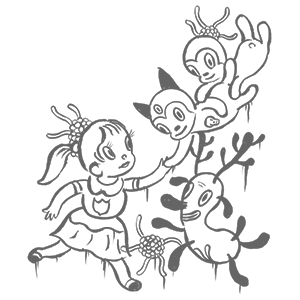
Gary Baseman (b. 1960) is a contemporary artist who works in various creative fields, including illustration, fine art, toy design, and animation. He is the creator of the Emmy-winning ABC/Disney cartoon series, ‘Teacher’s Pet,’ and the artistic designer of ‘Cranium,’ a popular board game.
Baseman’s aesthetic combines iconic pop art images, pre- and post-war vintage motifs, cross-cultural mythology and literary and psychological archetypes. He is noted for his playful, devious and cleverly named creatures, which recur throughout his body of work. Baseman’s art is frequently associated with the lowbrow pop movement, also known as pop surrealism.
read more »
Posted in Art, Games, Humor |
Leave a Comment »
May 8, 2013

‘Colorless green ideas sleep furiously‘ is a sentence composed by linguist Noam Chomsky in his 1957 book ‘Syntactic Structures’ as an example of a sentence that is grammatically correct, but semantically nonsensical. The term was originally used in his 1955 thesis ‘Logical Structures of Linguistic Theory.’
Although the sentence is grammatically correct, no obvious understandable meaning can be derived from it, and thus it demonstrates the distinction between syntax (linguistic rules) and semantics (symbolic meaning). As an example of a category mistake (a property is ascribed to a thing that could not possibly have that property), it was used to show inadequacy of the then-popular probabilistic models of grammar, and the need for more structured models.
read more »
Posted in Games, Language, Philosophy |
1 Comment »


 The Daily Omnivore