May 6, 2013

A rebus [ree-buhs] is an allusional device that uses pictures to represent words or parts of words. It was a favorite form of heraldic expression used in the Middle Ages to denote surnames, for example in its basic form three salmon fish to denote the name ‘Salmon.’
A more sophisticated example was the rebus of Bishop Walter Lyhart of Norwich, consisting of a stag (or hart) lying down in a conventional representation of water. The composition alludes to the name, profession or personal characteristics of the bearer, and speaks to the beholder ‘Non verbis, sed rebus’ (Latin: ‘not by words but by things’).
read more »
Posted in Games, Humor, Language |
Leave a Comment »
April 17, 2013

Booji Boy is a character created in the early 1970s by American New Wave band Devo. The name is pronounced ‘Boogie Boy’—the strange spelling resulted when the band was using Letraset to produce captions for a film, and ran out of the letter ‘g.’ When the ‘i’ was added but before the ‘e,’ Devo lead singer Mark Mothersbaugh reportedly remarked that the odd spelling ‘looked right.’
Booji Boy has traits of a simian child and typically wears an orange nuclear protection suit. He is portrayed by Mothersbaugh in a mask and is the son of another fictitious Devo character, General Boy. The intent of the figure is to satirize infantile regression in Western culture, a quality Devo enjoyed elucidating. This character was officially introduced in the 1976 short film ‘The Truth About De-Evolution.’
read more »
Posted in Art, Games, Humor |
Leave a Comment »
April 10, 2013
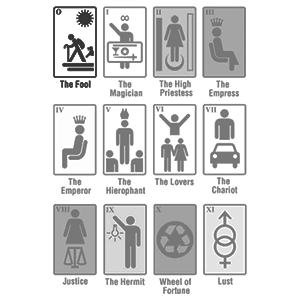
The Fool or The Jester is one of the 78 cards in a Tarot deck; it is in a suit of 22 trump cards called the ‘Major Acana.’ In many esoteric systems of interpretation, The Fool is usually interpreted as the protagonist of a story, and the Major Arcana is the path he takes through the great mysteries of life and the main human archetypes.
This path is known traditionally in Tarot as the ‘Fool’s Journey,’ and is frequently used to introduce the meaning of Major Arcana cards to beginners. The Fool is considered either the XXII or the 0 card in the suit, the highest or lowest trump). Traditionally, the Major Arcana in Tarot cards are numbered with Roman numerals. The Fool is numbered with the zero, an Arabic numeral.
read more »
Posted in Games, Philosophy |
1 Comment »
April 10, 2013
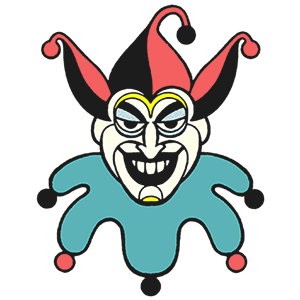
The Joker is a special type of playing card found in most modern decks, or else a type of tile in some Mahjong game sets, specifically used in the American version of Mahjong. It is believed that the term ‘Joker’ comes from ‘Jucker,’ the original German spelling of ‘Euchre,’ (a trick-taking card game for which the Joker card was invented).
The card was originally introduced in about 1860 to be used as the highest trump. Catherine Perry Hargrave documents jokers from 1862 and 1865 in her book ‘A History of Playing Cards.’ The 1862 card has a tiger on it and the label ‘Highest Trump,’ while the one from 1865 is inscribed ‘This card takes either Bower’ and ‘Imperial Bower,’ or ‘Highest Trump Card.’
read more »
Posted in Games, Humor, Language |
1 Comment »
March 28, 2013
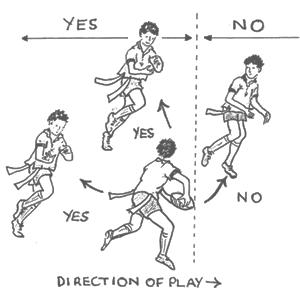
In American football, a lateral pass or lateral, officially backward pass (onside pass in Canadian football), occurs when the ball carrier throws the football to any teammate behind him or directly next to him (i.e. on or behind a line running through the ball and parallel to the line of scrimmage). A lateral pass is distinguished from a forward pass, in which the ball is thrown forward, towards the opposition’s end zone. In a lateral pass the ball is not advanced, but unlike a forward pass a lateral may be attempted from anywhere on the field by any player to any player at any time.
While the forward pass is an invention of the North American game, the lateral and backward pass is also a part of rugby union and rugby league, where such passes are much more common. Compared to its use in rugby, laterals and backward passes are less common in North American football, due to a much greater focus on ball control in American football strategy; they are most commonly used by the quarterback, after taking the snap, to quickly transfer (‘pitch’) the ball a short distance to a nearby running back (or, rarely, wide receiver) on a rushing play. Laterals are also often seen as part of a last-minute desperation strategy or as part of a trick play.
read more »
Posted in Games, World |
Leave a Comment »
March 28, 2013
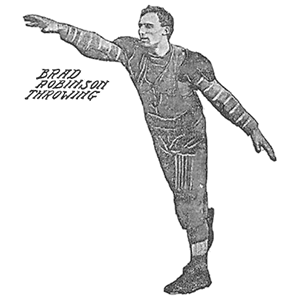
In several forms of football a forward pass is a throwing of the ball in the direction that the offensive team is trying to move, towards the defensive team’s goal line. The forward pass is one of main differences between gridiron football (American football and Canadian football) in which the play is legal and widespread, and rugby football (union and league) from which the North American games evolved, in which the play is illegal.
In some football codes, such as association football (soccer), the kicked forward pass is used so ubiquitously that it is not thought of as a distinct kind of play at all. In these sports, the concept of offside is used to regulate who can be in front of the play or be nearest to the goal. However, this has not always been the case. Some earlier incarnations of football allowed unlimited forward passing, while others had strict offside rules similar to rugby.
read more »
Posted in Games, World |
Leave a Comment »
March 27, 2013

Genetic algorithms are a kind of algorithm used to find approximations in search problems. Genetic algorithms are a class of evolutionary algorithms (algorithms that simulate evolution: each generation of solution is subjected to some kind of fitness function; those that survive are then recombined in some way to make the next generation of solution).
The concept of genetic algorithms is a search technique often used in computer science to find complex, non-obvious solutions to algorithmic optimization and search problems. Genetic algorithms are categorized as global search heuristics, and have a wide variety of applications, particularly in generating useful Artificial Intelligence agents in computer games.
read more »
Posted in Games, Technology |
Leave a Comment »
March 21, 2013

The treatment of animals in rodeo has been a source of concern for the industry, the public, and the law for decades. Protests were first raised in the 1870s, and, in the middle twentieth century, laws were enacted to curb events using animals. The American Humane Association (AHA) has worked with the rodeo industry (specifically, the PRCA, Professional Rodeo Cowboys Association) to establish rules improving animal treatment in rodeo and the treatment of rodeo animals. Today, animal cruelty complaints in rodeo are still very much alive, and continue to be a source of aggravation to the rodeo industry.
The PRCA (which governs about a third of the rodeos conducted in the United States annually) has provided rules for its members regarding animal welfare. Some locals have banned the use of certain rodeo tack (equipment worn by an animal) including flank straps (also called ‘bucking straps,’ irritants which encourage bucking) and certain events such as steer tripping (roping). Some charreada (amateur Mexican-American rodeo) events staged in the United States saw a crack down in the early years of the twenty-first century.
read more »
Posted in Games, Money, Politics |
1 Comment »
March 21, 2013

Mutton busting is an event held at rodeos similar to bull riding or bronc riding, in which children ride or race sheep. In the event, a sheep is held still, either in a small chute or by an adult handler while a child is placed on top in a riding position. Once the child is seated atop the sheep, the sheep is released and usually starts to run in an attempt to get the child off.
There are no set rules for mutton busting, no national organization, and most events are organized at the local level. The vast majority of children participating in the event fall off in less than 8 seconds. Organizations such as the ASPCA discourage the practice on the grounds that it does not promote kindness to, or respect of, animals.
Posted in Games, Humor |
Leave a Comment »
March 18, 2013

The World Sauna Championships were an annual endurance contest held in Heinola, Finland, from 1999 to 2010. They originated from unofficial sauna-sitting competitions that resulted in a ban from a swimming hall in Heinola. The Championships were first held in 1999 and grew to feature contestants from over 20 countries.
Sauna bathing at extreme conditions is a severe health risk: all competitors competed at their own risk, and had to sign a form agreeing not to take legal action against the organizers. Notably, the Finnish Sauna Society strongly opposed the event. After the death of one finalist and near-death of another during the 2010 championship, the organizers announced that they would not hold another event. This followed an announcement by prosecutors that the organizing committee would not be charged for negligence, as their investigation revealed that the contestant who died may have used painkillers and ointments that were forbidden by the organizers.
read more »
Posted in Death, Games, World |
Leave a Comment »
March 18, 2013

Urban vinyl is a type of designer toy, featuring action figures in particular which are usually made of vinyl. Although the term is sometimes used interchangeably with the term designer toy, it is more accurately used as a modifier: not all designer toys can be considered urban vinyl, while urban vinyl figures are necessarily designer toys, by virtue of the way in which they are produced.
Like designer toys in general, urban vinyl figures feature original designs, small production numbers, and are marketed to collectors, predominantly adults. The urban vinyl trend was initiated by artist Michael Lau, who first created urban vinyl figures in Hong Kong in the late 1990s. Other creators of urban vinyl figures are Japanese artist and designer Takashi Murakami, Australian designer Nathan Jurevicius’s ‘Scarygirl,’ based on characters from his comic of the same name, and produced in conjunction with Hong Kong company Flyingcat, and former graffiti artist KAWS.
read more »
Posted in Art, Games |
Leave a Comment »
March 15, 2013

Bullet time is a special and visual effect that refers to a digitally enhanced simulation of variable-speed (i.e. slow motion, time-lapse). It is characterized both by its extreme transformation of time (slow enough to show normally imperceptible and unfilmable events, such as flying bullets) and space (by way of the ability of the camera angle—the audience’s point-of-view—to move around the scene at a normal speed while events are slowed).
This is almost impossible with conventional slow-motion, as the physical camera would have to move impossibly fast; the concept implies that only a ‘virtual camera,’ often illustrated within the confines of a computer-generated environment such as a virtual world or virtual reality, would be capable of ‘filming’ bullet-time types of moments. Technical and historical variations of this effect have been referred to as time slicing, view morphing, slow-mo, temps mort, and virtual cinematography.
read more »
Posted in Art, Games, Technology |
Leave a Comment »


 The Daily Omnivore