November 7, 2012
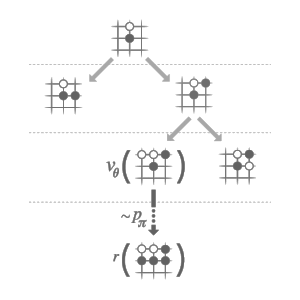
Go is a board game for two players that originated in China more than 2,500 years ago. The game is noted for being rich in strategy despite its relatively simple rules. According to chess master Edward Lasker: ‘The rules of Go are so elegant, organic, and rigorously logical that if intelligent life forms exist elsewhere in the universe, they almost certainly play Go.’
The two players alternately place black and white playing pieces, called ‘stones,’ on the vacant intersections (called ‘points’) of a grid of 19×19 lines. The object of the game is to use one’s stones to surround a larger total area of the board than the opponent.
read more »
Posted in Games, World |
Leave a Comment »
November 5, 2012

A shareholder rights plan, colloquially known as a ‘poison pill,’ is a type of defensive tactic used by a corporation’s board of directors against a takeover. There are a number of such tactics, referred to as ‘shark repellents’ generally. In the field of mergers and acquisitions, shareholder rights plans were devised in the early 1980s as a way for directors to prevent takeover bidders from negotiating a price for sale of shares directly with shareholders, and instead forcing the bidder to negotiate with the board.
Shareholder rights plans are unlawful without shareholder approval in many jurisdictions such as the United Kingdom, frowned upon in others such as throughout the European Union, and lawful if used ‘proportionately’ in others, including Delaware in the United States. They are controversial because they hinder an active market for corporate control. Further, giving directors the power to deter takeovers puts directors in a position to enrich themselves, as they may effectively ask to be compensated for the price of consenting to a takeover.
read more »
Posted in Games, Money, Politics |
Leave a Comment »
October 29, 2012
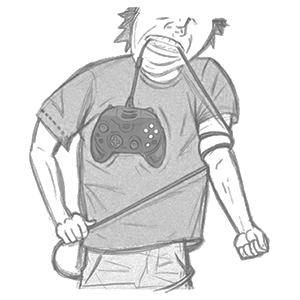
Video games addiction is use of computer and video games to make life bearable. Instances have been reported in which users play compulsively, isolating themselves from family and friends or from other forms of social contact, and focus almost entirely on in-game achievements rather than other life events, and exhibit lack of imagination and mood swings. There is no formal diagnosis of video game addiction in current medical or psychological literature.
Inclusion of it as a psychological disorder has been proposed and rejected for the next version of the Diagnostic and Statistical Manual of Mental Disorders (DSM). However, some scholars suggest the effects (or symptoms) of video game overuse may be similar to those of other proposed psychological addictions. Video game overuse may be like compulsive gambling, an impulse control disorder.
read more »
Posted in Games, Health |
2 Comments »
October 29, 2012
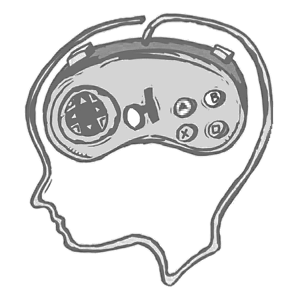
Game brain is a term coined by Japanese physiologist Akio Mori referring to the long term effects of video games on the human brain. Mori originally coined the term and presented the concept in his 2002 book ‘The Terror of Game Brain.’ Mori performed an experiment at Tokyo’s Nihon University designed to measure the effect of video games on human brain activity by examining beta waves (brainwaves associated with normal waking consciousness).
Mori claims his study revealed that people who spend long periods playing video games have reduced activity in the brain’s pre-frontal region, which governs emotion and creativity. Mori asserts that side effects can include loss of concentration, an inability to control temper, and problems socializing or associating with others. His theory has gained some recognition in popular culture, especially among parents who believe that video gaming can have detrimental effects on child development.
read more »
Posted in Games, Health, World |
Leave a Comment »
October 29, 2012

Finite and Infinite Games is a book by religious scholar James P. Carse. With this philosophy text, Carse demonstrates a way of looking at actions in life as being a part of at least two types of what he describes as ‘games,’ finite and infinite. Both games are played within rules, as agreed upon by the participants; however, the meaning of the rules are different between the two types of games.
The book stresses a non-serious (or ‘playful’) view of life on the part of ‘players,’ referring to their choices as ‘moves,’ and societal constructs and mores as ‘rules’ and ‘boundaries.’ He regularly employs familiar terms in specialized ways, but casts them as associated with finite or infinite play & players. Boundaries are ‘rules’ that one must stay within when playing a finite game, in contrast with horizons, which move with the player, and are constantly changing as he or she ‘plays.’ In short, a finite game is played with the purpose of winning (thus ending the game), while an infinite game is played with the purpose of continuing the play.
read more »
Posted in Games, Philosophy |
1 Comment »
October 29, 2012

Gamification is the use of game mechanics and game design techniques in non-game contexts. Typically gamification applies to non-game applications and processes, in order to encourage people to adopt them, or to influence how they are used.
Gamification’s proponents argue that it works by making technology more engaging, by encouraging users to engage in desired behaviors, by showing a path to mastery and autonomy, by helping to solve problems and being more engaging, and by taking advantage of humans’ psychological predisposition to engage in gaming. Available data from gamified websites, applications, and processes indicate potential improvements in areas such as user engagement, ROI, data quality, timeliness, and learning.
read more »
Posted in Education, Games, Money |
Leave a Comment »
October 29, 2012
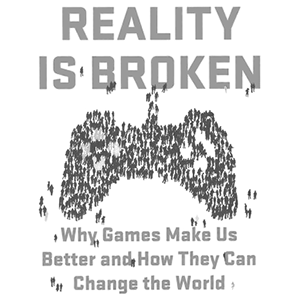
Game studies or ‘gaming theory’ is an academic discipline that deals with the critical study of games. More specifically, it focuses on game design, players, and their role in society and culture.
Game studies is an interdisciplinary field with researchers and academics from a multitude of other areas such as computer science, psychology, sociology, anthropology, philosophy, arts and literature, media studies, communication, theology, and more. Like other media disciplines, such as television studies and film studies, game studies often involves textual analysis and audience theory. Game studies tends to employ more diverse methodologies than these other branches, however, drawing from both social science and humanities approaches.
read more »
Posted in Education, Games, Technology |
1 Comment »
October 29, 2012
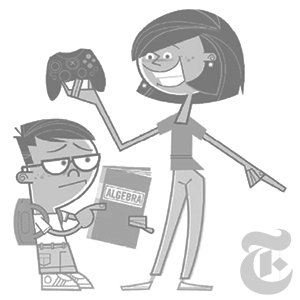
Numerous researchers have proposed potential positive effects of video games on aspects of social and cognitive development and psychological well-being. It has been shown that action video game players have better hand-eye coordination and visuo-motor skills, such as their resistance to distraction, their sensitivity to information in the peripheral vision and their ability to count briefly presented objects, than non-players.
With the development of the PlayStation Move, Kinect and Wii, video games can also help develop motor skills through full body movement. Video games also develop the individual’s intelligence, and in social games develop the social capabilities of the individual. Another way in which the usage of video games might provide a benefit is in the relief of stress.
read more »
Posted in Education, Games, Health |
1 Comment »
October 29, 2012
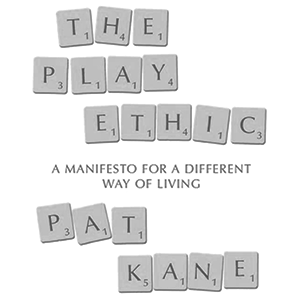
‘Everything Bad Is Good for You: How Today’s Popular Culture Is Actually Making Us Smarter’ is a non-fiction book written by American popular science author Steven Berlin Johnson.
Published in 2005, it is based upon Johnson’s theory that popular culture – in particular television shows and video games – has grown more complex and demanding over time and is improving the society within terms of intelligence and idea. The book’s claims, especially related to the proposed benefits of television, drew media attention.
read more »
Posted in Games, Health, Technology |
2 Comments »
October 18, 2012

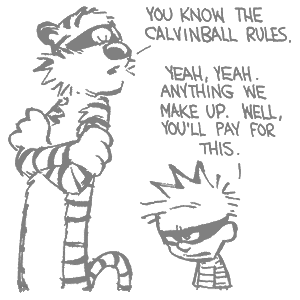
Calvinball is a game played by Calvin and Hobbes as a rebellion against organized team sports; according to Hobbes, ‘No sport is less organized than Calvinball!’ The game was first introduced to the readers at the end of a 1990 storyline involving Calvin reluctantly joining recess baseball. It quickly became a staple of the comic afterwards.
The only hint at the true creation of the sport ironically comes from the last Calvinball strip, in which a game of football quickly devolves into a game of Calvinball. Calvin remarks that ‘sooner or later, all our games turn into Calvinball,’ Calvin and Hobbes usually play by themselves, although in one storyline Rosalyn (Calvin’s babysitter) plays in return for Calvin doing his homework, and plays very well once she realizes that the rules are made up on the spot.
read more »
Posted in Games, Humor |
Leave a Comment »
October 18, 2012
Nomic is a game created in 1982 by philosopher Peter Suber in which the rules of the game include mechanisms for the players to change those rules, usually beginning through a system of democratic voting. According to Suber, the primary activity of Nomic is proposing changes in the rules, debating the wisdom of changing them in that way, voting on the changes, deciding what can and cannot be done afterwards, and doing it. Even this core of the game, of course, can be changed.’
The term ‘nomic’ actually refers to a large number of games based on the initial ruleset laid out by Suber in his book ‘The Paradox of Self-Amendment. The game is in some ways modeled on modern government systems. It demonstrates that in any system where rule changes are possible, a situation may arise in which the resulting laws are contradictory or insufficient to determine what is in fact legal. Because the game models (and exposes conceptual questions about) a legal system and the problems of legal interpretation, it is named after ‘nomos,’ the Greek word for ‘law.’
read more »
Posted in Games, Philosophy, Politics |
Leave a Comment »
October 18, 2012

Metagaming is a broad term usually used to define any strategy, action or method used in a game which transcends a prescribed ruleset, uses external factors to affect the game, or goes beyond the supposed limits or environment set by the game. Another definition refers to the game universe outside of the game itself. In simple terms, it is the use of out-of-game information or resources to affect one’s in-game decisions.
The term metagame arose in mathematics, passed to military use, and then to politics to describe actions or events that may have been originally thought of as outside the bounds of the situation in question, but that in fact play an important role in its outcome. For example, a specific military operation could be thought of as a game, with the political ramifications of that operation on the war in general as the metagame.
read more »
Posted in Games, Money, Politics |
Leave a Comment »


 The Daily Omnivore