October 18, 2012

Cheating in video games involves a player using non-standard methods for creating an advantage beyond normal gameplay, usually to make the game easier. Cheats sometimes may take the form of ‘secrets’ placed by game developers themselves. Cheats may be activated from within the game itself (‘cheat code’ implemented by the original game developers); or created by third-party software (‘game trainer’) or hardware (‘cheat cartridge’).
They can also be realized by exploiting software bugs. Cheating in video games has existed for almost their entire history. The first cheat codes were put in place for play testing purposes. Playtesters had to rigorously test the mechanics of a game and introduced cheat codes to make this process easier. An early cheat code can be found in ‘Manic Miner,’ where typing ‘6031769’ (based on developer Matthew Smith’s driving licence) enables the cheat mode.
read more »
Posted in Games, Humor, Technology |
Leave a Comment »
October 18, 2012

Gaming etiquette refers to the norms adopted while playing multi-player video games. While specific genres and games have their own accepted rules of conduct, some of these rules are universal across almost all games. Regardless of the game, certain behaviors are universally encouraged or discouraged.
Cheating is almost never acceptable unless all players agree it should be allowed, as it causes the game to become unfair and detracts from the enjoyment of legitimate players.
read more »
Posted in Games |
Leave a Comment »
October 17, 2012

‘A Rape in Cyberspace, or How an Evil Clown, a Haitian Trickster Spirit, Two Wizards, and a Cast of Dozens Turned a Database into a Society’ is an article written by freelance journalist Julian Dibbell and first published in ‘The Village Voice in 1993.’ The article was later included in Dibbell’s book ‘My Tiny Life’ on his experience at LambdaMOO (a text-based online virtual reality system to which multiple users are connected at the same time).
Technology advocate Lawrence Lessig has said that his chance reading of Dibbell’s article was a key influence on his interest in the field. Sociologist David Trend called it ‘one of the most frequently cited essays about cloaked identity in cyberspace.’
read more »
Posted in Games, Sex, Technology |
Leave a Comment »
October 17, 2012

Virtual crime or in-game crime refers to a virtual criminal act that takes place in a massively multiplayer online game (MMOG), usually an MMORPG. The huge time and effort invested into such games can lead online ‘crime’ to spill over into real world crime, and even blur the distinctions between the two.
Some countries have introduced special police investigation units to cover such ‘virtual crimes.’ South Korea is one such country and looked into 22,000 cases in the first six months of 2003. Several interpretations of the term ‘virtual crime’ exist. Some legal scholars opt for a definition based on a report on what was the first prominent case, a ‘rape in cyberspace.’
read more »
Posted in Games, Politics, Technology |
Leave a Comment »
October 17, 2012
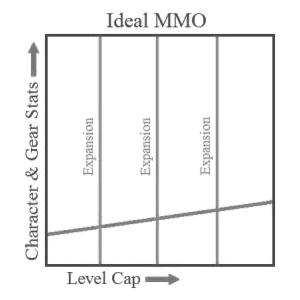
Mudflation, from MUD (multi-user dungeon) and inflation, is an economic issue that exists only in massively multiplayer online games. Mudflation occurs when future additions to (or even just continued operation of) a game causes previously acquired resources to decline in value. This can take many forms and have many causes, including new items introduced by an expansion pack, fundamental imbalances in the in-game economy, or even spread of information that allows a previously rare resource to be acquired more easily.
The term mudflation became popular during the height of the MMORPG EverQuest’s dominance, coming into common usage after the release of the ‘Ruins of Kunark’ (2000) expansion. The term originated many years prior with MUDs, the text based forerunner of MMORPGs, that also suffered from the same currency supply problems.
read more »
Posted in Games, Money, Technology |
1 Comment »
October 17, 2012

Gold farming is playing a massively multiplayer online game to acquire in-game currency that other players purchase in exchange for real-world money. People in China and in other developing nations have held full-time employment as gold farmers.
While most game operators expressly ban the practice of selling in-game currency for real-world cash, gold farming is lucrative because it takes advantage of economic inequality and the fact that much time is needed to earn in-game currency. Rich, developed country players, wishing to save many hours of playing time, may be willing to pay substantial sums to the developing country gold farmers. In 2009 the global market for gold farming was valued at around $3 billion annually.
read more »
Posted in Games, Money, Politics |
Leave a Comment »
October 17, 2012
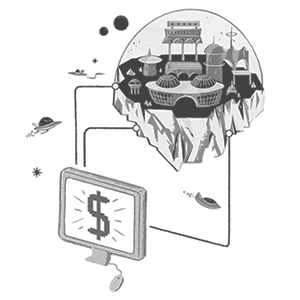
A virtual economy (or sometimes synthetic economy) is an emergent economy existing in a virtual persistent world, usually exchanging virtual goods in the context of an Internet game. People enter these virtual economies for recreation rather than necessity, which means that virtual economies lack the aspects of a real economy that are not considered to be ‘fun’ (for instance, players in a virtual economy often do not need to buy food in order to survive, and usually do not have any biological needs at all). However, some people do interact with virtual economies for ‘real’ economic benefit.
Virtual economies arise in numerous platforms. Multi-User Dungeons (MUDs) are text-based games that predate the World Wide Web. The largest virtual economies are in massively multi-player online role-playing games (MMORPGs). Virtual economies also exist in life simulation games which may have taken the most radical steps toward linking a virtual economy with the real world. For example, in ‘Second Life’ there is recognition of intellectual property rights for assets created ‘in-world’ by subscribers, and a laissez-faire policy on the buying and selling of ‘Linden Dollars’ (the world’s official currency) for real money on third party websites.
read more »
Posted in Games, Money, Technology |
Leave a Comment »
October 17, 2012

Virtual goods are non-physical objects purchased for use in online communities or online games. ‘Digital goods,’ on the other hand, may be a broader category including digital books, music, and movies.
Virtual goods have no intrinsic value and are intangible by definition. Including digital gifts and digital clothing for avatars, virtual goods may be classified as services instead of goods and are usually sold by companies that operate social networks, community sites, or online games. Sales of virtual goods are sometimes referred to as microtransactions, and the games that utilize this model are usually referred to as ‘freemium’ (free + premium) games.
read more »
Posted in Games, Money, Technology |
Leave a Comment »
October 10, 2012

Freestyle is a style of a cappella rap, with instrumental beats, in which rap lyrics are improvised, i.e. performed with no previously composed lyrics, or ‘off the top of the head.’ It is similar to other improvisational music such as jazz – Myka 9 of Freestyle Fellowship describes it as being ‘like a jazz solo’ where there is a lead saxophonist acting as the improviser and the rest of the band providing the beat. Rap battles are sometimes improvised in this way.
It is similar in both form and function to the ancient practice of flyting (contest consisting of the exchange of insults). Originally, in old school hip hop of the 1980s, the term ‘freestyle’ referred to a pre-written rap verse that was not on any particular subject matter, but rather was written for the purpose of demonstrating skill. The term is still occasionally used in this way, though since the 1990s, the majority of today’s artists use it to mean improvised rapping.
read more »
Posted in Art, Games, Language |
Leave a Comment »
October 10, 2012

The Dozens is a game of spoken words between two contestants, common in Hip-hop/Urban communities, where participants insult each other until one gives up or violence erupts. It is customary for the Dozens to be played in front of an audience of bystanders, who encourage the participants to reply with more egregious insults to heighten the tension and consequently, to be more interesting to watch. It is also known as ‘sounding,’ ‘joning,’ ‘woofing,’ ‘sigging,’ or ‘signifying,’ while the insults themselves are known as ‘snaps.’
The origin of the game is unclear, but it has roots in Africa: similar contests are held in Nigeria among the Igbo people, and in Ghana. Comments in the game focus on the opposite player’s intelligence, appearance, competency, social status, financial situation, and disparaging remarks about the other player’s family members—mothers in particular (‘yo′ mama…’)—are common. Commentary is often related to sexual issues, where the game is then referred to as the ‘Dirty Dozens.’
read more »
Posted in Games, Humor, Language |
Leave a Comment »
October 10, 2012

A roast is an event, almost exclusively in the United States, in which an individual is subjected to a public presentation of comedic insults, praise, outlandish true and untrue stories, and heartwarming tributes, the implication being that the roastee is able to take the jokes in good humor and not as serious criticism or insult, and therefore, show their good nature.
It is seen by some as a great honor to be roasted, as the individual is surrounded by friends, fans, and well-wishers, who can receive some of the same treatment as well during the course of the evening. The party and presentation itself are both referred to as a ‘roast.’ The host of the event is called the ‘roastmaster.’ Anyone who is honored in such a way is said to have been ‘roasted.’
read more »
Posted in Games, Humor, Language |
Leave a Comment »
October 3, 2012


In Broadcast programming, counterprogramming is the practice of offering television programs to attract an audience from another television station airing a major event. The Super Bowl is among the most-viewed programs on American television. Thus, counterprogramming focuses on the pre-game period and the halftime show.
However, it is a common gentlemen’s agreement that the broadcast networks who carry the league’s game coverage (and in turn, other cable networks owned by the broadcasters) never counterprogram the Super Bowl, yielding to the game and airing either low profile reruns of their series or a middling film in the timeslot instead.
read more »
Posted in Games, Money |
Leave a Comment »


 The Daily Omnivore