March 27, 2012

A vacuum bed is a device sometimes used in BDSM (bondage, domination, sadomasochism) play. A person is placed in a latex envelope spanned by a frame and a suction pump or floor vacuum removes most of the air in the envelope. The frame is often a simple rectangle of pierced PVC pipes, joined by PVC joints. There are several ways that the vacuum bed can be designed to facilitate breathing. The most common is a tube running from outside of the vacuum bed into the person’s mouth. A second option is a reinforced hole that is positioned so that the mouth protrudes. A third option is a reinforced gasket through which one forces the entire head. Incorporating a related fetish, some vacuum beds use a gas mask to facilitate respiration.
The vacuum bed is both a bondage and sensation device. The user is unable to move significantly (although some wiggling is possible), and is unable to speak or see, depending on the breathing hole used. In addition, though, the sensation of the vacuum bed itself, as well as any other play (stroking, percussion, vibrations) are quite pleasurable, and some are much more intense than what would be experienced without the vacuum bed. The vacuum bed must be used with the aid of another person, as the user cannot control the vacuum itself, nor escape the vacuum bed unaided.
Posted in Games, Money, Sex |
Leave a Comment »
March 27, 2012

Inkie is a London based painter and street artist, originally from Bristol. He is cited as being part of Bristol’s graffiti heritage, along with Banksy, 3D and Nick Walker. Inkie began working as part of Crime Incorporated Crew (CIC) in 1983, along with Felix and Joe Braun. He was one of many arrested in 1989 during ‘Operation Anderson,’ the UK’s largest ever graffiti bust. He arranged 1998’s ‘Walls On Fire’ event with Banksy, on the site of the future At-Bristol center.
He has subsequently worked in the video game industry, including some time as head of creative design at Sega, where his work featured in ‘Jet Set Radio.’ Inkie was one artist present to do live painting at the launch of Banksy’s book ‘Bristol: Home Sweet Home.’ Inkie has likened the time spent training as a graffiti artist to that of classical musicians.
Posted in Art, Games, World |
Leave a Comment »
March 27, 2012
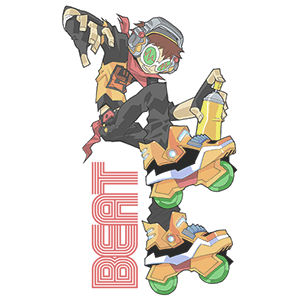
Jet Set Radio Future is a video game developed by Smilebit and the sequel to ‘Jet Set Radio’ (also known as ‘Jet Grind Radio’). It was published by Sega in 2002 in the US, near the beginning of the Xbox’s lifespan. Similar to the original, it depicts a future Tokyo where freedom of expression is outlawed. The user plays a character in the GG’s, a gang of in-line skating graffiti artists who skate around Tokyo covering up rival gangs’ graffiti, knocking over Rokkaku police, and dancing to the eclectic soundtrack.
The game uses a cel-shaded style of animation, and has been widely acclaimed for its unique music style, detailed art, and gameplay. The soundtrack introduces artists that are either foreign, not found mainstream, or work under gaming licenses such as Guitar Vader, BS 2000 (the side project of Adrock of the Beastie Boys), Hideki Naganuma, Scapegoat Wax, The Latch Brothers (including Mike D of the Beastie Boys, Richard Jacques, Chris ‘Wag’ Wagner and Kenny Tick Salcido), Cibo Matto, and The Prunes.
Posted in Art, Games, World |
Leave a Comment »
March 26, 2012

Fishing with John is a 1991 television series conceived, directed by and starring actor and musician John Lurie, which earned a cult following. On the surface, the series resembles a standard travel or fishing show: in each episode, Lurie takes a famous guest on a fishing expedition.
Since Lurie has no expert knowledge of fishing, the interest is in the interaction between Lurie and his guests, all of whom are his friends. Nothing particularly unusual actually happens, but the show is edited and narrated in a way to suggest that Lurie and his guest are involved in dramatic and even supernatural adventures. Guests included Jim Jarmusch, Matt Dillon, Tom Waits, Willem Dafoe, and Dennis Hopper. Each episode has voice-over narration by Robb Webb, which is sometimes bizarre and off-topic. The soundtrack is by Lurie, with several guest performers.
Posted in Food, Games, Humor |
1 Comment »
March 26, 2012

The World Pyro Olympics is an annual competition amongst the most prestigious fireworks companies in the world. The event is one of the largest and most intense international fireworks competitions of the world. The World Pyro Olympics runs through a period of five consecutive days allowing locals and tourists alike to experience the greatest fireworks display in the world.
Two countries fire each day; the last participant fires on the final evening of the event. The host of the event does not participate in the competition but performs a fireworks display on the last night. Awards, such as the People’s Choice, are given out after the exhibition. The crowning of the World Pyro Olympics Champion ends the event.
Posted in Games, Money, World |
Leave a Comment »
March 26, 2012

The World Fireworks Championship is one of the largest pyrotechnic competitions in the world. It takes place annually over three weeks in December and features separate fireworks displays from six international pyrotechnic production companies. Competitors come from all over the globe, with participating teams providing a 25 minute long ‘pyromusical’ show for the attending crowds.
At the end of each display, a score is awarded by a team of four international judges. By the tournament’s conclusion, the competitor with the highest score is presented with the Winner’s Trophy, which is made from solid gold. The design of the trophy is influenced by the host city taking part. As all of the firework displays are synchronized to music, each display is broadcast over the host city’s local radio stations. The host city does not take part in the displays but provides the setting for the closing ceremony and winner’s banquet.
Posted in Games, Money, World |
Leave a Comment »
March 24, 2012
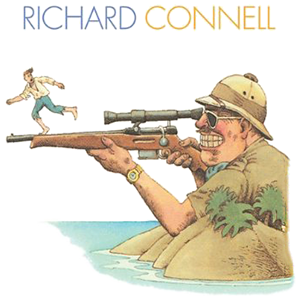
‘The Most Dangerous Game,’ also published as “The Hounds of Zaroff”, is a short story by Richard Connell. It was published in ‘Collier’s Weekly’ in 1924. Widely anthologized, and the author’s best-known work, it features as its main character a big-game hunter from New York, who falls off a yacht and swims to an isolated island in the Caribbean, where he is hunted by a Cossack aristocrat. The story is an inversion of the big-game hunting safaris in Africa and South America that were fashionable among wealthy Americans in the 1920s.
The story has been adapted for film numerous times. The most significant of these adaptations (and the only one to use the original characters) was RKO’s ‘The Most Dangerous Game,’ released in 1932, having been shot (mostly at night) on sets used during the day for the ‘Skull Island’ sequences of ‘King Kong.’ The film added two other principal characters: brother and sister pair Eve Trowbridge (Fay Wray) and Martin Trowbridge (Robert Armstrong). (Wray and Armstrong were also filming King Kong on the same sets during the day.)
read more »
Posted in Death, Games, Language |
Leave a Comment »
March 24, 2012
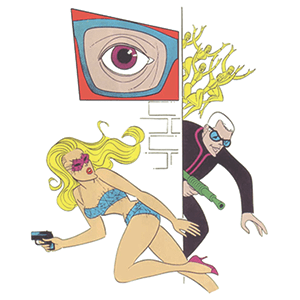
The 10th Victim (Italian: ‘La decima vittima’) is a 1965 Italian/French international co-production science fiction film directed by Elio Petri. It is based on Robert Sheckley’s 1953 short story ‘Seventh Victim.’ Sheckley later published a novelization of the film in 1966. In the near future, big wars are avoided by giving individuals with violent tendencies a chance to kill in the ‘Big Hunt.’ The Hunt is the most popular form of entertainment in the world and also attracts participants who are looking for fame and fortune. It includes ten rounds for each competitor, five as the hunter and five as the victim. The survivor of ten rounds becomes extremely wealthy and retires.
Scenes switch between the pursuit, romance between the hunter and the victim, and a narrator explaining the rules and justification of the Hunt. Caroline Meredith (Ursula Andress) is the huntress armed with a high caliber Bosch shotgun looking for her tenth victim. Marcello Poletti (Marcello Mastroianni) is the victim. He is reluctant to kill Meredith as he is not sure whether she is his hunter, but then later because they become romantically involved. To maximize financial gain, Meredith wants to get a perfect kill in front of the cameras as she has negotiated a major sponsor from the Ming Tea Company.
Posted in Art, Games, Money |
Leave a Comment »
March 24, 2012
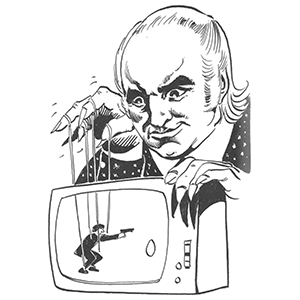
The Prize of Peril is a science fiction short-story by Robert Sheckley, written in 1958 and first published in the collection ‘Store of Infinity’ in 1960 by Bantam Books. The short story is noted for its plot’s anticipation of Reality television shows such as Survivor and Fear Factor by several decades. The screenplay for the fake German reality show ‘Das Millionenspiel’ (‘The Million Game’) was based on the story, as was the French film version of ‘Das Millionenspiel,’ ‘Le prix du danger.’ The protagonist of the story is Jim Raeder, a man only notable due to his normality, who has been a participant in many reality television-shows (given the name ‘thrill shows’) and thus become a celebrity.
In all the shows the risk of dying has been a part of the concept; he has fought a real bull in Spain, he has driven a Formula 1-car, and fought with other divers while trying to escape sharks and other sea monsters. In the story he partakes in the greatest of all reality shows; he is to be hunted by professional gangland murderers. As he is hunted, his journey is shown all over the US on TV and he receives help from the viewers; the so called Good Samaritans and the commentator, Mike Terry, makes a point of this during the show: ‘All of America is ready to help Jim!,’ but Raeder soon finds out that things are not what he expected them to be and that maybe his survival is not the main priority among the public. The story ends with Raeder winning The Prize of Peril, but being dragged away after presumably having a mental breakdown, not being ‘himself’ at the moment according to Terry.
Posted in Art, Games, Language |
Leave a Comment »
March 23, 2012


Tilt is a poker term for a state of mental or emotional confusion or frustration in which a player adopts a less than optimal strategy, usually resulting in the player becoming over-aggressive. This term is closely associated with ‘steam’ and some consider the terms equivalent, but ‘steam’ typically indicates more anger and intensity. Placing an opponent on tilt or dealing with being on tilt oneself is an important aspect of poker. It is a relatively frequent occurrence due to frustration, animosity against other players, or simply bad luck. Experienced players recommend learning to recognize that one is experiencing tilt and avoid allowing it to influence one’s play.
The most likely origin of the word ’tilt’ is as a reference to tilting a pinball machine. The frustration from seeing the ball follow a path towards the gap between the flippers can lead to the player physically tilting the machine (in an attempt to guide the ball towards the flippers). However, in doing so, some games will flash the word ‘TILT’ and freeze the flippers, causing the ball to be lost. The metaphor here being over-aggression due to frustration leads to severely detrimental gameplay.
read more »
Posted in Games, Language, Money |
Leave a Comment »
March 23, 2012

Dorodango is a Japanese art form in which earth and water are molded to create a delicate shiny sphere, resembling a marble or billiard ball. The phrase is derived from ‘doro’ (‘mud’) and ‘dango’ (a round dumpling, created from pressed rice flour). Making the basic dorodango is a traditional pastime for school children.
More recently the process has been refined into the art of the ‘hikaru’ (‘shining’) dorodango, which has a glossy or patterned surface. The core of the ball is made of basic mud, and further dusted with finer-grained soil before the water is drawn out through various methods- even sealing the ball inside a plastic bag and letting the water evaporate and then condense. Once the ball is fully tempered and hardened, it is polished by hand and displayed.
Posted in Art, Games, World |
Leave a Comment »
March 19, 2012
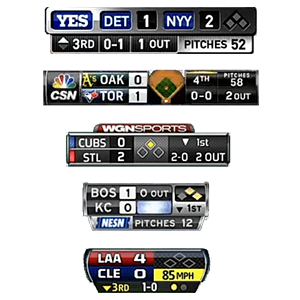
A score bug (or, in an expanded form, a score banner or scorebar) is a digital on-screen graphic which is displayed at either the top or lower third bottom of a television screen during the broadcast of a sports game in order to display the current score and other statistics. The first television network in the United States to produce a score bug (digital on-screen graphic) was ABC, which used one on the telecast of the 1994 Purolator 500 NASCAR event. A transparent digit counted down the number of laps remaining in the race.
ABC also incorporated the Sports Bug for their 1994 World Cup coverage, providing the time and score on the game as well as enabling advertiser sponsorship to broadcast games without interruptions. Later that fall, Fox introduced a full-score bug for its NFL coverage, known as the ‘FoxBox,’ as did cable network ESPN. ABC expanded theirs to ‘Monday Night Football’ in 1997. CBS introduced theirs upon returning to the NFL in the fall of 1998, and NBC in 2001 during its coverage of the XFL.
Posted in Games, Money, Technology |
Leave a Comment »




 The Daily Omnivore