March 16, 2012

Vale tudo [val-ay / too-doe] (Portuguese: ‘anything goes’) are full-contact unarmed combat events, with a limited number of rules, that became popular in Brazil during the 20th century. While Vale Tudo uses techniques from many martial art styles, making it similar to modern mixed martial arts competitions, it is a distinct style in its own right. Fighting sideshows, termed ‘Vale Tudo,’ became popular in Brazilian circuses during the 1920s.
Examples of such bouts were described in the ‘Japanese-American Courier’ in 1928: ‘One report from São Paulo declares that Jiu Jitsu is truly an art and that in an interesting exhibition in the side tent to the big circus a Bahian of monstrous dimensions met his waterloo at the hands of a diminutive Japanese wrestler. The man was an expert at capoeira, an old South American style of fighting, but after putting the Japanese on his back and trying to kick his head … the little oriental by the use of a Jiu Jitsu hold threw the Bahian and after a short struggle he was found sitting on the silent frame of the massive opponent.
read more »
Posted in Games, Money, World |
Leave a Comment »
March 16, 2012

The Gracie challenge was an open invitation issued by some members of the Brazilian Gracie family, known for their Brazilian Jiu-jitsu (BJJ) mastery, to martial artists of other styles to fight them in a Vale tudo (‘anything goes’) match. A precursor to the Ultimate Fighting Championship (UFC), the purpose of these challenges were to prove the effectiveness of the Gracie style of BJJ.
The Gracie challenge was first issued by Carlos Gracie in the 1920s to promote and develop the Gracie’s style of Brazilian Jiu-Jitsu, and as an attempt to show that it was superior to other styles of martial arts. The matches typically featured a smaller Gracie versus a larger and/or more athletic looking opponent, and became increasingly popular. Carlos and later his brother Hélio Gracie and both of these men’s sons defeated martial artists of many different styles such as boxing, judo, karate, and wrestling, while experiencing few losses.
Posted in Games, World |
1 Comment »
March 16, 2012


Mixed martial arts (MMA) is a full contact combat sport that allows the use of both striking and grappling techniques, both standing and on the ground, including boxing, wrestling, Brazilian jiu-jitsu, muay Thai, kickboxing, taekwondo, karate, judo and other styles. The roots of modern mixed martial arts can be traced back to the ancient Olympics where one of the earliest well documented systems of codified full range unarmed combat was utilized in the sport of Pankration.
Various mixed style contests also took place throughout Europe, Japan and the Pacific Rim during the early 1900s. The combat sport of Vale Tudo that had developed in Brazil from the 1920s was brought to the United States by the Gracie family in 1993 with the founding of the Ultimate Fighting Championship (UFC), which is currently the largest MMA promotion company worldwide. Prior to the UFC, professional MMA events had also been held in Japan by Shooto since 1989.
read more »
Posted in Games, Money, Politics |
Leave a Comment »
March 16, 2012
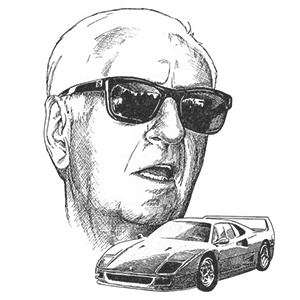
Enzo Ferrari (1898 – 1988) was an Italian race car driver and entrepreneur, the founder of the Scuderia Ferrari Grand Prix motor racing team, and subsequently of the Ferrari car manufacturer.
He was often referred to as ‘il Commendatore.’ Ferrari’s management style was autocratic and he was known to pit driver against driver in the hope of improving performance. He did not often get close to his drivers. Enzo Ferrari spent a reserved life, and rarely granted interviews.
read more »
Posted in Games, Money, Technology |
1 Comment »
March 13, 2012

Thin-slicing is a term used in psychology and philosophy to describe the ability to find patterns in events based only on ‘thin slices,’ or narrow windows, of experience. The term seems to have been coined in 1992 by Nalini Ambady and Robert Rosenthal in a paper in the ‘Psychological Bulletin.’ Many different studies have shown indication that brief observations can be used to assess outcomes, at levels higher than expected by chance. Once comparing these observations of less than five minutes, to greater than five minutes the data showed no significant change, thus implying that observations made within the first few minutes were unchanging.
One of the first series conducted by James Bugental and his colleagues showed that parents expectancies, identified from brief clips of their tone, are related to their children’s behavior process. The tone of a mother with a normal child and the tone of a mother with behavior problems differed significantly. These conceptions provide an underlying basis that there actually is an ability to judge from brief observations. Research in classrooms has shown that judges can distinguish biased teachers from unbiased teachers along with ‘differential teacher expectancies’ simply from brief clips of teachers’ behaviors. Likewise, research in the courtroom has shown that brief experts of judges’ instructors to jurors in trials, raters could predict the judge’s expectations for the trial.
read more »
Posted in Games, Science |
Leave a Comment »
March 13, 2012

A wired glove (sometimes called a dataglove or cyberglove) is an input device for human–computer interaction worn like a glove. Various sensor technologies are used to capture physical data such as bending of fingers. Often a motion tracker, such as a magnetic tracking device or inertial tracking device, is attached to capture the global position/rotation data of the glove. These movements are then interpreted by the software that accompanies the glove, so any one movement can mean any number of things.
Gestures can then be categorized into useful information, such as to recognize Sign Language or other symbolic functions. Expensive high-end wired gloves can also provide haptic feedback, which is a simulation of the sense of touch. This allows a wired glove to also be used as an output device. Traditionally, wired gloves have only been available at a huge cost, with the finger bend sensors and the tracking device having to be bought separately. Wired gloves are often used in virtual reality environments.
read more »
Posted in Games, Money, Technology |
Leave a Comment »
March 13, 2012
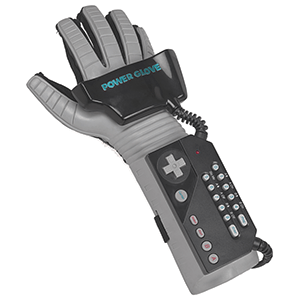
The Power Glove is a controller accessory for the Nintendo Entertainment System, and the first peripheral interface controller to recreate human hand movements on a television or computer screen in real time. The Power Glove was not popular and was criticized for its imprecise and difficult-to-use controls. The Power Glove was originally released in 1989. Though it was an officially licensed product, Nintendo was not involved in the design or release of this accessory. Rather, it was designed by Grant Goddard and Samuel Cooper Davis for Abrams Gentile Entertainment (AGE), made by Mattel in the United States and PAX in Japan.
Additional development was accomplished through the efforts of Thomas G. Zimmerman and Jaron Lanier, a virtual reality pioneer responsible for co-developing and commercializing the DataGlove who had made a failed attempt at a similar design for Nintendo earlier. The Power Glove and DataGlove were based on Zimmerman’s instrumented glove. Zimmerman built the first prototype that demonstrated finger flex measurement and hand position tracking using a pair of ultrasonic transmitters. His original prototype used optical flex sensors to measure finger bending which were replaced with less expensive carbon-based flex sensors by the AGE team.
read more »
Posted in Games, Money, Technology |
Leave a Comment »
March 13, 2012

The Virtual Boy was a video game console developed and manufactured by Nintendo. It was the first video game console that was supposed to be capable of displaying ‘true 3D graphics’ out of the box. Whereas most video games use monocular cues to achieve the illusion of three dimensions on a two-dimensional screen, The Virtual Boy creates an illusion of depth through the effect known as parallax.
In a manner similar to using a head-mounted display, the user looks into an eyepiece made of neoprene on the front of the machine, and then an eyeglass-style projector allows viewing of the monochromatic (in this case, red) image. It was released in 1995 in Japan and North America at a price of around US$180. It met with a lukewarm reception that was unaffected by continued price drops. Nintendo discontinued it the following year.
read more »
Posted in Games, Money, Technology |
Leave a Comment »
March 12, 2012

BarCraft is a portmanteau name for watching ‘StarCraft’ at bars. This phenomenon popped up in the spring of 2011 in the United States, with the start of North American Star League. It is often attributed to Team Liquid user ‘primadog,’ the redditor ‘_Oskar,’ and the Chao Bistro in Seattle. In May 2011, the user o_Oskar posted a topic on reddit saying that on the 11th of that month, people could go to Chao in Seattle to watch that day’s North American Star League games while drinking a few beers and enjoying the company of other ‘StarCraft’ fans.
Since then, the BarCraft phenomenon has grown exponentially, with BarCrafts in the United States, Canada, Sweden, Australia, and many more countries around the world, covering a variety of eSports events, not just StarCraft. New initiatives have recently sprouted from the barcraft trend. Namely, barcrafts have been used to raise money for the charity Child’s Play. Additionally, while not a charity in the strictest sense, One Nation of Gamers -a network of barcrafts composed of volunteers- pools all the money they raise to fund online starcraft tournaments for the community to watch.
Posted in Drugs, Food, Games |
1 Comment »
March 12, 2012

The World Beard and Moustache Championships is a biennial competition in which men with beards and moustaches display lengthy, highly-styled facial hair in several categories which are rated by a panel of judges. The first Championship took place in Höfen-Enz, Germany, in 1990. The 2011 championships were hosted by ‘The Norwegian Moustache Club of 91’ in Trondheim, Norway.
The 12th incarnation of the contest will be in Stuttgart, Germany in 2013 and will be hosted by Belle Moustache Beard and Culture Club. There are 3 brackets of facial hair: Moustache, Partial Beard and Full Beard. Each bracket is broken into individual categories. There are usually 17 categories but there were 18 different categories for the 2009 championships.
Posted in Games, Humor, World |
Leave a Comment »
March 12, 2012

A polymath [pol-ee-math] (Greek: ‘having learned much’) is a person whose expertise spans a significant number of different subject areas. In less formal terms, a polymath (or polymathic person) may simply be someone who is very knowledgeable. Most ancient scientists were polymaths by today’s standards. The common term Renaissance man is used to describe a person who is well educated or who excels in a wide variety of subjects or fields. The concept emerged from the numerous great thinkers of that era who excelled in the arts and sciences, including Leonardo da Vinci, Michelangelo, Galileo Galilei, Copernicus, and Francis Bacon.
The emergence of these thinkers was likewise attributed to the then rising notion in Renaissance Italy expressed by one of its most accomplished representatives, Leon Battista Alberti (1404–1472): that ‘a man can do all things if he will.’ It embodied the basic tenets of Renaissance humanism, which considered humans empowered, limitless in their capacities for development, and led to the notion that people should embrace all knowledge and develop their capacities as fully as possible. Thus the gifted people of the Renaissance sought to develop skills in all areas of knowledge, in physical development, in social accomplishments, and in the arts. The term has since expanded from original usage and has been applied to other great thinkers before and after the Renaissance such as Aristotle, Johann Goethe, and Isaac Newton.
read more »
Posted in Education, Games, Science |
Leave a Comment »
March 11, 2012

Brian Bosworth (b.1965), also known as the “The Boz,” is a former American professional football player. He played college football for the University of Oklahoma, and was a two-time All-American. He played professionally for the NFL’s Seattle Seahawks. In college, he was known for his radical hairstyles and criticism of the NCAA as much as his play on the field. Bosworth was never one to shy from publicity or controversy.
On more than one occasion he referred to the NCAA as the ‘National Communists Against Athletes.’ He wore a shirt bearing that slogan during the 1987 Orange Bowl. Banned from the game because of steroid use, Bosworth unveiled the shirt while standing on the sidelines to the shock and outrage of many, including his own coach, Barry Switzer. While Switzer was known for running a loose ship, this incident was too much even for him, and he threw Bosworth off the team.
read more »
Posted in Games, Money |
2 Comments »




 The Daily Omnivore