March 8, 2012

Game Over is a message in video games which signals that the game has ended, often due to a negative outcome – although the phrase sometimes follows the end credits after successful completion of a game. In certain uses; particularly during conversation, ‘Game Over’ is sometimes shortened to the first two letters: ‘GO’ with each letter pronounced individually. The phrase was used as early as the 1950s in devices such as electromechanical pinball machines, which would light up the phrase with a light bulb.
Before the advent of video game consoles and personal computing, arcades were the predominant platform for playing games which required users to deposit a token or coin into an arcade game machine in order to play. Players would usually be given a finite number of lives (or attempts) to progress through the game which when expended would usually result in the display of the message ‘Game Over’ indicating that the game had ended. The phrase might also be followed by the message ‘Continue?’ and a prompt asking the player to insert additional tokens to prevent the game from terminating and allowing the player to continue their progress.
read more »
Posted in Games, Money, Technology |
1 Comment »
March 5, 2012
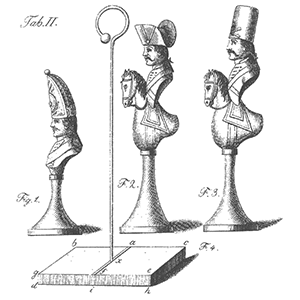
Kriegsspiel [kreeg-speel] (German: ‘wargame’) was a system used for training officers in the Prussian army. The first set of rules was created in 1812 and named ‘Instructions for the Representation of Tactical Maneuvers under the Guise of a Wargame.’ It was originally produced and developed further by Lieutenant Georg Leopold von Reiswitz and his son Georg Heinrich Rudolf von Reiswitz of the Prussian Army. Their system for simulating war was initially based around a specially designed table created for King Friedrich Wilhelm III.
The table divided the game field into a grid system, a core element of many later wargame and roleplaying systems, and included different pre-cast terrain types used in modular combinations, as well as making use of special gaming pieces and dice. The system also included a position called ‘confidant,’ an impartial third party calculating and assessing the moves, analogous to the modern gamemaster or dungeon master.
read more »
Posted in Games, War, World |
Leave a Comment »
March 5, 2012
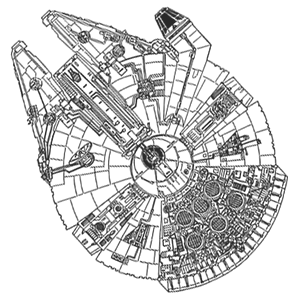
Kitbashing is a practice whereby a new scale model is created by taking pieces out of commercial kits. These pieces may be added to a custom project or to another kit. For professional modelmakers, kitbashing is popular to create concept models for detailing movie special effects. Professionals often kitbash to build prototype parts which are then recreated with lightweight materials. Although it has a long history, kitbashing came to the attention of a wider public via the fine modelwork seen in TV series such as ‘Thunderbirds’ and the films ‘2001: A Space Odyssey’ and ‘Star Wars.’ Many of the spaceship models created for these programs incorporated details from tank, speedboat and car kits. Another example is the Tumbler from the 2005 film ‘Batman Begins.’
An important aspect of kitbashing in model railroading is the reconfiguration of structure kits, most often to fit the geometry of a specific space. Walls can be shortened or lengthened, and/or corner angles changed to fit a given location on the layout. Another application is to use the wall parts to create a ‘flat,’ or shallow relief model to be displayed against the backdrop. For example, since it isn’t needed in this case, the rear wall can be abutted to the front to double the length of the building; usually, but not exclusively, done with industrial structures. Plain sheet styrene or other material is typically added to the rear to strengthen the resulting model.
Posted in Art, Games, Money |
Leave a Comment »
February 28, 2012

Competitive eating is a sport in which participants compete against each other to consume large quantities of food in a short time period. Contests are typically less than 15 minutes in length, with the person consuming the most food being declared the winner. Competitive eating is most popular in the United States and Japan, where organized professional eating contests often offer $10,000 or more in prize money. Competitive eaters are sometimes known as ‘gurgitators,’ a word used by those close to the sport and an assumed opposite of regurgitation.
The chief criticism of competitive eating is the message the gluttonous sport sends in an age of rising obesity levels among Americans and the example it sets for today’s youth. Others contend that competitive eating is an example of Western gluttony at a time when others around the world are starving. Gastroparesis, also known as stomach paralysis, is also a concern among those who routinely stretch their stomachs beyond capacity. The condition may lead to the stomach’s inability to contract and lose its ability to empty itself.
read more »
Posted in Food, Games, Health |
Leave a Comment »
February 27, 2012

Cycle polo is a team sport invented in Ireland in 1891 by retired cyclist Richard J. Mecredy. It is similar to traditional polo, except that bicycles are used instead of horses. In recent years, an alternate form of the game known as ‘Hardcourt Bike Polo’ or ‘Urban Bike Polo’ has grown in popularity. In this variation, teams composed of three to five players compete on tennis courts, street hockey rinks, or whatever other surfaces are available.
The rules vary slightly by city. In the case of a ‘foot down’ or ‘dab’ (touching the ground with one’s foot) the player must ‘tap out’ by riding to mid-court and hitting a designated area with their mallet. There is usually a tap-out located on either side of the court. In order to score, the offensive player must hit the ball across the goal line using the narrow end of the mallet – this is called a ‘shot’ or ‘hit’ – hitting the ball across the goal line with the wide end of the mallet is called a ‘shuffle.’
Posted in Games, Humor |
Leave a Comment »
February 25, 2012

A monofin is a type of swimfin typically used in finswimming and free-diving. It consists of a single surface attached to footpockets for both of the free-diver’s feet. Monofins were introduced in 1972, by a Ukrainian finswimming club, and have been used for finswimming competitions since, allowing monofin swimmers to reach speeds of 12km/h. Monofins can be made of glass fiber or carbon fiber. The diver’s muscle power, swimming style, and the type of aquatic activity the monofin is used for determines the choice of size, stiffness, and materials.
To differentiate between the use of monofins and conventional fins, the latter are sometimes referred to as stereo fins or bi-fins. The monofin swimmer extends arms forward, locking hands together, locking the head between the biceps. The undulating movement starts in the shoulders, with maximum amplitude towards the hips, the legs almost don’t bend to transfer the movement to the monofin. This technique is called the dolphin kick.
Posted in Games, Technology |
Leave a Comment »
February 21, 2012

The Turing test is a test to see if a computer can trick a person into believing that the computer is a person too. Alan Turing thought that if a human could not tell the difference between another human and the computer, then that computer must be as intelligent as a human. No one has made a computer that can pass the Turing test. A chatterbot called Elbot came close in 2008. The test was introduced by Alan Turing in his 1950 paper ‘Computing Machinery and Intelligence,’ which opens with the words: ‘I propose to consider the question, ‘Can machines think?” Since ‘thinking’ is difficult to define, Turing chooses to ‘replace the question by another, which is closely related to it and is expressed in relatively unambiguous words’:
‘Are there imaginable digital computers which would do well in the imitation game?’ (a party game in which a man and a woman go into separate rooms and guests try to tell them apart by writing a series of questions and reading the typewritten answers sent back; both the man and the woman aim to convince the guests that they are the other). This question, Turing believed, is one that can actually be answered. In the remainder of the paper, he argued against all the major objections to the proposition that ‘machines can think.’ In the years since 1950, the test has proven to be both highly influential and widely criticized, and it is an essential concept in the philosophy of artificial intelligence.
read more »
Posted in Games, Language, Technology |
Leave a Comment »
February 21, 2012

‘Slaves to Armok: God of Blood, Chapter II: Dwarf Fortress,’ most commonly known simply as Dwarf Fortress, is a freeware video game by Bay 12 Games for Microsoft Windows, Linux, and Mac OS X set in a high fantasy universe that combines aspects of roguelike (a sub-genre of role-playing video games, characterized by randomization for replayability, permanent death, and turn-based movement) and city-building games.
It is primarily known for its unique level of complexity and difficulty. The title of the game is inspired by its primary focus on the construction, management, and exploration of dwarven fortresses within the game world. Development started in 2002; the game’s first public release was in 2006.
read more »
Posted in Art, Games, Technology |
Leave a Comment »
February 13, 2012
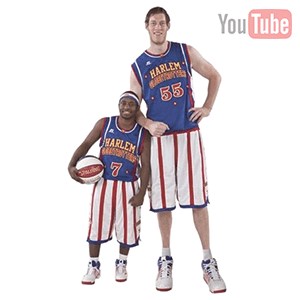
Paul Sturgess is an English-born basketball player for the Harlem Globetrotters. At 7 ft 7.82 in (2.3322 m) and 320 lb (150 kg), Sturgess was the tallest ever college basketball player in the US, is the tallest professional basketball player in the world, and is taller than any basketballer ever to play for the NBA. He joined the team in 2011 with fellow rookie, Jonte ‘Too Tall’ Hall, who at 5 ft 2 in (1.57 m) is the shortest ever player and is 2.5 ft (77 cm) shorter than Sturgess.
Sturgess wears a size 21 shoe. Examinations as a teenager revealed that his growth is healthy and not the result of disorder, rather he possesses familial tall stature, that is to say his height is genetic. His biological father is 6 ft 9 in (2.06 m) and there are other tall members in his family although his mother is 5 ft 5 in (1.65 m) and his younger sister is 5 ft 6 in (1.68 m). Sturgess was always tall but a growth spurt between the ages of 16-17 resulted in a foot (30 cm) of height added within a single year. Sturgess enjoys playing many other sports and before concentrating on basketball also played golf and soccer.
Posted in Games, Humor |
Leave a Comment »
February 9, 2012

An egg of Columbus refers to a brilliant idea or discovery that seems simple or easy after the fact. The expression refers to a popular story of how Christopher Columbus, having been told that discovering the Americas was no great accomplishment, challenged his critics to make an egg stand on its tip.
After his challengers gave up, Columbus did it himself by tapping the egg on the table so as to flatten its tip. The story is often alluded to when discussing creativity.
read more »
Posted in Games, Humor, Language |
Leave a Comment »
February 4, 2012

Zugzwang [tsook-tsvahng] (German: ‘compulsion to move’) is a term usually used in chess which also applies to various other games. The term finds its formal definition in combinatorial game theory, and it describes a situation where one player is put at a disadvantage because he has to make a move when he would prefer to pass and make no move. The fact that the player must make a move means that his position will be significantly weaker than the hypothetical one in which it was his opponent’s turn to move.
In game theory, it specifically means that it directly changes the outcome of the game from a win to a loss. The term is used less precisely in games such as chess. For instance, it may be defined loosely as ‘a player to move cannot do anything without making an important concession.’ Putting the opponent in zugzwang is a common way to help the superior side win a game.
Posted in Games |
Leave a Comment »
February 3, 2012

Spirograph is a geometric drawing toy that produces mathematical curves of the variety technically known as hypotrochoids and epitrochoids. The term has also been used to describe a variety of software applications that display similar curves, and applied to the class of curves that can be produced with the drawing equipment (so in this sense it may be regarded as a synonym of hypotrochoid).
The name is a registered trademark of Hasbro, Inc. Drawing toys based on gears have been around since at least 1908, when The Marvelous Wondergraph was advertised in the Sears catalog. The ‘Boys Mechanic’ publication of 1913 had an article describing how to make a Wondergraph drawing machine. An instrument called a spirograph was invented by the mathematician Bruno Abakanowicz between 1881 and 1900 for calculating an area delimited by curves. The Spirograph toy was developed by the British engineer Denys Fisher, who exhibited it in 1965 at the Nuremberg International Toy Fair. In 1968, Kenner introduced Spirotot, a less complex version of Spirograph, for preschool-age children, too young for Spirograph.
Posted in Art, Games, Science |
Leave a Comment »



 The Daily Omnivore