November 28, 2011

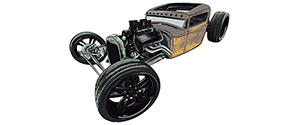
A rat rod is a style of hot rod or custom car that, in most cases, imitates (or exaggerates) the early hot rods of the 40s, 50s, and 60s. It is not to be confused with the somewhat closely related ‘traditional’ hot rod, which is an accurate re-creation or period-correct restoration of a hot rod from the same era.
Most rat rods appear ‘unfinished’ (whether they actually are or not), with just the bare essentials to be driven. The rat rod is the visualization of the idea of function over form. Rat rods are meant to be driven, not shown off. Sometimes the customization will include using spare parts, or parts from another car altogether.
read more »
Posted in Games, Money, Technology |
Leave a Comment »
November 24, 2011

Shovelware is a derogatory computer jargon term that refers to software noted more for the quantity of what is included than for the quality or usefulness. The term is also used to refer to software that is ported from one computer platform or storage medium to another with little thought given to adapting it for use on the destination platform or medium, resulting in poor quality. The metaphor implies that the creators showed little care for the original software, as if the new compilation or version had been indiscriminately created / ported with a shovel, without any care shown for the condition of the software on the newly created product. The term ‘shovelware’ is coined with semantic analogy to phrases like shareware and freeware, which describe methods of software distribution.
Shovelware was often used to refer to conversions in the manner floppy disc collections were aggregated onto CD-ROMs. Today there is potential for similar shovelware in converting PC websites into mobile websites with little thought to optimizing for the new platform or the conversion of console games to PC games. The practice of shovelware has largely decreased due to the wide availability of high speed networking and software downloading and the limited capacity of removable media in modern computers compared to the growing massive file sizes of newer software packages. It continues in some cases with bundled or pre-installed software, where many extra programs of dubious quality and usefulness are included with a piece of hardware, often called derisively ‘crapware.’
Posted in Games, Money, Technology |
Leave a Comment »
November 23, 2011

Myachi [mee-ah-chee] is the brand name of a type of hand sack. It is a small rectangular bag approximately 1.5 by 3.5 inches (40 by 90 mm) that players use to perform a variety of tricks using every part of the body except the palm of the hand. Myachi can be played alone or in groups. There are a number of different games played with the Myachi including big air, best trick and MYACH, but it is most commonly used for freestyle.
Myachi is based on a popular college game in which lighters, keys or coins are tossed from person to person using only the back of the hand. Myachi founder Steven Ochs was introduced to this game while studying at Vanderbilt University and saw marketing potential in this simple hobby. Headquartered in Nashville, Tennessee, the company began in 1998 when Ochs quit his job as a Wall Street Broker. Starting in the back of an RV, he hand-stitched the first ten thousand Myachis and traveled the country selling his concept at concerts, festivals and street fairs. Today Myachi is a top selling toy.
Posted in Games, Money |
Leave a Comment »
November 23, 2011
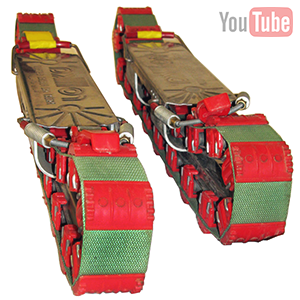
Grass skiing was invented by Richard Martin in Germany in 1966. It was created initially as a training method for skiers before the winter season. Two years later, Martin introduced the new skiing variation to the Vosges region of France. Eventually, it grew in popularity and became wide-known in the country. Short skis that were actually rolling treads, much like those on tanks, or wheels were used.
These skis were attached to the skiers boots and a grassy downhill slope was found. Depending on the skill of the grass skier, high speeds and jumps could be navigated. Many skiers have created their own pistes as an alternative to grass ski centers or grassy mountainous regions. Moreover, aspiring alpine skiers or skiing beginners in general can try this skiing variation to learn skiing moves and techniques even before the onset of snow.
Posted in Games |
1 Comment »
November 23, 2011

No pain, no gain is an exercise motto that promises greater value rewards for the price of hard and even painful work. Under this conception competitive professionals such as athletes and artists are required to endure pain and pressure to achieve professional excellence. It came into prominence after 1982 when actress Jane Fonda began to produce a series of aerobics workout videos. In these videos, Fonda would use ‘No pain, no gain’ and ‘Feel the burn’ as catchphrases for the concept of working out past the point of experiencing muscle aches. It expresses the belief that solid large muscle are the result of training hard and suffering sore muscles repeatedly, implying that those who avoid pain will never reach a professional level as bodybuilders. In terms of the expression used for development, the discomfort caused may be beneficial in some instances while detrimental in others.
American author David B. Morris wrote, ‘No pain, no gain’ is an American modern mini-narrative: it compresses the story of a protagonist who understands that the road to achievement runs only through hardship.’
Posted in Games, Health, Language |
Leave a Comment »
November 22, 2011

Beer pong, also known as Beirut [bey-root], is a drinking game in which players throw a ping pong ball across a table with the intent of landing the ball in a cup of beer on the other end. The game typically consists of two two-to-four-player teams and multiple cups set up, in triangle formation, on each side. There are no official rules, and rules may vary widely, though usually there are six or ten plastic cups on each side. Each side then takes turns attempting to shoot ping pong balls into the opponent’s cups. If a ball lands in a cup, then the contents of that cup are consumed, and the cup is either placed aside or reinserted into the triangle. If the cup is reinserted and the other team knocks the cup over, it is removed. If the opposing team throws the ball into an empty cup, they must consume the contents of one of their cups. The first side to eliminate all of the opponent’s cups is the winner.
The order of play varies—both players on one team shoot followed by both players on the other team, or players on opposite teams can alternate back and forth. Beer pong is played at parties, North American colleges and universities, bars, and elsewhere, such as tailgating or other sporting events.
read more »
Posted in Food, Games, Health |
Leave a Comment »
November 21, 2011
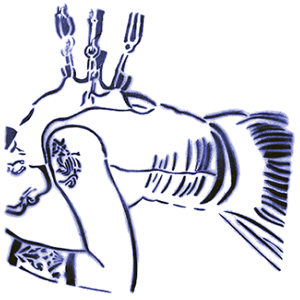
A suspension is the act of suspending a human body from hooks that have been put through body piercings. These piercings are temporary and are performed just prior to the actual suspension.
Multiple hooks are usually located around the shoulders, upper arm, and back, as well as around the knees (depending on the position in which the body is to be suspended). Finding the proper hook placement and number requires an understanding of human anatomy and physiology, as well as the durability of the individual’s skin. If the number of hooks are too few, the suspended individual’s skin will be unable to withstand the body’s weight and will rip.
read more »
Posted in Art, Games, Philosophy |
Leave a Comment »
November 18, 2011
Polybius is a supposed arcade game featured in an Internet urban legend. According to the story, the Tempest-style game was released to the public in 1981, and drove its players insane, causing them to suffer from intense stress, horrific nightmares, and even suicidal tendencies. A short time after its release, it supposedly disappeared without a trace. Not much evidence for the existence of such a game has ever been discovered. Polybius gets its name from the Greek historian who’s works are are relevant to modern cryptography.
According to the story, an unheard-of new arcade game appeared in several suburbs of Portland, Oregon in 1981, something of a rarity at the time. The game, ‘Polybius,’ proved to be incredibly popular, to the point of addiction, and lines formed around the machines, often resulting in fighting over who played next. This was followed by clusters of visits from men in black. Rather than the usual marketing data collected by company visitors to arcade machines, they collected some unknown data, allegedly testing responses to the psychoactive machines. The players themselves suffered from a series of unpleasant side-effects, including amnesia, insomnia, nightmares, night terrors, and even suicide in some versions of the legend.
read more »
Posted in Games, Humor |
Leave a Comment »
November 13, 2011

The Stardust was a casino resort located on the Las Vegas Strip, which opened in 1958, although most of the modern casino complex (including the main 32-story tower) was built in 1991. The Stardust officially closed in 2006, after operating continuously for 48 years. It was imploded a year later, and was the youngest undamaged high-rise building to ever be demolished at the time. Construction started immediately for Echelon Place, which was planned to replace The Stardust, but development was suspended in 2008, and remains suspended as 2011.
The famed Stardust sign became a symbol of Las Vegas. Young Electric Sign Company was hired to fabricate the sign. Kermit Wayne’s design was selected for both the façade and the roadside signs. Although Moe Dalitz (bootlegger, racketeer, and philanthropist who was one of the major figures who helped shape Las Vegas), who took over from original developer Tony Cornero upon his death, said it was from his original plans, the sign was really part of Cornero’s original concept.
read more »
Posted in Games, Money, Politics |
1 Comment »
November 12, 2011
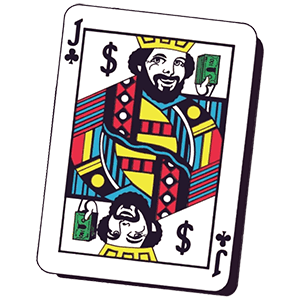
Hole carding refers to obtaining knowledge of cards that are supposed to be hidden from view in card games. The term is usually applied to blackjack but can apply to other games with hidden hole cards, like three card poker and Caribbean stud poker.
So long as it does not involve the use of a device like a mirror or actions like touching the dealer’s cards, in most jurisdictions hole carding is a legal form of advantage gambling. In other games, like stud poker, casinos normally have rules against ‘rubbernecking’ (having a confederate stand behind an opponent to signal hole cards).
read more »
Posted in Games, Money |
Leave a Comment »
November 12, 2011

In poker, a hole cam (or pocket cam) is a camera that displays a player’s face-down cards (known as ‘hole cards’) to television viewers. The hole cam became popular in 1999 when it was first used by the BBC. In some cases, the camera is placed under a glass panel in the table and players are instructed to place their cards over the glass. In other cases, the rail of the table is elevated and a small camera placed within the rail, and players are instructed to examine their cards in the usual manner, but while they’re in front of the camera.
The goal in both cases is to allow for the filming and broadcast of the player’s hole cards to the spectators without exposing them to the other players. This has led to the audience garnering a greater understanding of what is going on at the table and an increased interest in the thought processes of the players.
read more »
Posted in Games, Money, Technology |
1 Comment »
November 10, 2011

Slow playing (also called sandbagging or trapping) is deceptive play in poker that is roughly the opposite of bluffing: betting weakly or passively with a strong holding rather than betting aggressively with a weak one. The flat call is one such play. The objective of the passive slow play is to lure opponents into a pot who might fold to a raise, or to cause them to bet more strongly than they would if the player had played aggressively (bet or raised). Slow playing sacrifices protection against hands that may improve and risks losing the pot-building value of a bet if the opponent also checks.
Against observant opponents, the frequency of bluffing affects the effectiveness of slow playing, and vice versa. If a player’s table image is that of an aggressive bluffer, slow playing is less important because his opponents will be more willing to call his usual bets and raises. Similarly, if a player is perceived as a ‘trappy’ player (uses frequent slow plays), his bluffs are less likely to be respected (i.e., more likely to be called) because his opponents expect him to slow play his strong hands. Fishing for the overcall occurs when the last card a player is dealt makes him a very strong hand, an opponent in front of him bets, and there are more opponents yet to act behind him. While the player might normally raise with his hand, just calling may encourage the opponents behind him to overcall when they would have folded to a raise.
Posted in Games, Money |
Leave a Comment »





 The Daily Omnivore