June 30, 2011

Tutting is a contemporary abstract interpretive street dance style modeled after Egyptian hieroglyphics. It is performed with attention to the musics’ rhythm by altering the position of the body and limbs in a synchronized, robotic manner. The size of poses, or tuts, varies from large body tuts to intricate finger tuts. The transitions between poses can be elaborate and expressive. Moreover, certain sub-styles have emerged such as boxing (creating and manipulating box-like or rectangular shapes predominantly with ones arms) and a liquid-influenced style that some tutters use to make the joints appear as hinges that can then be manipulated by another body part.
Both techniques are special applications of the mime concept ‘fixed point.’ Much as a mime conveys a wall by always keeping one hand on the wall, or shows a rope by always keeping one hand on the rope, a tutter shows a shape by always maintaining at least one side of the shape. To do this, a tutter will use his body parts to assemble a shape segment by segment and disassemble it in the same piecemeal fashion. The electronic dance community has played a large role in the increasing robustness of tutting due to the more abstract nature of its own predominant style, liquiding. Tutting is highly regarded in both the electronic and popping communities for its technical depth and distinctiveness.
Posted in Art, Games, Language |
Leave a Comment »
June 30, 2011


A chiptune, also known as chip music, is synthesized electronic music often produced with the sound chips of old computers and video game consoles, as well as with other methods such as emulation. In the early 1980s, home computers became cheaper and more accessible; this led to a proliferation of personal computers and gaming consoles that were abandoned as users moved on to the next generation of software, and the hardware to run it. Small groups of artists and musicians continue to use these forgotten computers to produce audio and visual work.
The game technologies that are typically used in chip music production are those produced from the 1980s up until the early to mid 1990s. These systems, including the NEC PC-8801, Commodore 64, Nintendo Entertainment System, and Nintendo Game Boy, were aimed at the domestic consumer market. These systems were unique in that they marked a period in the technological development of game audio in which dedicated hardware sub-systems or sound chips were used to create sound.
read more »
Posted in Art, Games, Technology |
Leave a Comment »
June 30, 2011

The Other World Kingdom (OWK) was a large, commercial BDSM and femdom resort and micronation, which opened in 1996 using the buildings and grounds of a 16th century chateau located in Czech Republic. Although it was not recognized by any other country, it maintained its own currency, passports, police force, courts, state flag, and state hymn. The OWK was a matriarchy and the state’s goal was ‘to get as many male creatures under the unlimited rule of Superior Women on as much territory as possible.’
The OWK was ruled by Her Royal Majesty Queen Patricia I, an absolute monarch. The site was 7.4 acres with several buildings and a small lake. The main building was the Queen’s Palace, which was the residence of the monarch, and contained a banqueting hall, library, throne room, torture chamber, schoolroom, gym, and extensive basement prison, the cells of which could be rented.
read more »
Posted in Games, Sex, World |
Leave a Comment »
June 28, 2011

Stitch ‘n Bitch is a phrase that has been used to refer to social knitting groups. ‘Stitch ‘n Bitch’ is a name used by knitting groups that meet on a weekly or monthly basis at locations throughout the world. This use of the term originates as early as the Second World War.
Today’s Stitch ‘n Bitch clubs are generally casual groups of knitters who meet in public spaces such as bars or cafes for socializing and sharing knitting advice. These groups are free or small fee required memberships and open to the public, and are listed in a directory of worldwide knitting groups.
Posted in Art, Games, Humor |
Leave a Comment »
June 24, 2011

In the culture of American adolescents, the game of baseball is often used as a euphemistic metaphor for the degree of sexual intimacy achieved in intimate encounters or relationships. In the metaphor, prevalent in the post-World War II period, sexual activities are described as if they are actions in a game of baseball.
Although details vary, a broadly accepted description of what each base represents, first base is commonly understood to be any form of mouth to mouth kissing, especially open mouth (‘French’) kissing involving the tongue. Thus, if a person complains that s/he ‘can’t get to first base,’ it means that the partner spurned advances or is not interested, although this is not necessarily a specific reference to a spurned attempt to engage in kissing. Second base is manual stimulation of the genitalia. Third base is oral stimulation of the genitalia. Finally, a home run (Fourth base) is the act of penetrative intercourse.
read more »
Posted in Games, Humor, Sex |
Leave a Comment »
June 22, 2011
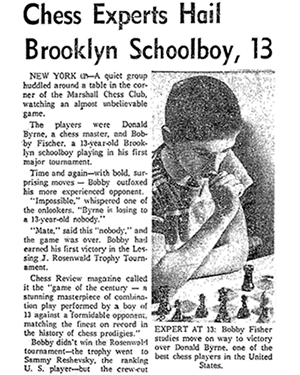
The Game of the Century refers to a chess game played between US chess champion Donald Byrne and the 13-year old Bobby Fischer in the Rosenwald Memorial Tournament in New York City on October 17, 1956.
It was nicknamed ‘The Game of the Century’ by Hans Kmoch in ‘Chess Review,’ who wrote: ‘The following game, a stunning masterpiece of combination play performed by a boy of 13 against a formidable opponent, matches the finest on record in the history of chess prodigies.’
read more »
Posted in Games |
Leave a Comment »
June 13, 2011

Didacticism [dahy-dak-tuh-siz-uhm] is an artistic philosophy that emphasizes instructional and informative qualities in literature and other types of art. The primary intention of didactic art is not to entertain, but to teach. Didactic plays, for instance, teach the audience through the use of a moral or a theme. An example of didactic writing is Alexander Pope’s ‘An Essay on Criticism’ (1711), which offers a range of advice about critics and criticism. An example of didactism in music is the chant ‘Ut queant laxis,’ which was used by Guido of Arezzo to teach solfege syllables.
The term ‘didactic’ is also used as a criticism for work that appears to be overly burdened with instructive, factual, or otherwise educational information, to the detriment of the enjoyment of the reader. Edgar Allan Poe called didacticism the worst of ‘heresies’ in his essay ‘The Poetic Principle.’
Posted in Art, Games, Language |
Leave a Comment »
June 11, 2011

A Googlewhack is a type of a contest for finding a Google search query consisting of exactly two words without quotation marks, that returns exactly one hit. A Googlewhack must consist of two actual words found in a dictionary. A Googlewhack is considered legitimate if both of the searched-for words appear in the result page.
Published googlewhacks are short-lived, since when published to a web site, the new number of hits will become at least two, one to the original hit found, and one to the publishing site. The term Googlewhack first appeared on the web at UnBlinking in 2002; the term was coined by Gary Stock. Subsequently, Stock created The Whack Stack, at googlewhack.com, to allow the verification and collection of user-submitted Googlewhacks.
read more »
Posted in Games, Humor, Technology |
Leave a Comment »
June 6, 2011

Audiosurf is a 2008 puzzle/rhythm hybrid game created by Invisible Handlebar, a personal company created by Dylan Fitterer. Its track-like stages visually mimic the music the player chooses, while the player races across several lanes collecting colored blocks that appear in sync with the music. The music used in the game is chosen from the user’s own library, from almost any DRM-free format, as well as stamdard CDs. Upon completing the track, the score is uploaded to the score server together with the track length and form, any feats achieved, and the character used including the ironmode option if this was enabled. Scores are stored per song title, allowing people to compete. The uploaded length and track form make it possible to detect mislabelled or variant versions of songs in the score browser.
Audiosurf synchronizes the environment, traffic patterns and scenery with the events in the current song. Each music file imported to the game by the user is first analyzed by the game engine, and an ASH file (containing the dynamics of the sounds and how the track and blocks are arranged) associated to the music is created and saved (typically around 30 kilobytes). This helps speed up the loading time of future replays of the same sound file. The game loads the environment from the ASH files, with the track’s elevation, surface and layout reflected in the dynamics of the music being played. For example, if a player were to choose to play a very soft and mellow song, the track would be uphill, very slow, relaxing and rich in cool colors. If a player were to choose a very intense and loud song, the track would be downhill, sped up, thick with traffic and lit up with hot colors.
Posted in Art, Games, Technology |
Leave a Comment »
May 20, 2011

An adult prom is a social event that is almost perfectly similar to a high school prom in terms of themes and attire, except that adult proms usually serve alcohol, and most require those attending to be at least 21 years of age to attend. They have become increasingly common, especially in the United States, and usually are hosted as fundraisers for charities.
A slightly different take on the adult prom is that of the disabilities prom, dedicated to providing a prom experience to disabled adults at no charge to the attendees. These events are most often organized by non-profit organizations focusing on the disabled, or large churches.
Posted in Education, Games, Humor |
Leave a Comment »
May 11, 2011


A sleeper (called a Q-car in the UK) is a car that has high performance and an unassuming exterior. Sleeper cars are termed such because their exterior looks little or no different from a standard or economy-class car. In some cases the car appears worse due to seeming neglect on the owner’s part, typically referred to as ‘all go and no show.’ While appearing to be a standard or neglected car, internally they are modified to perform at higher performance levels. The American nomenclature comes from the term sleeper agent, while the British term derives from the Q-ships used by the Royal Navy.
American actor Paul Newman famously drove a 1963 VW Beetle convertible with a 300-horsepower engine, racing suspension and five-speed gearbox. The back seats were removed to make room for the 351-cubic-inch Ford engine.
read more »
Posted in Games, Language, Technology |
Leave a Comment »
May 9, 2011

The clustering illusion refers to the tendency to erroneously perceive small samples from random distributions as having significant ‘streaks’ or ‘clusters,’ caused by a human tendency to underpredict the amount of variability likely to appear in a small sample of random or semi-random data due to chance. Illusionary clusters were found in the locations of impact of V-1 flying bombs on London during World War II and as streaks in stock market price fluctuations over time.
The clustering illusion was central to a widely reported study by Gilovich, Robert Vallone and Amos Tversky. They found that the idea that basketball players shoot successfully in ‘streaks,’ sometimes called by sportcasters as having a ‘hot hand’ and widely believed by Gilovich et al.’s subjects, was false. In the data they collected, if anything the success of a previous throw very slightly predicted a subsequent miss rather than another success. Using this cognitive bias in causal reasoning may result in the Texas sharpshooter fallacy. It may also have a relationship with gambler’s fallacy. More general forms of erroneous pattern recognition are pareidolia and apophenia.
Posted in Games, Language, Science |
Leave a Comment »


 The Daily Omnivore