May 9, 2011


An executive toy is a novelty item that is usually a small mechanical gadget placed on the desk of a corporate executive or other office workers. They have no work-related function but are usually interesting to look at and entertaining. The first executive toy may have been a gadget designed by the great mathematician and engineer Philo of Byzantium (c.280 BCE), an octagon-shaped ink pot with openings on each side. One could turn the pot so that any face is on top and dip the pen in the opening, but the ink never ran out through the holes on other sides. The inkwell was suspended in the center on a series of gimbals and remained stationary in spite of any rotation.
Examples of executive toys include: EcoSphere (closed Aquarium), Etch A Sketch, Hoberman sphere (a folding and opening geodesic dome), oil and water liquid motion toys, Drinking bird, Magic 8-Ball, mechanical puzzles, music boxes, Nanoblocks (plastic building blocks similar to Lego but about half the linear dimensions), Newton’s cradle (where a set of metal balls are suspended from above, one is pulled from the rest and kicks them, transferring the kinetic energy to the last one), Perpetual pendulum (which doesn’t stop due to an electric magnet in the base of the toy), Pin Art (a box with thousands of small pins of equal length inserted into a board, that can be pressed from one side with any object so that the other ends of the pins form a three-dimensional image of the object on the other side of the board), Rubik’s Cubes, Tops, Yo-yos, Snow globes, Lava lamps, magnet toys, and stress balls.
Posted in Games, Money |
Leave a Comment »
May 9, 2011

Buckyballs are a magnetic toy launched at the New York International Gift Fair in 2009 and sold in the hundreds of thousands before the U.S. Consumer Product Safety Commission issued a recall. In several cases, children swallowed them, and injured their intestines, resulting in at least one death. As a result, regulatory agencies banned them, and the magnets are no longer marketed as toys. This led to a debate over the risks of toys and parental responsibility.
In 2009, a number of US companies decided to repackage sphere magnets and sell them as toys. Despite existing toy regulations at the time, Maxfield & Oberton, maker of Buckyballs, told the ‘New York Times’ that he saw the product on YouTube and repackaged them as Buckyballs. After the recall all mentions of ‘toy’ were changed to ‘desk toy,’ positioning the product as a stress-reliever for adults and restricted sales from stores that sold primarily children’s products.
read more »
Posted in Games, Science |
Leave a Comment »
May 8, 2011


Super Meat Boy is a platform game developed by Edmund McMillen and Tommy Refenes, and is the successor to ‘Meat Boy,’ originally released in 2008. Super Meat Boy was released in 2010. The game follows Meat Boy as he attempts to rescue his girlfriend Bandage Girl from the villainous Dr. Fetus through over 300 levels filled with deadly hazards. It has won acclaim for its extremely high difficulty.
Players must guide Meat Boy to the end of each level while avoiding buzzsaws, salt, and various other fatal obstacles. The player can jump and run, and can stick to walls in order to either jump off of them or to slide down them. The player has an unlimited number of attempts to complete each level; if Meat Boy is killed he immediately restarts the level, though the red blood left behind on surfaces that the player has touched remains.
Posted in Games, Humor |
Leave a Comment »
April 28, 2011

Cluster ballooning is a form of ballooning where a harness attaches a balloonist to a cluster of helium-inflated rubber balloons. Unlike traditional hot-air balloons, where a single large balloon is equipped with vents enabling altitude control, cluster balloons are multiple, small, readily available and individually sealed balloons. To control flight, arrest a climb or initiate a descent, the pilot incrementally jettisons or deflates balloons.
In 1982, Californian truck driver Larry Walters, without any prior ballooning experience, attached 42 helium-filled weather balloons to a lawn chair and lifted off. He quickly rose to nearly 3 miles. He controlled his altitude by using a pellet gun to selectively pop some of the balloons. In his defense to charges filed against him by the FAA, he stated that he intended to rise just a few hundred feet, but underestimated helium’s lifting power causing his tethering strap to break prematurely.
Posted in Games, Humor |
Leave a Comment »
April 28, 2011

A burqini is a type of swimsuit for women designed by Lebanese Australian Aheda Zanetti under the company name Ahiida. The suit covers the whole body except the face, the hands and the feet (enough to preserve Muslim modesty), whilst being light enough to enable swimming. It looks rather like a full-length wetsuit with built-in hood, but somewhat looser and made of swimsuit material instead of neoprene.
In August 2009, a woman in France was prevented from swimming in a public pool wearing a burqini. This was due to a long-standing law requiring swimwear in place of street clothing in public pools, for hygienic reasons, rather than the result of any specific political position on the garment, despite controversy in France over Islamic dress. There are other styles of Islamic swimwear such as the veilkini and mycozzie which was the actual garment worn in the France incident.
Posted in Games, Philosophy, Sex |
Leave a Comment »
April 28, 2011

An undress code is a dress code or social norm which sets an upper limit on the amount of clothing that can be worn. For example, some public swimming facilities set maximum clothing standards, for sanitary reasons.
These rules restrict persons using the facilities to specific types of bathing suits.
read more »
Posted in Games, Politics, Sex |
Leave a Comment »
April 27, 2011

Proun is a freeware racing game in a world of geometric objects and large colored surfaces. You avoid obstacles by rotating around a cable in order to gain as much speed as possible. There is no up or down; there is only the cable to which you are attached. The game was developed by Amsterdam-based, Joost van Dongen.
Posted in Art, Games, Technology |
Leave a Comment »
April 26, 2011
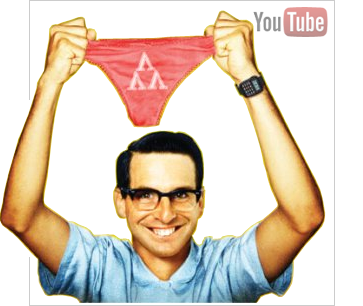
A panty raid is a prank in which male students steal the panties (undergarments) of female students by intruding into their living quarters. The term dates to February, 1949.
It was the first college craze after World War II, following the 1930s crazes of goldfish swallowing or seeing how many could fit in a phone booth. By the 1970s, mixed dorms, less inhibited attitudes to intercourse on campus led to fading of panty raids.
read more »
Posted in Games, Humor, Sex |
Leave a Comment »
April 26, 2011

The Cardboard Tube Fighting League (CTFL) is a global organization that hosts cardboard tube based events in Seattle, Washington; San Francisco, California; and Sydney, Australia. The CTFL hosts tournaments and battles where cardboard tube fighters go head-to-head in an attempt to break their opponents tube without breaking their own.
The events also focus on cardboard costumes and theatrics. These events are often held at public parks throughout the summer, are open to everyone ages 5 and up, and emphasize fun over competition. Cardboard tubes are provided and all events are free for participants.
Posted in Games, Humor |
Leave a Comment »
April 26, 2011

Ringolevio [ring-uh-lee-vee-oh] is a children’s game which may be played anywhere but which originates in the streets of Depression era New York City. In some quarters this game is known as Manhunt which is really another game with different rules. Both are among the many variations of tag. Ringolevio requires close team work and near-military strategy.
There are two teams, each has its own ‘jail,’ perhaps a park bench or other defensible turf. Anyone on the pursuing side can catch anyone on the pursued side by grabbing hold of them and chanting ‘Chain chain double chain, no break away’ or (‘Ringolevio, 1-2-3, 1-2-3, 1-2-3’) If the person pursued breaks free at any point during this brief recitation, the person is not caught. If caught, the pursuer takes the prisoner to jail. The game ends when one team catches all the members of the opposing team.
read more »
Posted in Games, Language |
Leave a Comment »
April 20, 2011

The High Times Cannabis Cup is the world’s preeminent Cannabis festival. Founded in 1987 by Steven Hager, the contest takes place each November in Amsterdam. The event allows judges from around the world to sample and vote for their favorite marijuana strains. These judges-at-large decide the Cannabis Cup (overall winner in the cannabis strain competition), best new product, best booth, best glass, best hash and best Nederhash (a slate-like hash variety). A team of VIP judges decide which seed company has grown the best marijuana.
Recently, High Times created the Medical Cannabis Cup – an event that celebrates the medical marijuana movement in America. The first High Times Medical Cannabis Cup took place in San Francisco in June of 2010. To be a judge one must pay an extra fee, which allows the attendee to vote upon the many different strains. The judge’s pass sells for $199 USD prior to June 1 after which the price increases to $250 USD. A judge’s pass costs 250 euros if purchased at the event. The highest recorded participation was in 2008 with 2,300 judges.
Posted in Drugs, Games, Money |
Leave a Comment »
April 19, 2011

Dubailand is an entertainment complex under development in the United Arab Emirates. When announced in 2003 it was one of the most ambitious leisure developments ever proposed anywhere in the world, but development has been severely impacted by global recession and Dubai’s financial crisis.
The park is divided into six zones: Attractions and Experience World, Sports and Outdoor World, Eco-Tourism World, Themed Leisure and Vacation World, Retail and Entertainment World, and Downtown. It will be twice the size of Walt Disney World Resort, and will be the largest collection of theme parks in the world; however, no theme park in Dubailand will surpass Disney’s Animal Kingdom as the world’s largest theme park.
Posted in Games, Money, World |
Leave a Comment »


 The Daily Omnivore