February 21, 2011

Shoefiti is the practice of throwing shoes whose shoelaces have been tied together so that they hang from overhead wires such as power lines or telephone cables or onto trees or fences. This practice plays a widespread, though mysterious, role in adolescent folklore in the United States. Soldiers leaving the military often paint a pair of combat boots yellow or orange and toss them over a power line or telephone wire near the barracks or unit to which they were assigned.
Posted in Art, Games, Humor |
Leave a Comment »
February 17, 2011

Travis Rice (b. 1982) is a professional snowboarder who grew up and currently resides by Jackson Hole Mountain Resort. He is known for being the ‘Paul Revere’ of the big mountain freestyle movement.
Posted in Games |
Leave a Comment »
February 17, 2011
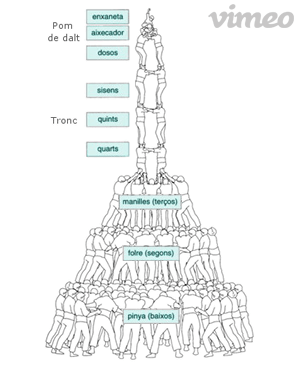
A castell is a human tower built traditionally in festivals at many locations within Catalonia, Spain. At these festivals, several ‘colles castelleres’ or teams often succeed in building and dismantling a tower’s structure.
The tradition of building castells originated in Valls, near the city of Tarragona, in the southern part of Catalonia towards the end of the 18th century. Later it developed a following in other regions of Catalonia and, since 1981, when the first castell of 9 levels of the 20th century was built.
Posted in Games, Humor, World |
Leave a Comment »
February 17, 2011

An ultramarathon is any sporting event involving running longer than the traditional marathon length. There are two types of ultramarathon events: those that cover a specified distance, and events that take place during specified time (with the winner covering the most distance in that time). The most common distances are 50 km, 100 km, 50 mi, and 100 miles. Other distances/times include double marathons, 24-hour races, and multiday races of 1000 miles or even longer. The format of these events and the courses vary, ranging from single or multiple loops (some as short as a 400-meter track), to point-to-point road or trail races, to cross-country rogaines.
Many ultramarathons, especially trail challenges, have severe course obstacles, such as inclement weather, elevation change, or rugged terrain. Many of these races are run on dirt roads or mountain paths, though some are run on paved roads as well. Usually, there are aid stations every 5 to 15 km apart, where runners can replenish food and drink supplies or take a short break. Timed events range from 6, 12, and 24 hours to 3 and 6 days (known as multi-day events). Timed events are generally run on a track or a short road course, often one mile or less.
Posted in Games, Health |
Leave a Comment »
February 11, 2011
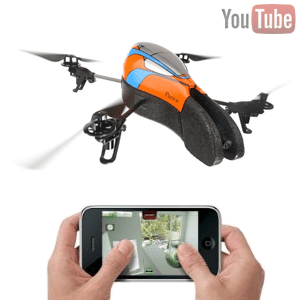
The Parrot AR.Drone is a RC quadricopter with cameras attached to it built by French wireless products manufacturer Parrot. It is designed to be controllable with an iPhone, iPad, or an iPod Touch. Parrot demos the device with 2 games, a virtual combat called ‘DRONE WAR’ with solo and multiplayer mode and a ‘ROBOT’ solo game demo against a virtual Robot. Parrot has launched ARdrone.org Open API game development platform, to gather game studios and developers. It sells for around $300 on Amazon.com.
Posted in Games, Money, Technology |
Leave a Comment »
February 10, 2011
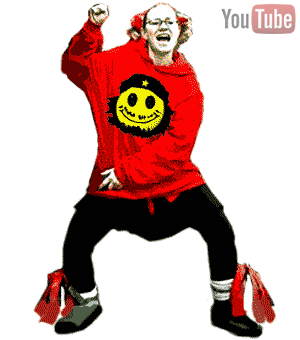
Radical cheerleading is a form of cheerleading that originated in Florida, but has now spread across the United States as well as Canada, Europe and beyond. The idea is to ironically reappropriate the aesthetics of cheerleading, for example by changing the chants to promote feminism and left-wing causes. Radical cheerleaders often perform at demonstrations. They also often perform at feminist and other radical festivals and events.
Radical cheerleading is used at demonstrations to promote a radical message in a media-friendly, people-friendly way. It is also used to support the actions of other activists who put themselves at physical risk and to denounce infiltrators and opponents. Radical cheerleaders are often anti-authoritarian and anti-capitalist. Their cheers are usually written from scratch or by rewriting the words of popular and historic songs. Radical cheerleaders dress in diverse ways but often wear a combination of red or pink and black.
Posted in Games, Humor, Politics |
Leave a Comment »
February 8, 2011
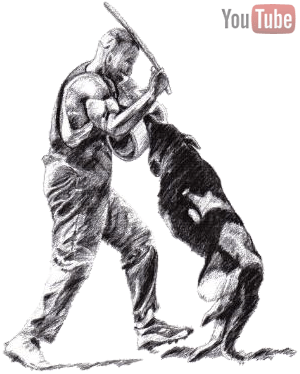
Schutzhund (German for protection dog) is a dog sport that was developed in Germany in the early 1900s to test whether German Shepherd Dogs exhibit the traits necessary for police-type work, rather than simply evaluating a dog’s appearance. Today, many breeds other than German Shepherds can compete in Schutzhund, but it is a demanding test for any dog and few are able to pass successfully.
Posted in Games, Language, World |
Leave a Comment »
February 3, 2011
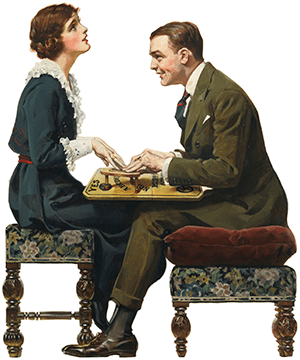
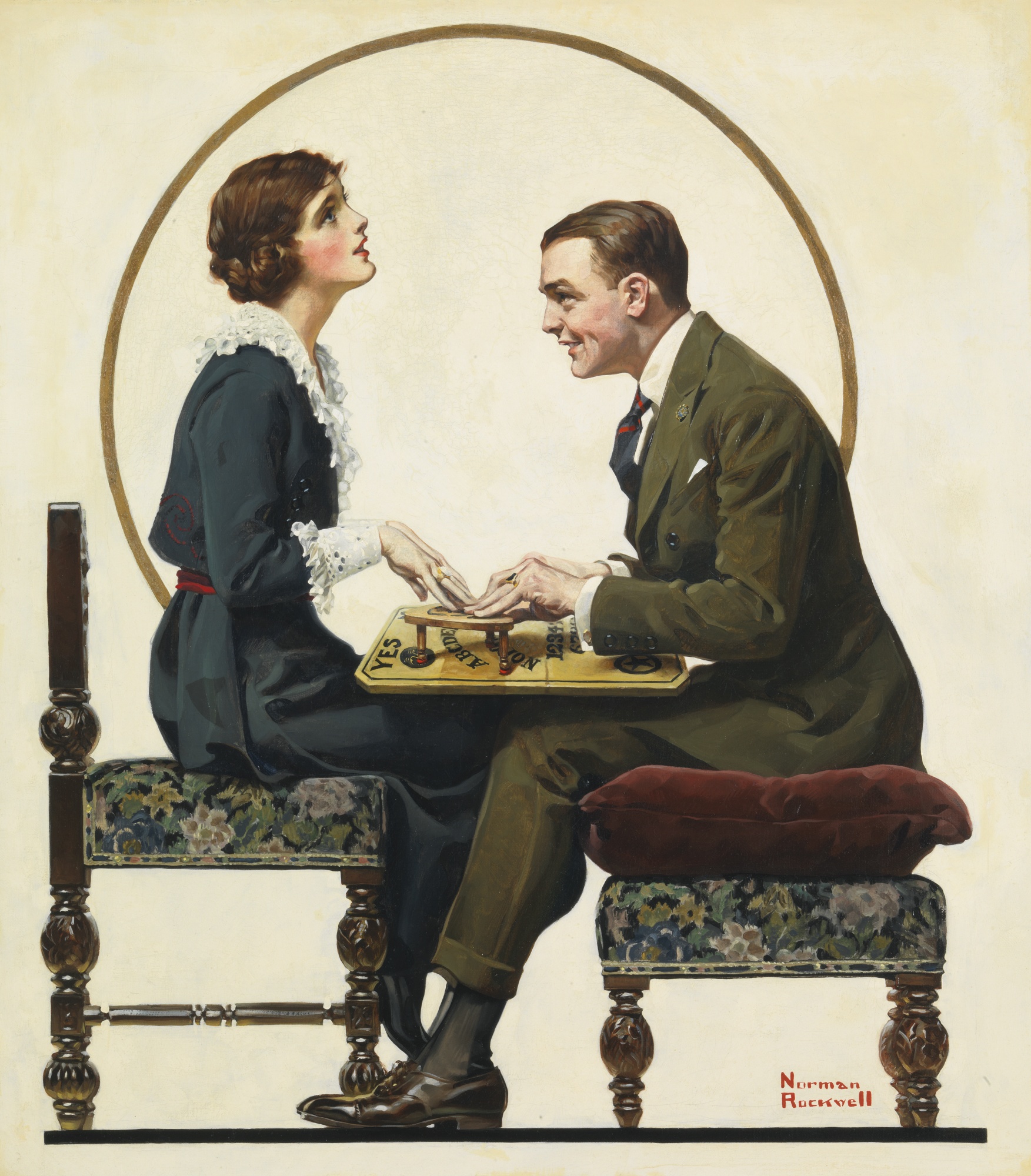
Ouija [wee-jee] is a commercial trademark for a ‘talking board,’ which is a device marked with letters, numbers, and other symbols, supposedly used to communicate with spirits. It uses a planchette (small heart-shaped piece of wood) to indicate the spirit’s message by spelling it out on the board during a séance. The fingers of the séance participants are placed on the planchette, which then moves about the board to spell out words or become physically manifested as a result of the ideomotor effect (a psychological phenomenon wherein a subject makes motions unconsciously).
Following its commercial introduction by businessman Elijah Bond in the late 1890s, the Ouija board was regarded as a harmless parlor game unrelated to the occult until American Spiritualist Pearl Curran popularized its use as a divining tool during World War I. Some mainstream Christian religions have associated use of the Ouija board with the threat of demonic possession, as have certain Occultist movements.
Posted in Death, Games, Humor |
Leave a Comment »
February 2, 2011
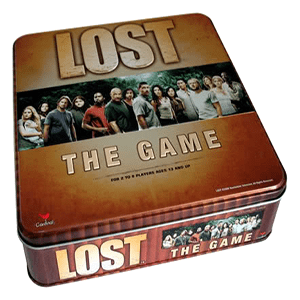
The Game is a mental game where the objective is to avoid thinking about The Game itself. Thinking about The Game constitutes a loss, which, according to the rules of The Game, must be announced each time it occurs. It is impossible to win The Game; players can only attempt to avoid losing for as long as they possibly can. The Game has been variously described as pointless and infuriating. There are three rules to The Game: Everyone in the world is playing The Game. You cannot not play The Game. Whenever one thinks about The Game, one loses.
Posted in Games, Humor |
Leave a Comment »
February 1, 2011
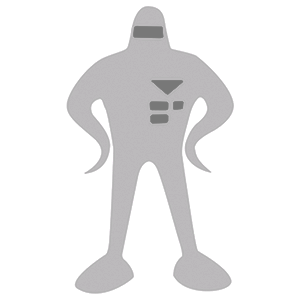
EarthBound is a 1994 role-playing video game co-developed by Ape and HAL Laboratory and published by Nintendo for the Super NES video game console. The game has been lauded by gamers for its humorous depictions of American culture and parody of the RPG genre, and has since become a cult classic.
The game takes place on Earth in the year 199X. The game’s main antagonist is Giygas, an alien from a distant galaxy with the power to influence people using their own evil nature.
Posted in Art, Games, Humor |
Leave a Comment »
January 31, 2011

Photoshop tennis is a game played through sequential alternating photoshopping of an image. Photoshop tennis originated in graphics-related internet forums in the late-1990s/early-2000s. The game was made popular by art director Jim Coudal, and the matches on coudal.com have since been renamed Layer Tennis, as they are no longer restricted to the use of Adobe Photoshop. Each match of Photoshop tennis is generally played with two competing players. The players pick a starting image, or one is ‘served’ by a player, then another player makes some sort of alteration to the image in any chosen image editor (matches are not exclusive to Adobe Photoshop).
He or she then sends that altered image to the other player or players, usually via e-mail or by posting the image to a Photoshop tennis forum, who then edits that image and sends it back to the first player. This process goes back and forth until a predetermined number of rounds have elapsed, or the players otherwise wish to end the game. When the final round is over, there may be an independent judge who determines who has played the best shots, and declares that person the winner, or players may play without a clear winner. Sometimes extra rules can be enforced, such as sticking to one particular software package, or keeping to a particular theme.
Posted in Art, Games, Humor |
Leave a Comment »
January 31, 2011

Exquisite corpse is a method by which a collection of words or images is collectively assembled. Each collaborator adds to a composition in sequence, either by following a rule (e.g. ‘The adjective noun adverb verb the adjective noun’) or by being allowed to see the end of what the previous person contributed. The name is derived from a phrase that resulted when the game was first played, ‘Le cadavre exquis boira le vin nouveau.’ (‘The exquisite corpse will drink the new wine.’) The technique was invented by Surrealists and is similar to an old parlor game called ‘Consequences’ in which players write in turn on a sheet of paper, fold it to conceal part of the writing, and then pass it to the next player for a further contribution.
Surrealist André Breton reported that it started in fun, but became playful and eventually enriching. Breton said the diversion started about 1925, but Pierre Reverdy wrote that it started much earlier, at least before 1918. Later the game was adapted to drawing and collage, producing a result similar to children’s books in which the pages were cut into thirds, the top third pages showing the head of a person or animal, the middle third the torso, and the bottom third the legs, with children having the ability to ‘mix and match’ by turning pages.
Posted in Art, Games, Language |
Leave a Comment »



 The Daily Omnivore