August 30, 2014


A superhuman is a person with extraordinary and unusual capabilities enabling feats beyond anything a layperson could conceivably achieve, even through extensive training. Superhuman can mean an improved human, for example, by genetic modification, cybernetic implants, nanotechnology, or natural evolution. Occasionally, it could mean an otherwise ‘normal’ human with purported super-abilities, such as psychic/psionic powers, levitation or flight, herculean strength, or unique proficiency at some task.
Superhuman can also mean something that is not human, but considered to be ‘superior’ to humans in some ways. This might include a robot that easily passed the Turing test (an indicator of a machine’s ability to exhibit intelligent behavior) that possessed greater than human strength, which is already common in robots today. A very intelligent or strong alien could be considered superhuman. In its most basic sense it means anything beyond (typical) human capabilities, e.g. a tiger may be described as having ‘superhuman strength.’
read more »
Posted in Games, Health, Science |
Leave a Comment »
August 29, 2014

The True Believer: Thoughts On The Nature Of Mass Movements is a 1951 social psychology book by American moral philosopher Eric Hoffer that discusses the psychological causes of fanaticism. The book analyzes and attempts to explain the motives of the various types of personalities that give rise to mass movements; why and how mass movements start, progress and end; and the similarities between them, whether religious, political, radical or reactionary.
Hoffer argues that even when their stated goals or values differ mass movements are interchangeable, that adherents will often flip from one movement to another, and that the motivations for mass movements are interchangeable. Thus, religious, nationalist, and social movements, whether radical or reactionary, tend to attract the same type of followers, behave in the same way and use the same tactics and rhetorical tools. As examples, the book often refers to Communism, Fascism, National Socialism, Christianity, Protestantism, and Islam.
read more »
Posted in Health, Language, Politics |
Leave a Comment »
August 23, 2014
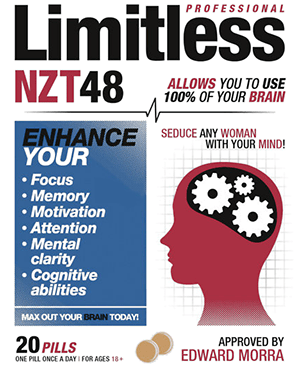
The 10% of brain myth is the widely perpetuated urban legend that the average human can only make use of 10% (or some other small percentage) of their brain. It has been misattributed to many people, including Albert Einstein. By association, it is suggested that a person may harness this unused potential and increase intelligence by spiritual, chemical, or technological means.
Though factors of intelligence can increase with training, the popular notion that large parts of the brain remain unused, and could subsequently be ‘activated,’ rests more in popular folklore than scientific theory. Though mysteries regarding brain function remain—e.g. memory, consciousness—the physiology of brain mapping suggests that all areas of the brain have a function.
read more »
Posted in Health, Science |
1 Comment »
August 20, 2014

Entrainment [en-treyn-muhnt] in the biomusicological [bahy-oh-myoo-zi-kol-loj-i-kuhl] sense refers to the synchronization of organisms to an external rhythm, usually produced by other organisms with whom they interact socially. Examples include firefly flashing, mosquito wing clapping, as well as human music and dance such as foot tapping.
Beat induction is the process in which a regular isochronous pulse is activated while one listens to music (i.e. the beat to which one would tap one’s foot). It was thought that the cognitive mechanism that allows us to infer a beat from a sound pattern, and to synchronize or dance to it, was uniquely human. No other primate can dance or collaboratively clap to the beat of the music. Humans know when to start, when to stop, when to speed up or to slow down, in synchronizing with their fellow dancers or musicians. Although apes do not appear to display beat induction, some parrots do. The most famous example, Snowball was shown to display genuine dance, including changing his movements to a change in tempo in a 2009 study.
read more »
Posted in Art, Health, Science |
Leave a Comment »
August 5, 2014
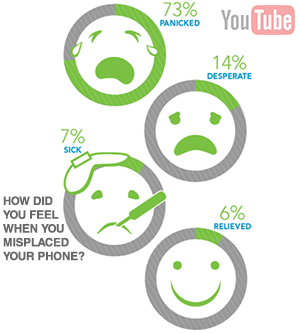
Nomophobia (‘no-mobile-phone phobia’) is the fear of being out of mobile phone contact. The term was coined during a 2010 study by the UK Post Office who commissioned YouGov, a UK-based research organization to look at anxieties suffered by mobile phone users. The study found that nearly 53% of mobile phone users in Britain tend to be anxious when they ‘lose their mobile phone, run out of battery or credit, or have no network coverage.’ The study found that about 58% of men and 47% of women suffer from the phobia, and an additional 9% feel stressed when their mobile phones are off.
The study indicated that stress levels induced by the average case of nomophobia are similar in severity to ‘wedding day jitters’ and trips to the dentists. Ten percent of those questioned said they needed to be contactable at all times because of work. It is, however, arguable that the word ‘phobia’ is misused and that in the majority of cases it is only a normal anxiety. More than one in two nomophobes never switch off their mobile phones. The study prompted two editorial columns authored by those who minimize their mobile phone use or choose not to own one at all, treating the condition with levity or outright disbelief.
Posted in Health, Humor, Technology |
Leave a Comment »
August 4, 2014

Anchoring or focalism is a cognitive bias that describes the common human tendency to rely too heavily on the first piece of information offered (the ‘anchor’) when making decisions. Once an anchor is set, other judgments are made by adjusting away from that anchor, and there is a bias toward interpreting other information around the anchor. For example, the initial price offered for a used car sets the standard for the rest of the negotiations, so that prices lower than the initial price seem more reasonable even if they are still higher than what the car is really worth.
Anchoring is also called the focusing effect (or focusing illusion) because it occurs when people place too much importance on one aspect of an event, causing an error in accurately predicting the utility of a future outcome. Individuals tend to focus on notable differences, excluding those that are less conspicuous, when making predictions about happiness or convenience.
read more »
Posted in Health, Money, Science |
Leave a Comment »
July 10, 2014
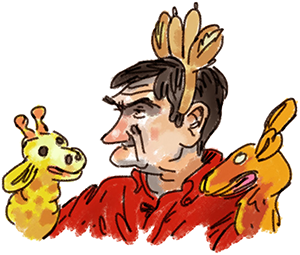

Nonviolent Communication (NVC) is an interpersonal communicative process developed by psychologist Marshall Rosenberg beginning in the 1960s. NVC often functions as a conflict resolution process. It focuses on three aspects of communication: self-empathy (a deep and compassionate awareness of one’s own inner experience), empathy (listening to another with deep compassion), and honest self-expression (expressing oneself authentically in a way that is likely to inspire compassion in others).
NVC is based on the idea that all human beings have the capacity for compassion and only resort to violence or behavior that harms others when they don’t recognize more effective strategies for meeting needs. Habits of thinking and speaking that lead to the use of violence (psychological and physical) are learned through culture. NVC theory supposes all human behavior stems from attempts to meet universal human needs and that these needs are never in conflict. Rather, conflict arises when strategies for meeting needs clash. NVC proposes that if people can identify their needs, the needs of others, and the feelings that surround these needs, harmony can be achieved.
read more »
Posted in Health, Language, War |
1 Comment »
July 9, 2014

The broaden-and-build theory of positive emotions suggests that positive emotions such as enjoyment, happiness, and joy (and perhaps interest and anticipation) broaden one’s awareness and encourage novel, varied, and exploratory thoughts and actions. Over time, this broadened behavioral repertoire builds skills and resources.
For example, curiosity about a landscape becomes valuable navigational knowledge; pleasant interactions with a stranger become a supportive friendship; aimless physical play becomes exercise and physical excellence. This is in contrast to negative emotions, which prompt narrow, immediate survival-oriented behaviors. For example, the negative emotion of anxiety can lead to a fight-or-flight response concerned only with immediate safety.
read more »
Posted in Health |
Leave a Comment »
July 2, 2014

The illusion of control is the tendency for people to overestimate their ability to control events, for instance to feel that they control outcomes that they demonstrably have no influence over. The effect was named by psychologist Ellen Langer and has been replicated in many different contexts.
It is thought to influence gambling behavior and belief in the paranormal. Along with illusory superiority (overestimating positive abilities and underestimating negative qualities) and optimism bias (unrealistic or comparative optimism), the illusion of control is one of the positive illusions, unrealistically favorable attitudes that people have towards themselves or to people that are close to them. Positive illusions are a form of self-deception or self-enhancement that feel good, maintain self-esteem or stave off discomfort at least in the short term.
read more »
Posted in Health, Science |
1 Comment »
June 30, 2014


The Cassandra complex occurs when valid warnings or concerns are dismissed or disbelieved. The term originates in Greek mythology. Cassandra was a daughter of Priam, the King of Troy. Struck by her beauty, Apollo provided her with the gift of prophecy, but when Cassandra refused Apollo’s romantic advances, he placed a curse ensuring that nobody would believe her warnings. Cassandra was left with the knowledge of future events, but could neither alter these events nor convince others of the validity of her predictions.
The metaphor has been applied in a variety of contexts such as psychology, environmentalism, politics, science, cinema, the corporate world, and in philosophy, and has been in circulation since at least 1949 when French philosopher Gaston Bachelard coined the term to refer to a belief that things could be known in advance. The Cassandra metaphor is applied by some psychologists to individuals who experience physical and emotional suffering as a result of distressing personal perceptions, and who are disbelieved when they attempt to share the cause of their suffering with others, and they feel like they are being ignored.
read more »
Posted in Health |
Leave a Comment »
June 26, 2014


A sedentary lifestyle is characterized by a lack of physical activity. A person who lives a sedentary lifestyle may colloquially be known as a ‘couch potato.’ It is commonly found in both the developed and developing world. Sedentary activities include sitting, reading, watching television, playing video games, and computer use for much of the day with little or no vigorous physical exercise. A sedentary lifestyle can contribute to many preventable causes of death. ‘Screen time’ is the amount of time a person spends watching a screen such as a television, computer monitor, or mobile device. Excessive screen time is linked to negative health consequences, such as insufficient blinking and tear flow.
The term couch potato was coined by a friend of underground comics artist Robert Armstrong in the 1970s; Armstrong featured a group of couch potatoes in a series of comics featuring sedentary characters and with Jack Mingo and Allan Dodge created a satirical organization that purported to watch television as a form of meditation. With two books and endless promotion through the 1980s, the ‘Couch Potatoes’ appeared in hundreds of newspapers, magazines and broadcasts, spreading its ‘turn on, tune in, veg out’ message, garnering 7,000 members, and popularizing the term.
read more »
Posted in Death, Health |
1 Comment »
June 16, 2014

Tactical ignoring, also known as planned ignoring, is a behavioral management strategy used in response to challenging behavior that seeks to receive attention or to gain a reaction from others. It is a commonly used strategy when the person displaying the attention seeking behavior would feel rewarded even by a negative response. An example of this is a cough or noise that is excessively loud in order to gain sympathy from work colleagues, loved ones, and friends, which is still seen as desirable attention by the person.
Tactical ignoring can be one element of a behavior management plan when there are a variety of challenging behaviors being addressed. As such, it is a method of responding to a behavior, complemented by a positive reinforcement schedule and skill development in learning a more appropriate method of seeking attention.
read more »
Posted in Education, Health |
Leave a Comment »


 The Daily Omnivore