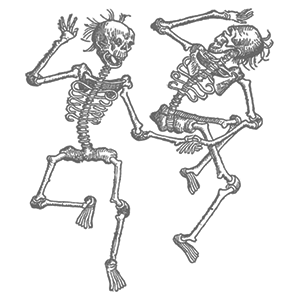
Mass psychogenic [sahy-kuh-jen-ik] illness (MPI) is ‘the rapid spread of illness signs and symptoms affecting members of a cohesive group, originating from a nervous system disturbance involving excitation, loss or alteration of function, whereby physical complaints that are exhibited unconsciously have no corresponding organic etiology [cause].’ MPI is distinct from other collective delusions, but included under the blanket term mass hysteria, because MPI causes symptoms of disease, though there is no organic cause.
There is a clear preponderance of female victims. The DSM-IV does not have specific diagnosis for this condition but the text describing conversion disorder (where patients suffer apparently neurological symptoms, such as numbness, blindness, paralysis, or fits, but without a neurological cause) states that ‘In ‘epidemic hysteria,’ shared symptoms develop in a circumscribed group of people following ‘exposure’ to a common precipitant.’
read more »
Mass Psychogenic Illness
Dancing Mania
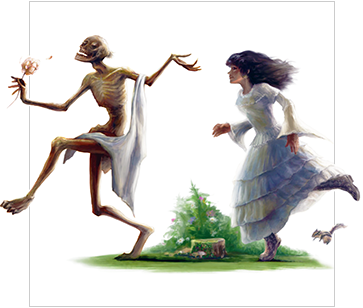
Dancing mania was a social phenomenon that occurred primarily in mainland Europe between the 14th and 17th centuries. It involved groups of people, sometimes thousands at a time, who danced uncontrollably and bizarrely. They would also scream, shout, and sing, and claim to have visions or hallucinations. The mania affected men, women, and children, who danced until they collapsed from exhaustion.
One of the first major outbreaks was in Aachen, Germany, in 1374, and it quickly spread throughout Europe; another particularly notable outbreak occurred in Strasbourg in 1518. Affecting thousands of people across several centuries, dancing mania was not a one-off event, and was well documented in contemporary reports.
read more »
Tarantism

Tarantism [tar-uhn-tiz-uhm] is an alleged, possibly deadly syndrome, popularly believed to result from the bite of a kind of a tarantula. It was originally described in the eleventh century and was supposedly common in southern Italy during the sixteenth and seventeenth centuries. There were strong suggestions that there is no organic cause for the heightened excitability and restlessness that gripped the victims. The stated belief of the time was that victims needed to engage in frenzied dancing to prevent death, and a particular kind of dance, called the tarantella, evolved from this therapy.
Arachnologist John Compton proposed that ancient Bacchanalian rites that had been suppressed by the Roman Senate in 186 BCE went underground, reappearing under the guise of emergency therapy for bite victims. The phenomenon of tarantism is consistent with mass psychogenic illness (the rapid spread of illness symptoms affecting members of a cohesive group, originating from a nervous system disturbance involving excitation, loss or alteration of function, whereby physical complaints that are exhibited unconsciously have no corresponding organic etiology). Although the popular belief persists that tarantism results from a spider bite, it remains scientifically unsubstantiated. The actual cause or causes of tarantism remain unknown.
Lexical-gustatory Synesthesia

Lexical-gustatory [lek-si-kuhl guhs-tuh-tawr-ee sin-uhs-thee-zhuh] synesthesia [sin-uhs-thee-zhuh] is one of the rarer forms of synesthesia (a mixing of the senses), in which spoken or written words evoke vivid sensations of taste, sometimes including temperature and texture (e.g., for lexical-gustatory synesthete JIW, ‘jail’ tastes of cold, hard bacon).
This form of synesthesia was first documented in 1907 in both Italy and the United States, but has only recently become the topic of scientific investigation.
read more »
Ideasthesia

Ideasthesia is a neurological or cognitive phenomenon in which activation of a particular concept triggers a sensory-like experience. Specifically it is when activations of concepts (inducers) evoke perception-like experiences (concurrents). The name comes from Greek, meaning sensing concepts or sensing ideas.
The main reason for introducing the notion of ideaesthesia was the empirical evidence indicating that the related term synesthesia (i.e. union of senses) suggests incorrect explanation of a set of phenomena traditionally covered by this heading.
read more »
Grapheme–color Synesthesia

Grapheme-color [graf-eem] synesthesia [sin-uhs-thee-zhuh] is a form of synesthesia (mixing of sensations) in which an individual’s perception of numbers and letters is associated with the experience of colors. Like all forms of synesthesia, grapheme-color synesthesia is involuntary, consistent, and memorable. It is one of the most common forms of synesthesia, and because of the extensive knowledge of the visual system, one of the most studied. While it is extremely unlikely that any two synesthetes will report the same colors for all letters and numbers, studies of large numbers of synesthetes find that there are some commonalities across letters (e.g., ‘A’ is likely to be red).
Early studies argued that the condition was not due to associative learning, such as from playing with colored refrigerator magnets. However, one recent study has documented a case of synesthesia in which synesthetic associations could be traced back to colored refrigerator magnets. Despite the existence of this individual case, the majority of synesthetic associations do not seem to be driven by learning of this sort. Rather, it seems that more frequent letters are paired with more frequent colors, and some meaning-based rules, such as ‘b’ being blue, drive most synesthetic associations.
read more »
Brain Waves

Neural oscillation is rhythmic or repetitive neural activity in the central nervous system. In individual neurons, oscillations can appear either as oscillations in membrane potential or as rhythmic patterns of action potentials, which then produce oscillatory activation of post-synaptic neurons. At the level of neural ensembles, synchronized activity of large numbers of neurons can give rise to macroscopic oscillations, which can be observed in the electroencephalogram (EEG).
Oscillatory activity in groups of neurons generally arise from feedback connections between the neurons that result in the synchronization of their firing patterns. The interaction between neurons can give rise to oscillations at a different frequency than the firing frequency of individual neurons. A well-known example of macroscopic neural oscillations is alpha activity, neural oscillations in the frequency range of 8–12 Hz arising from electrical activity of thalamic pacemaker. In lay terms, they are brain waves associated with feelings of relaxation.
read more »
Sensory Deprivation

Sensory deprivation or perceptual isolation is the deliberate reduction or removal of stimuli from one or more of the senses. Simple devices such as blindfolds or hoods and earmuffs can cut off sight and hearing respectively, while more complex devices can also cut off the sense of smell, touch, taste, thermoception (heat-sense), and ‘gravity.’
Sensory deprivation has been used in various alternative medicines and in psychological experiments (e.g., see isolation tank). Short-term sessions of sensory deprivation are described as relaxing and conducive to meditation; however, extended or forced sensory deprivation can result in extreme anxiety, hallucinations, bizarre thoughts, and depression.
read more »
Isolation Tank
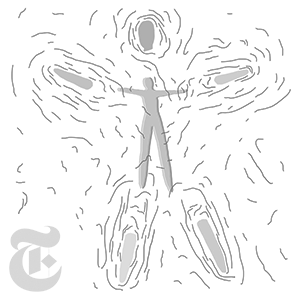
An isolation tank is a lightless, soundproof tank inside which subjects float in salt water at skin temperature. They were first used by John C. Lilly in 1954 to test the effects of sensory deprivation. Such tanks are now also used for meditation and relaxation and in alternative medicine.
The isolation tank was originally called the sensory deprivation tank. Other names for the isolation tank include flotation tank, John C. Lilly tank, REST tank, sensory attenuation tank, and think tank.
read more »
Idiopathic
Idiopathic [id-ee-uh-path-ik] is an adjective used primarily in medicine meaning arising spontaneously or from an obscure or unknown cause. From Greek ‘idios’ (‘one’s own’) and ‘pathos’ (‘suffering’), it means approximately ‘a disease of its own kind.’ It is technically a term from nosology, the classification of disease.
For some medical conditions, one or more causes are somewhat understood, but in a certain percentage of people with the condition, the cause may not be readily apparent or characterized. In these cases, the origin of the condition is said to be idiopathic.
read more »
Ageplay
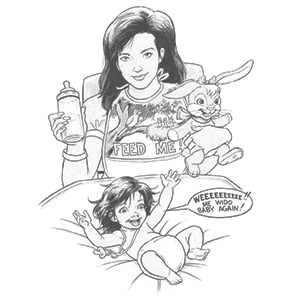
Ageplay or age play is a form of roleplaying in which an individual acts or treats another as if they were a different age. The practice can be regressive, in which the goal is to re-experience childhood, or sexual, recreating a sexual relationship with people of the pretend or true ages.
Sexual variations may include among other things such as incest play, in which individuals recreate and sexualize roles within a family, and ‘Daddy’s girl’ fetishism in which real or imagined age differences are the basis of the roleplaying and the female is portrayed as the younger partner. Ageplay is also commonly done by children when they play games such as ‘house’ and take on roles of a nuclear family, which typically consists of a father, mother, a child or children, and/or a baby.
Erotic Target Location Error
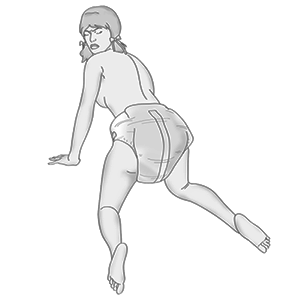
Erotic target location error (ETLE) is a term coined in 1993 by sexologist Ray Blanchard, referring to having a sexual preference (or very strong sexual interest) in features that are somewhere other than on one’s sexual partner(s). When one’s sexual arousal is based on imagining one’s self in another physical form (such as an animal, an infant, or an amputee) the erotic target is said to be one’s self, or erotic target identity inversion.
The best known examples of erotic target identity inversions are biological males who experience sexual arousal in response to imaging themselves as women (called autogynephilia), but there has also been at least one reported case of anatomic autoandrophilia (a woman’s tendency to be sexually aroused by the thought or image of herself as a man). Autogynephilia can be associated with gender dysphoria and Gender Identity Disorder, discontent with one’s biological sex and the desire to under surgery for sex reassignment and permanently take on a role and life of the other sex. A male with sexual arousal based on temporarily taking on the appearance or role of a woman is called ‘transvestic’ fetishism.
read more »


 The Daily Omnivore