February 28, 2012

When Prophecy Fails is a 1956 classic book in social psychology by Leon Festinger, Henry Riecken, and Stanley Schachter about a UFO religion that believes the end of the world is at hand. Festinger’s theory of cognitive dissonance (holding conflicting thoughts or feelings at the same time causes distress) can account for the psychological consequences of disconfirmed expectations.
Festinger and his associates read an interesting item in their local newspaper headlined ‘Prophecy from planet Clarion call to city: flee that flood.’ A housewife given the name ‘Marian Keech’ (real name Dorothy Martin, later known as Sister Thedra), had mysteriously been given messages in her house in the form of ‘automatic writing’ from alien beings. These messages revealed that the world would end in a great flood before dawn on December 21, 1954.
read more »
Posted in Health, Language, Philosophy |
1 Comment »
February 28, 2012

Cognitive dissonance [dis-uh-nuhs] is a discomfort caused by holding conflicting thoughts or feelings at the same time. In this state, people may feel surprise, dread, guilt, anger, or embarrassment. An example is the conflict between wanting to smoke and knowing that smoking is unhealthy. Reacting to this unpleasant state, people often change their feelings, thoughts or memories so they are less in conflict. For instance, a smoker might change their belief about the likelihood that smoking will make them ill, or they might introduce the idea that there are other benefits that make smoking worth it.
The phrase was coined by American psychologist Leon Festinger in his 1956 book ‘When Prophecy Fails,’ which chronicled the followers of a UFO cult as reality clashed with their fervent belief in an impending apocalypse. The believers met at a predetermined place and time, believing they alone would survive the Earth’s destruction. The appointed time came and passed without incident. They faced acute cognitive dissonance: had they been the victim of a hoax? Had they donated their worldly possessions in vain? Most members chose to believe something less dissonant: the aliens had given earth a second chance, and the group was now empowered to spread the word: earth-spoiling must stop. The group dramatically increased their proselytism despite the failed prophecy.
read more »
Posted in Health, Philosophy |
1 Comment »
February 28, 2012

Vocal fry (creak, glottal scrape, or strohbass), is the lowest vocal register, voice is next, then falsetto, and finally whistle is the highest vocal register. It is produced through a loose glottal closure which will permit air to bubble through slowly with a popping or rattling sound of a very low frequency. Some authorities consider the use of vocal fry in speech a dysphonia, while others consider it so only if it is used excessively. However, the register is more widely used in singing than might at first seem apparent.
Within the bass part of gospel quartet singing the practice is quite common. The croaking sound produced by male singers at the start of phrases in American country music are produced by moving from this mode to the normal voice. Additionally some Russian Anthems contain bass lines within the vocal-fry register. Within choral music, when true basses are not available, choirs often rely on singers who can ‘fry’ the low bass notes. Vocal fry is also used in metal music, usually in combination with air from the diaphragm, in order to create a ‘growl’ or ‘scream’ which sounds aggressive and harsh.
Posted in Art, Health, Language |
1 Comment »
February 27, 2012
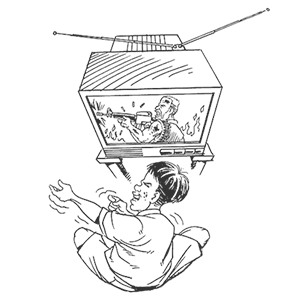
Cultivation theory is a social theory which examines the long-term effects of television. Developed by George Gerbner and Larry Gross of the University of Pennsylvania. They were ‘concerned with the effects of television programming (particularly violent programming) on the attitudes and behaviors of the American public.’
Gerbner asserts that the overall concern about the effects of television on audiences stemmed from the unprecedented centrality of television in American culture. He posited that television as a mass medium of communication had formed into a common symbolic environment that bound diverse communities together, socializing people in to standardized roles and behaviors. He compared the power of television to the power of religion, saying that television was to modern society what religion once was in earlier times.
read more »
Posted in Health, Science, Technology |
1 Comment »
February 27, 2012

Stupidity is a lack of intelligence, understanding, reason, wit, or sense. It may be innate, assumed, or reactive – ‘being ‘stupid with grief’ as a defence against trauma,’ a state marked with ‘grief and despair…making even simple daily tasks a hardship.’ The root word ‘stupid,’ which can serve as an adjective or noun, comes from the Latin verb ‘stupere,’ for ‘being numb’ or ‘astonished,’ and is related to ‘stupor’ (in Roman culture ”the stupidus of the mimes’ was a sort of professional buffoon – the ‘fall-man,’ the eternal he-who-gets-kicked.’ The word entered the English language in the 16th century; since then, stupidity has become a pejorative appellation for human misdeeds, whether purposeful or accidental, due to absence of mental capacity.
The modern English word ‘stupid’ has a broad range of application, from being slow of mind (indicating a lack of intelligence, care or reason), dullness of feeling or sensation (torpidity, senseless, insensitivity), or lacking interest or point (vexing, exasperating). It can either infer a congenital lack of capacity for reasoning, or a temporary state of daze or slow-mindedness.
read more »
Posted in Education, Health, Humor |
Leave a Comment »
February 26, 2012

The Monroe Institute (TMI) is a nonprofit education and research organization devoted to the exploration of human consciousness, based in Virginia. TMI, which claims a policy of no dogma or bias with respect to belief system, religion, political or social stance, was founded by Robert Monroe after he experienced an ‘out of body experience,’ now also commonly referred to as OBEs. Activities includes teaching various techniques, based on audio-guidance processes, in order to expand consciousness and explore areas of consciousness not normally available in the waking state.
Controlled studies of the Institute’s technology suggest that it is effective as an analgesic supplement and can reduce hospital discharge times. The Institute has an affiliated professional membership, and also publishes scientific papers on a subset of its own studies of altered states of consciousness. In its in-house laboratory, these states or focus levels are typically induced by delivering Hemi-Sync signals to subjects performing relaxation procedures inside a shielded, sense-depriving isolation tank. Progression through states is detected and monitored by measurement of peripheral skin temperature, galvanic skin response and DC skin potential voltage.
Posted in Health, Technology |
Leave a Comment »
February 25, 2012

The hedonic treadmill is the supposed tendency of humans to quickly return to a relatively stable level of happiness despite major positive or negative events or life changes. According to this theory, as a person makes more money, expectations and desires rise in tandem, which results in no permanent gain in happiness. Brickman and Campbell coined the term in their essay ‘Hedonic Relativism and Planning the Good Society’ (1971). During the late ’90s, the concept was modified by Michael Eysenck, a British psychology researcher, to become the current ‘hedonic treadmill theory’ which compares the pursuit of happiness to a person on a treadmill, who has to keep working just to stay in the same place. The general idea of the ‘Hedonic (or Happiness) Set Point’ has gained interest throughout the field of positive psychology.
Research supports a three-factor model, where our level of happiness is 50% determined by genetics, 10% determined by outside circumstances, and 40% determined by intentional activities. That last factor, of intentional activities, is the focus of positive psychology, especially because not all activities are equally effective at helping one to reach the higher end of their happiness range. One study concluded that life goals along with personality characteristics are important determinants of one’s subjective well-being. Life goals that enrich one’s relationships and social resources, such as altruistic and family oriented goals, increase their level of subjective well-being. On the other hand, materialistic life goals, such as monetary achievement, have a negative effect on people’s overall subjective well-being.
Posted in Health, Science |
1 Comment »
February 24, 2012

The term outsider art was coined by art critic Roger Cardinal in 1972 as an English synonym for ‘art brut’ (French: ‘raw art’), a label created by French artist Jean Dubuffet to describe art created outside the boundaries of official culture; Dubuffet focused particularly on art by insane-asylum inmates.
While Dubuffet’s term is quite specific, the English term ‘outsider art’ is often applied more broadly, to include certain self-taught or Naïve art makers who were never institutionalized. Typically, those labeled as outsider artists have little or no contact with the mainstream art world or art institutions. In many cases, their work is discovered only after their deaths. Often, outsider art illustrates extreme mental states, unconventional ideas, or elaborate fantasy worlds.
read more »
Posted in Art, Health |
Leave a Comment »
February 17, 2012

The Ganzfeld effect (German: ‘complete field’) is a phenomenon of visual perception caused by staring at an undifferentiated and uniform field of color. The effect is described as the loss of vision as the brain cuts off the unchanging signal from the eyes. The result is ‘seeing black’ – apparent blindness. In the 1930s, research by psychologist Wolfgang Metzger established that when subjects gazed into a featureless field of vision they consistently hallucinated and their electroencephalograms changed. The Ganzfeld effect is the result of the brain amplifying neural noise in order to look for the missing visual signals. The noise is interpreted in the higher visual cortex, and gives rise to hallucinations. This is similar to dream production because of the brain’s state of sensory deprivation during sleep.
The Ganzfeld effect has been reported since ancient times. The adepts of Pythagoras retreated to pitch black caves to receive wisdom through their visions, known as the prisoner’s cinema. Miners trapped by accidents in mines frequently reported hallucinations, visions and seeing ghosts when they were in the pitch dark for days. Arctic explorers seeing nothing but featureless landscape of white snow for a long time also reported hallucinations and an altered state of mind.
Posted in Health, Philosophy, Science |
Leave a Comment »
February 15, 2012

An exocortex is a theoretical artificial external information processing system that would augment a brain’s biological high-level cognitive processes. An individual’s exocortex would be composed of external memory modules, processors, IO devices and software systems that would interact with, and augment, a person’s biological brain. Typically this interaction is described as being conducted through a direct brain-computer interface, making these extensions functionally part of the individual’s mind. Individuals with significant exocortices could be classified as cyborgs or transhumans.
Cortex (Latin: bark) is used in neuroscience for the outer bark-like layer of the brain that is the site of most sophisticated cognitive information processing. It was coined in allusion to the neocortex (literally ‘new bark’), the newest part of the mammalian brain (in evolutionary history), believed to be responsible for the highest human cognitive abilities including conscious thought, spatial reasoning, and sensory perception. Thus the terminology suggests a progression from reptilian thought (the older parts of the brain) through human (neocortex) to high-level human or even supra-human cognitive processing capabilities (exocortex).
Posted in Health, Technology |
Leave a Comment »
February 8, 2012
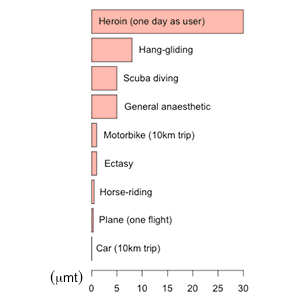
A micromort is a unit of risk measuring a one-in-a-million probability of death (from micro- and mortality). Micromorts can be used to measure riskiness of various day-to-day activities. A microprobability is a one-in-a million chance of some event; thus a micromort is the microprobability of death. The micromort concept was introduced by Ronald A. Howard who pioneered the modern practice of decision analysis.
An application of micromorts is measuring the value that humans place on risk: for example, one can consider the amount of money one would have to pay a person to get him or her to accept a one-in-a-million chance of death (or conversely the amount that someone might be willing to pay to avoid a one-in-a-million chance of death).
read more »
Posted in Death, Health, Money |
2 Comments »
February 7, 2012

The phrase snake oil is as a derogatory term used to describe quackery, the promotion of fraudulent or unproven medical practices. The expression is also applied metaphorically to any product with questionable and/or unverifiable quality or benefit. By extension, the term ‘snake oil salesman’ may be applied to someone who sells fraudulent goods, or who is a fraud himself.
The phrase originates with a topical preparation made from the Chinese Water Snake. Chinese laborers on railroad gangs involved in building the First Transcontinental Railroad first gave snake oil to Europeans with joint pain. When rubbed on the skin at the painful site, snake oil was claimed to bring relief. This claim was ridiculed by rival medicine salesmen, and in time, snake oil became a generic name for many compounds marketed as panaceas or miraculous remedies whose ingredients were usually secret, unidentified, or mis-characterized and mostly inert or ineffective.
read more »
Posted in Drugs, Health, Politics |
Leave a Comment »


 The Daily Omnivore