December 8, 2011
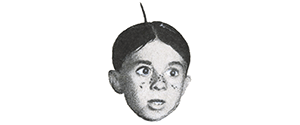
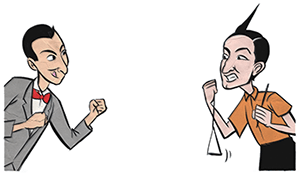
A cowlick [kou-lik] is a section of hair that stands straight up or lies at an angle at odds with the style in which the rest of an individual’s hair is worn. They appear when the growth direction of the hair forms a spiral pattern. The term originates from the domestic bovine’s habit of licking its young, which results in a swirling pattern in the hair.
The most common site of a human cowlick is in the crown, but they can show up anywhere. They also sometimes appear in the front and back of the head.
read more »
Posted in Health, Language |
1 Comment »
December 8, 2011
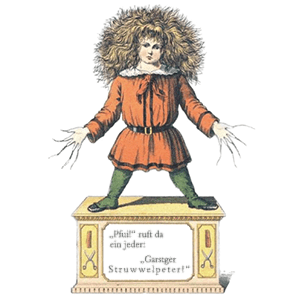
Uncombable hair syndrome (also known as Pili trianguli et canaliculi, Spun-glass hair, and Cheveux incoiffables) is a rare structural anomaly of the hair with a variable degree of effect. It was discovered in the 1970s. It becomes apparent from as little as 3 months to up to 12 years.
The hair is normal in quantity and is usually silvery-blond or straw-colored. It is disorderly, it stands out from the scalp, and cannot be combed flat. The underlying structural anomaly is longitudinal grooving of the hair shaft, which appears triangular in cross section. To be noticeable, 50 % of hairs must be affected by the structural abnormality. Improvement often occurs in later childhood.
Posted in Health |
Leave a Comment »
December 8, 2011
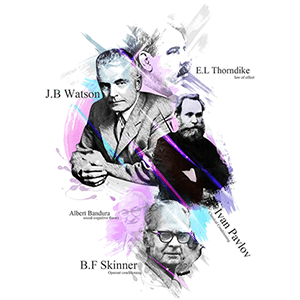
John B. Watson (1878 – 1958) was an American psychologist who established the psychological school of behaviorism. Through his behaviorist approach, Watson conducted research on animal behavior, child rearing, and advertising. In 1920 Johns Hopkins University asked Watson to leave his faculty position because of publicity surrounding the affair he was having with his graduate student-assistant Rosalie Rayner.
In addition, he and Rayner conducted the controversial ‘Little Albert’ experiment. After his divorce was finalized, Watson and Rayner married in 1921. They remained together until her death in 1935. In his post academic career, Watson worked for many years for J. Walter Thompson, a leading American advertising agency. He is credited with popularizing the ‘coffee break’ during an ad campaign for Maxwell House coffee.
read more »
Posted in Health, Money, Science |
1 Comment »
December 7, 2011

Paradoxical [par-uh-dok-si-kuhl] laughter is an exaggerated expression of humor which is unwarranted by external events. It may be uncontrollable laughter which may be recognized as inappropriate by the person involved. It is associated with altered mental states or mental illness, such as mania, hypomania or schizophrenia, and can have other causes.
Paradoxical laughter is indicative of an unstable mood, often caused by the pseudobulbar affect (a neurologic disorder characterized by uncontrollable episodes of crying and/or laughing), which can quickly change to anger and back again, on minor external cues. This type of laughter can also occur at times when the fight-or-flight response may otherwise be evoked.
Posted in Health, Language |
Leave a Comment »
December 7, 2011

Blissymbols or Blissymbolics was conceived as an ideographic writing system called Semantography consisting of several hundred basic symbols, each representing a concept, which can be composed together to generate new symbols that represent new concepts. Blissymbols differ from most of the world’s major writing systems in that the characters do not correspond at all to the sounds of any spoken language.
Blissymbols were invented by Charles K. Bliss (1897–1985), born Karl Kasiel Blitz in the Austro-Hungarian city of Czernowitz (in what is now Ukraine), which had a mixture of different nationalities that ‘hated each other, mainly because they spoke and thought in different languages.’ Bliss graduated as a chemical engineer at the Vienna University of Technology, and joined an electronics company as a research chemist. When the German Army invaded Austria in 1938, he was sent to the concentration camps of Dachau and Buchenbald. His German wife Claire managed to get him released, and they finally became exiles in Shanghai, where Bliss had relatives.
read more »
Posted in Health, Language, World |
Leave a Comment »
December 4, 2011

Supersize is a very large portion of fast food. At McDonald’s it once referred to the largest size of French fries (7-ounce) and soft drinks (42-ounce). After taking a customer’s order, employees would ask, ‘Would you like that Supersized?’
The 2004 documentary ‘Super Size Me’ is often credited with associating the term with obesity and unhealthy portions sizes. The movie followed one man’s month-long McDonald’s diet. McDonald’s began to phase out the Super Size option from their menu in the spring of 2004, and by the end of the year it was gone completely.
read more »
Posted in Food, Health, Money |
Leave a Comment »
November 29, 2011
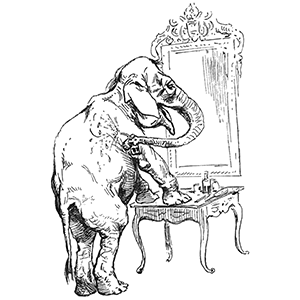
The mirror test is a measure of self-awareness, as animals either possess or lack the ability to recognize themselves in a mirror. The test was developed by Gordon Gallup Jr. in 1970, based in part on observations made by Charles Darwin. While visiting a zoo, Darwin held a mirror up to an orangutan and recorded the animal’s reaction, which included making a series of facial expressions.
Darwin noted that the significance of these expressions was ambiguous, and could either signify that the primate was making expressions at what it perceived to be another animal, or it could be playing a sort of game with a new toy.
read more »
Posted in Health, Science |
Leave a Comment »
November 29, 2011

Pleasure center is the general term used for the brain regions involved in pleasure. Discoveries made in the 1950s initially suggested that rodents could not stop electrically stimulating parts of their brain, mainly the nucleus accumbens, which was theorized to produce great pleasure.
Further investigations revealed that the septum pellucidium and the hypothalamus can also be targets for self-stimulation. Yet, more recent research has shown that such ‘pleasure’ electrodes do not, in fact, lead to pleasure but only a form of ‘wanting’ or motivation to obtain the stimulation. Instead, the weight of the evidence suggests that the pleasure center of the human brain is not a single center but rather a distributed system of brain regions of which important nodes include subcortical regions (such as the nucleus accumbens and ventral pallidum) and cortical regions (orbitofrontal cortex and anterior cingulate cortex).
read more »
Posted in Drugs, Health |
Leave a Comment »
November 29, 2011


Tetrahydrocannabinol [te-truh-hahy-druh-kuh-nab-uh-nawl] (THC), also known as delta-9-tetrahydrocannabinol (Δ9-THC), is the main chemical psychoactive substance found in the cannabis plant. It was first isolated in 1964. In pure form, it is a glassy solid when cold, and becomes viscous and sticky if warmed. An organic chemical (specifically an aromatic terpenoid), with very low solubility in water, but good solubility in most organic solvents (e.g. alcohol, acetone, and butane).
Like most pharmacologically-active plants, THC in cannabis is assumed to be involved in self-defense, perhaps against herbivores. THC also possesses high UV-B absorption properties, which, it has been speculated, could protect the plant from harmful UV radiation exposure. Dronabinol is the generic name of a THC isomer (it has the same number and type of atoms as THC but in a different configuration); it is sold as Marinol (a registered trademark of Solvay Pharmaceuticals).
read more »
Posted in Drugs, Health, Politics |
Leave a Comment »
November 28, 2011

Erotophobia [ih-rot-uh-foh-bee-uh] is a term coined by a number of researchers in the late 1970s and early 1980s to describe one pole on a continuum of attitudes and beliefs about sexuality. The model of the continuum is a basic polarized line, with erotophobia (fear of sex or negative attitudes about sex) at one end and erotophilia (positive feelings/attitudes about sex) at the other end.
Erotophobia has many manifestations. An individual or culture can have one or multiple erotophobic attitudes. Some types of erotophobia include fear of nudity, fear of sexual images, homophobia, fear of sex education, fear of sexual discourse, etc.
read more »
Posted in Health, Sex |
Leave a Comment »
November 28, 2011

Love-shyness is a specific type of severe chronic shyness that impairs or prevents intimate relationships. It implies a degree of inhibition and reticence with potential partners that is sufficiently severe to preclude participation in courtship, marriage and family roles.
According to this definition, love-shy people find it difficult if not impossible to be assertive in informal situations involving potential romantic or sexual partners. For example, a heterosexual love-shy man will have trouble initiating conversations with women because of strong feelings of social anxiety.
read more »
Posted in Health, Love |
Leave a Comment »
November 28, 2011
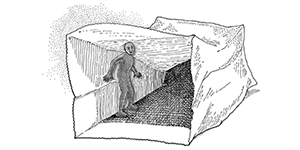
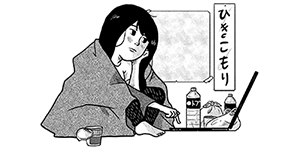
Avoidant personality disorder (or anxious personality disorder) is a personality disorder recognized in the Diagnostic and Statistical Manual of Mental Disorders handbook in a person characterized by a pervasive pattern of social inhibition, feelings of inadequacy, extreme sensitivity to negative evaluation, and avoidance of social interaction.
People with avoidant personality disorder often consider themselves to be socially inept or personally unappealing and avoid social interaction for fear of being ridiculed, humiliated, rejected, or disliked. Avoidant personality disorder is usually first noticed in early adulthood. Childhood emotional neglect and peer group rejection (e.g. bullying) are both associated with an increased risk for the development of AvPD.
read more »
Posted in Health |
Leave a Comment »


 The Daily Omnivore