November 10, 2011
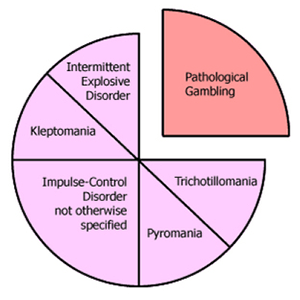
Impulse control disorder is a set of psychiatric disorders including intermittent explosive disorder, kleptomania, pathological gambling, pyromania (fire-starting), and three body-focused repetitive or compulsive behaviors (trichotillomania, a compulsion to pull one’s hair out; onychophagia, compulsive nail biting; and dermatillomania, compulsive skin picking). The onset of these disorders usually occurs between the ages of 7 and 15. Impulsivity, the key feature of these disorders, can be thought of as seeking a small, short term gain at the expense of a large, long term loss. Those with the disorder repeatedly demonstrate failure to resist their behavioral impetuosity.
Considered to be part of the obsessive-compulsive disorder spectrum, impulse control disorders are often associated with substance use disorders because ‘it has been speculated that these disorders are mediated by alterations of partially overlapping neural circuits.’ Impulse control disorders have two treatment options: psychosocial and pharmacological. Treatment methodology is informed by the presence of comorbid conditions.
Posted in Health |
Leave a Comment »
November 10, 2011

Compulsive hoarding (or disposophobia) is the acquisition of possessions (and failure to use or discard them) in excess of socially normative amounts, even if the items are worthless, hazardous, or unsanitary. Compulsive hoarding may impair mobility and interfere with basic activities, including cooking, cleaning, hygiene, sanitation, bathroom use and sleeping. It is not clear whether compulsive hoarding is an isolated disorder, or rather a symptom of another condition, such as obsessive-compulsive disorder.
While there is no clear definition of compulsive hoarding in accepted diagnostic criteria (such as the current DSM), there are several defining features: the acquisition of, and failure to discard, a large number of possessions that appear to be useless or of limited value; living spaces sufficiently cluttered so as to preclude activities for which those spaces were designed; significant distress or impairment in functioning caused by the hoarding; and reluctance or inability to return borrowed items; as boundaries blur, impulsive acquisitiveness could sometimes lead to stealing or kleptomania.
read more »
Posted in Health, Money |
2 Comments »
November 9, 2011

The Mozart effect can refer to: A set of research results that indicate that listening to Mozart’s music may induce a short-term improvement on the performance of certain kinds of mental tasks known as spatial-temporal reasoning; popularized versions of the theory, which suggest that ‘listening to Mozart makes you smarter, or that early childhood exposure to classical music has a beneficial effect on mental development. The term was first coined by Alfred A. Tomatis who used Mozart’s music as the listening stimulus in his work attempting to cure a variety of disorders.
The approach has been popularized in a book by Don Campbell, and is based on an experiment published in ‘Nature’ suggesting that listening to Mozart temporarily boosted scores on one portion of the IQ test. As a result, the Governor of Georgia, Zell Miller, proposed a budget to provide every child born in Georgia with a CD of classical music. Subsequent studies have had limited success duplicating the Mozart effect, and its validity is debated.
Posted in Art, Education, Health |
Leave a Comment »
November 9, 2011
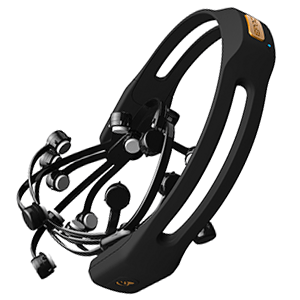
Thought identification refers to the empirically verified use of technology to, in some sense, read people’s minds. Recent research using Neuroimaging has provided some early demonstrations of the technology’s potential to recognize high-order patterns in the brain. In some cases, this provides meaningful (and controversial) information to investigators.
With brain scanning technology becoming increasingly accurate, experts predict important debates over how and when it should be used. One potential area of application is criminal law. Haynes explains that simply refusing to use brain scans on suspects also prevents the wrongly accused from proving their innocence.
read more »
Posted in Health, Politics, Technology |
1 Comment »
November 3, 2011

Movember is an annual, month-long event involving the growing of moustaches during the month of November. The event was conceived in 1999 by a group of Australian men from Adelaide. It is also known as ‘Novembeard.’ Since 2004, the Movember Foundation charity has run events to raise awareness and funds for men’s health issues, such as prostate cancer and depression, in Australia and New Zealand. In 2007, events were launched in Ireland, Canada, Cyprus, Czech Republic, Denmark, Greece, Spain, the United Kingdom, Israel, South Africa, and the United States.
The rules for participants as given on the official movember website are as follows: Once registered each bro must begin the 1st Movember with either a clean shaven face or facial growth dependant on your usual style. For the entire month of Movember each bro must shape grow and groom a moustache. There is to be no joining of the mo to the sideburns (that is considered a beard). There is to be no joining of the handlebars to your chin (that is considered a goatee). Each bro must conduct himself like a true country gentleman. Also shaving a beard to provide a ready-made mustache is cheating and not in the spirit of movember. A small growth of hair under the bottom lip (aka a tickler) is permitted as long as it is not connected to any other region.
Posted in Health, Humor |
Leave a Comment »
November 3, 2011

Lipstick is a cosmetic product containing pigments, oils, waxes, and emollients that applies color, texture, and protection to the lips. Ancient Mesopotamian women were possibly the first to wear lipstick. They crushed semi precious jewels and used them to decorate their lips.
Ancient Egyptians extracted purplish-red dye from seaweed, iodine, and toxic bromine, which resulted in serious illness. Cleopatra had her lipstick made from crushed carmine beetles, which gave a deep red pigment, and ants for a base. Lipsticks with shimmering effects were initially made using a pearlescent substance found in fish scales.
read more »
Posted in Health, Sex |
Leave a Comment »
November 3, 2011

Norepinephrine [nawr-ep-uh-nef-rin] is a hormone and a neurotransmitter. Areas of the body that produce or are affected by norepinephrine are described as noradrenergic. The terms noradrenaline (from the Latin) and norepinephrine (derived from Greek) are interchangeable, with noradrenaline the common name in most parts of the world. However, to avoid confusion and achieve consistency medical authorities have promoted norepinephrine as the favored nomenclature.
One of the most important functions of norepinephrine is its role as the neurotransmitter released from the sympathetic neurons (part of the subconscious, autonomic nervous system) affecting the heart. An increase in norepinephrine from the sympathetic nervous system increases the rate of contractions. As a stress hormone, norepinephrine affects parts of the brain, such as the amygdala, where attention and responses are controlled.
read more »
Posted in Drugs, Health, Science |
Leave a Comment »
November 3, 2011
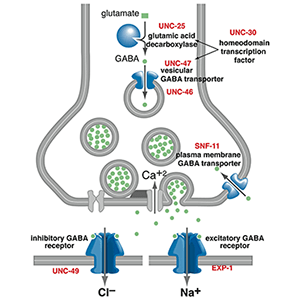
GABA (Gamma-Aminobutyric acid) is a neurotransmitter in the central nervous system of mammals. Its role changes from excitatory to inhibitory as the brain develops into adulthood. Normally, when a neuron receives an impulse, it will make the signal stronger, an inhibiting neurotransmitter prevents the cell from receiving the impulse, and the signal as a whole is weakened. In mammals, GABA regulates the extent to which neurons in the central nervous system will be stimulated.
It plays a role in regulating neuronal excitability throughout the nervous system. In humans, GABA is also directly responsible for the regulation of muscle tone. Even though chemically it is an amino acid, GABA is rarely referred to as such in the scientific or medical communities. The term ‘amino acid,’ used without a qualifier, refers to the alpha amino acids, which GABA is not. GABA is also not incorporated into proteins.
read more »
Posted in Drugs, Health, Science |
Leave a Comment »
November 1, 2011
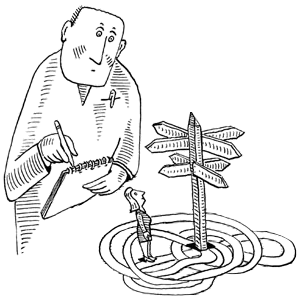
Developmental Topographical Disorientation, also known as DTD, is caused by the inability to segregate landmarks and derive navigational information from them, navigate through a non-verbal process, or generate cognitive maps. This is a newly discovered cognitive disorder in which patients who do not have brain structural abnormalities, such as lesions, and exhibit symptoms since childhood. Not to be confused with healthy individuals who have a poor sense of direction, DTD patients get lost in very familiar surroundings, such as their house or neighborhood, daily. This disorder could stem from a lack of experience in navigation during development and could present in different degrees of severity.
A woman in Vancouver, referred to as Pt1, presented with topographical disorientation in absence of any structural lesions. Despite normal cognitive development, she has never been able to orient with in the environment. Further testing showed that she was able to follow route based, landmark based, and verbal directions to reach a destination in an urban environment. In map based testing, the patient was unable to determine the shortest path between two locations on a map, but was able to follow a route traced on a map. The patient was unable to draw a detailed schematic of her house. Although the number of rooms and their locations were accurate, the spatial scaling was distorted.
Posted in Health, Language |
Leave a Comment »
October 31, 2011
Stumbling on Happiness is a 2006 non-fiction book by Daniel Gilbert, the central thesis of which is that, through perception and cognitive biases, people imagine the future poorly, in particular what will make them happy. He argues that imagination fails in three ways: Imagination tends to add and remove details, but people do not realize that key details may be fabricated or missing from the imagined scenario. Imagined futures (and pasts) are more like the present than they actually will be (or were). And imagination fails to realize that things will feel differently once they actually happen — most notably, the psychological immune system will make bad things feel not so bad as they are imagined to feel.
The advice Gilbert offers is to use other people’s experiences to predict the future, instead of imagining it. It is surprising how similar people are in much of their experiences, he says. He does not expect too many people to heed this advice, as our culture, accompanied by various thinking tendencies, is against this method of decision making. Also, Gilbert covers the topic of ‘filling in’or the frequent use of patterns, by the mind, to connect events which we do actually recall with other events we expect or anticipate fit into the expected experience. This ‘filling in’ is also used by our eyes and optic nerves to remove our blind spot or scotoma, and instead substitute what our mind expects to be present in the blind spot.
Posted in Health, Language |
Leave a Comment »
October 29, 2011
Mickey Hart (b. 1943), real name Michael Steven Hartman, is an American percussionist and musicologist. He is best known as one of the two drummers of the rock band the Grateful Dead. He and fellow Dead drummer Bill Kreutzmann earned the nickname ‘the rhythm devils.’ Before joining the Grateful Dead, Hart and his father, Leonard Hart, a champion rudimental drummer, owned and operated Hart Music, selling drums and musical instruments in San Carlos, California. Hart joined the Grateful Dead in 1967, and left in 1971 when he extricated himself from the band, due to conflict between band management and Mickey’s father. During his sabbatical, in 1972, he recorded the album ‘Rolling Thunder.’ He returned to the Dead in 1974, and remained with the group until their official dissolution in 1995. Collaboration with the remaining members of the Grateful Dead continues, under the band name The Dead.
Alongside his work with the Grateful Dead, Mickey Hart has flourished as a solo artist, percussionist, and the author of several books. In these endeavors he has pursued a lifelong interest in ethnomusicology and in world music. His travels and his interest in all things percussion-related led him to collect percussion instruments, and to collaborate with percussion masters the world over.
read more »
Posted in Art, Health, World |
1 Comment »
October 29, 2011

Wake therapy is a form of sleep deprivation used as a treatment for depression. The subject is woken at 1AM and stays awake all morning, and the next full day.
While sleepy, patients find that their depression vanishes, until they sleep again. Combining this with bright light therapy make the beneficial effects last longer than one day.
Posted in Health |
1 Comment »



