May 14, 2015


The Third Wave was an experimental social movement created by high school history teacher Ron Jones to demonstrate the appeal of fascism and explain how the German populace could accept the actions of the Nazi regime. Over the course of five days, Jones conducted a series of exercises in his classroom emphasizing discipline and community, intended to model certain characteristics of the Nazi movement.
As the movement grew outside his class and began to number in the hundreds, Jones began to feel that the experiment had spiraled out of control. He convinced the students to attend a rally where he claimed the announcement of a Third Wave presidential candidate would be televised. Upon their arrival, the students were presented with a blank channel and told the true nature of the movement, and shown a short film discussing the actions of Nazi Germany. The psychology involved has been extensively studied in terms of youth gang behavior and peer pressure, of which this experiment was a variant.
read more »
Posted in Health, Politics, War |
Leave a Comment »
May 6, 2015

A male bra (also known as a compression bra, compression vest, or gynecomastia vest) is a brassiere worn by a man. Adolescent boys and middle-aged men sometimes develop breasts (gynecomastia). Although there are options for treating gynecomastia, some elect surgery to reduce their breasts or wear a male bra, which typically flatten rather than lift. Other men wear bras for cross-dressing, for sexual purposes such as transvestic fetishism or feminization, or as a form of submission to their partner.
Additionally, some male athletes – more specifically runners – may choose to wear a sports bra under their shirts in order to prevent a common medical condition called jogger’s nipple, also known as nipple chafing. This condition is caused by excessive rubbing of wet sweat-soaked material over one’s nipples. In an episode ‘Seinfeld,’ titled ‘The Doorman,’ Kramer invented a male bra, which he called a ‘bro,’ for Frank Costanza, who was said to have very large breasts. Frank initially decided to market the invention, but disagreed on the name, instead wanting to call it a ‘Manssiere.’
Posted in Health, Humor, Sex |
Leave a Comment »
April 16, 2015

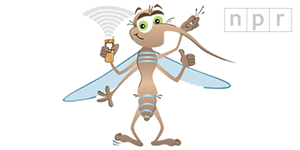
‘The Mosquito’ or Mosquito alarm is an electronic device used to deter loitering by young people by emitting sound at high frequency that older people have lost the ability to hear. It has two frequency settings, one of approximately 17.4 kHz that can generally be heard only by young people, and another at 8 kHz that can be heard by most people. The maximum potential output sound pressure level is stated by the manufacturer to be 108 decibels. The range of the sound is 140 feet with the sound baffle, and 200 feet without.
The sound can typically only be heard by people below 25 years of age, as the ability to hear high frequencies deteriorates with age (a phenomenon known as presbycusis). Crafty teenagers turned the sounds into a mobile phone ringtone, which could not be heard by older teachers if the phone rang during a class. Mobile phone speakers are capable of producing frequencies above 20 kHz. This ringtone became informally known as ‘Teen Buzz’ or ‘the Mosquito ringtone’ and has since been sold commercially.
read more »
Posted in Health, Politics, Technology |
Leave a Comment »
April 14, 2015

Road rage is aggressive or angry behavior by a driver of an automobile or other road vehicle. Such behavior might include rude gestures, verbal insults, deliberately driving in an unsafe or threatening manner, or making threats. Road rage can lead to altercations, assaults, and collisions that result in injuries and even deaths. It can be thought of as an extreme case of aggressive driving. The term originated in 1987 at KTLA, a Los Angeles television station, during a rash of freeway shootings. These shooting sprees even spawned a response from the AAA Motor Club to its members on how to respond to drivers with road rage or aggressive maneuvers and gestures.
Road rage levels and laws vary from country to country. In Germany, mere insults and rude gestures in traffic can lead to fines and even prison sentences. Australia also has rather stringent laws against malicious motoring. In the US, a 2007 study concluded that the cities with the least courteous drivers (most road rage) are Miami, Phoenix, New York, Los Angeles, and Boston. The cities with the most courteous drivers (least road rage) are Minneapolis, Nashville, St. Louis, Seattle, and Atlanta. In spite of this, in 2009, New York, Dallas/Fort Worth, Detroit, Atlanta and Minneapolis/St. Paul were rated the top five ‘Road Rage Capitals’ of the United States.
read more »
Posted in Health, Politics, World |
1 Comment »
April 13, 2015

Monoamine oxidase A (MAO-A), is an enzyme that in humans is encoded by the MAO-A gene, a version of which has been popularly referred to as the Warrior Gene. Several different versions of the gene are found in different individuals, although a functional gene is present in most humans (with the exception of a few individuals with Brunner syndrome, a rare genetic disorder). MAO aids in the breakdown of neurotransmitters such as serotonin and dopamine and are, therefore, capable of influencing the feelings, moods, and behaviors of individuals.
According to this, if there was a mutation to the gene that is involved in the process of promoting or inhibiting MAO enzymes, it could affect a person’s personality and could therefore make them more prone to aggression. A deficiency in the MAO-A gene has been linked to higher levels of aggression in males. In a 2009 criminal trial in the US, an argument based on a combination of ‘warrior gene’ and history of child abuse was successfully used to avoid a conviction of first-degree murder and the death penalty; however, the convicted murderer was sentenced to 32 years in prison.
Posted in Health, Politics, Science |
Leave a Comment »
April 9, 2015
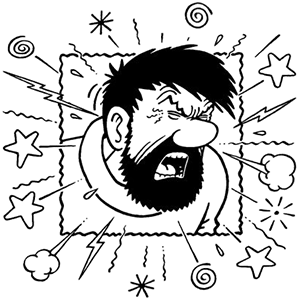
Coprolalia [kop-ruh-ley-lee-uh] is involuntary swearing or the involuntary utterance of obscene words or socially inappropriate and derogatory remarks. Coprolalia comes from the Greek ‘kopros’ meaning ‘feces’ and ‘lalia,’ ‘to talk.’ The term is often used as a clinomorphism (a simplification or amplification of the term for a medical condition), with ‘compulsive profanity’ inaccurately referred to as being Tourette syndrome (an inherited neurological disorder characterized by involuntary speech and movements). Related terms are ‘copropraxia,’ performing obscene or forbidden gestures, and ‘coprographia,’ making obscene writings or drawings.
Coprolalia encompasses words and phrases that are culturally taboo or generally unsuitable for acceptable social use, when used out of context. The term is not used to describe contextual swearing. It is usually expressed out of social or emotional context, and may be spoken in a louder tone or different cadence or pitch than normal conversation. It can be a single word, or complex phrases. A person with coprolalia may repeat the word mentally rather than saying it out loud; these subvocalizations can be very distressing.
read more »
Posted in Health, Language |
Leave a Comment »
April 6, 2015


Goose bumps (‘cutis anserina,’ also called ‘goose pimples’ or ‘goose flesh’) are bumps that develop on human skin at the base of body hairs in response to cold. They can also occur involuntarily as the result of strong emotions such as fear, nostalgia, pleasure, euphoria, awe, admiration, or sexual arousal. The same effect is manifested in the root word ‘horror’ in English, which is derived from Latin ‘horrere,’ which means ‘to bristle,’ and ‘be horrified,’ because of the accompanying hair reaction.
The reflex of producing goose bumps is known as ‘arasing,’ ‘piloerection,’ or the ‘pilomotor reflex.’ It occurs in many mammals besides humans; a prominent example is porcupines, which raise their quills when threatened, or sea otters when they encounter sharks or other predators. Small muscles at the follicles raise the body’s hair to make the animal appear larger and more imposing when facing predators. The formation of goose bumps in humans under stress is considered by some to be a vestigial reflex. In furred animals, the cold response erects hairs to trap air, creating a layer of insulation.
read more »
Posted in Health, Language, Science |
1 Comment »
April 1, 2015

Perceptual learning is the process of learning improved skills of perception from simple sensory discriminations (e.g., distinguishing two musical tones from one another) to complex categorizations of spatial and temporal patterns relevant to real-world expertise (e.g., reading, seeing relations among chess pieces, knowing whether or not an X-ray image shows a tumor). Perceptual learning forms important foundations of complex cognitive processes (i.e., language).
In visual Vernier acuity tasks, observers judge whether one line is displaced above or below a second line. Untrained observers are often already very good with this task, but after training, observers’ threshold has been shown to improve as much as six fold. Similar improvements have been found for visual motion discrimination and orientation sensitivity.
read more »
Posted in Education, Health, Science |
Leave a Comment »
March 26, 2015

The Truman Show delusion, informally known as Truman Syndrome, is a type of persecutory/grandiose delusion in which patients believe their lives are staged plays or reality television shows. The term was coined in 2008 by brothers Joel and Ian Gold, a psychiatrist and a neurophilosopher, respectively, after the 1998 film ‘The Truman Show,’ about a man who discovers he is living in a constructed reality televised globally around the clock. Since he was in the womb, all the people in Burbank’s life have been paid actors.
The concept predates this particular film. It was based on a 1989 episode of the ‘Twilight Zone,’ ‘Special Service,’ which begins with the protagonist discovering a camera in his bathroom mirror. This man soon learns that his life is being broadcast 24/7 on TV. Author Philip K. Dick has also written short stories and, most notably, a novel, ‘Time Out of Joint’ (1959), in which the protagonist lives in a created world in which his ‘family’ and ‘friends’ are paid to maintain the delusions.
read more »
Posted in Art, Health, Technology |
Leave a Comment »
March 13, 2015
‘Why Zebras Don’t Get Ulcers‘ is a 1994 (2nd ed. 1998, 3rd ed. 2004) book by Stanford University biologist Robert M. Sapolsky. The book proclaims itself as a ‘Guide to Stress, Stress-Related Diseases, and Coping’ on the front cover of its third and most recent edition. The title derives from Sapolsky’s idea that for animals such as zebras, stress is generally episodic (e.g., running away from a lion), while for humans, stress is often chronic (e.g., worrying about financial burdens). Therefore, many wild animals are less susceptible than humans to chronic stress-related disorders such asulcers, hypertension, decreased neurogenesis and increased hippocampal neuronal atrophy. However, chronic stress occurs in some social primates (Sapolsky studies baboons) for individuals on the lower side of the social dominance hierarchy.
Sapolsky focuses on the effects of glucocorticoids (a class of steroid hormones) on the human body, stating that they may be useful to animals in the wild escaping their predators during the fight-or-flight response, but the effects on humans, when secreted at high quantities or over long periods of time, are much less desirable. He relates the history of endocrinology, how the field reacted at times of discovery, and how it has changed through the years. While most of the book focuses on the biological machinery of the body, the last chapter of the book focuses on self-help. He also explains how social phenomena such as child abuse and the chronic stress of poverty affect biological stress, leading to increased risk of disease and disability.
Posted in Health, Language |
Leave a Comment »
March 9, 2015
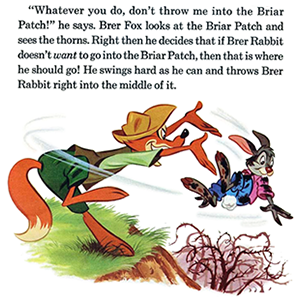
Reverse psychology is a technique involving the advocacy of a belief or behavior that is opposite to the one desired, with the expectation that this approach will encourage the subject of the persuasion to do what actually is desired: the opposite of what is suggested. This technique relies on the psychological phenomenon of reactance, in which a person has a negative emotional reaction to being persuaded, and thus chooses the option which is being advocated against. The one being manipulated is usually unaware of what is really going on.
Reverse psychology is often used on children due to their high tendency to respond with reactance, a desire to restore threatened freedom of action (e.g. telling children to stay in the house when you really want them to choose to go outside and play). Questions have however been raised about such an approach when it is more than merely instrumental, in the sense that ‘reverse psychology implies a clever manipulation of the misbehaving child’ and nothing more. With respect to ’emotional intelligence,’ the advice has been given: ‘don’t try to use reverse psychology….such strategies are confusing, manipulative, dishonest, and they rarely work’. In addition, consistently allowing a child to do the opposite of what he/she is being advised, undermines the authority of the parent.
read more »
Posted in Health, Science |
Leave a Comment »
March 5, 2015

Neural oscillation is rhythmic or repetitive neural activity in the central nervous system. For example Delta waves (0-4 Hz on an EEG) is the lowest frequency neural oscillation and is associated with deep sleep. Gamma waves are the highest frequency pattern at 25-100 Hz (though 40 Hz is typical), and according to a popular theory, they may be related to subjective awareness.
Gamma waves were initially ignored before the development of digital electroencephalography as analog electroencephalography is restricted to recording and measuring rhythms that are usually less than 25 Hz. One of the earliest reports on them was in 1964 using recordings of the electrical activity of electrodes implanted in the visual cortex of awake monkeys.
read more »
Posted in Health, Philosophy, Science |
Leave a Comment »


 The Daily Omnivore