March 28, 2013
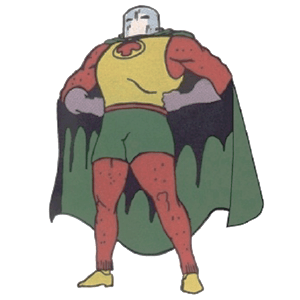
The Red Tornado is a fictional character, a superhero in the DC Comics universe, debuting during the Golden Age of Comic Books. Created by Sheldon Mayer, she first appeared in her civilian identity as Abigail Mathilda ‘Ma’ Hunkel in All-American Publications’ ‘All-American Comics’ #3 (June 1939), and became the ‘Red Tornado’ in ‘All-American Comics’ #20 (Nov. 1940).
As the Red Tornado, she was one of the first superhero parodies, as well as one of the first female superheroes (possibly the very first), and, when occasionally disguised as a man, comics’ first cross-dressing heroine. (Madame Fatal, earlier that year, was the first cross-dressing hero.) Initially as simply ‘Ma Hunkel,’ the Golden Age Red Tornado originated in Sheldon Meyer’s semi-autobiographical humor feature ‘Scribbly,’ about a boy cartoonist, in ‘All-American Comics.’ The feature ran through ‘All-American Comics’ #59, in 1944, the year DC Comics absorbed All-American Publications.
read more »
Posted in Humor |
Leave a Comment »
March 28, 2013

Forbush Man is the mascot of Marvel Comics’ satirical ‘Not Brand Echh’ (1967); he is the alter-ego of Irving Forbush, a fictional gofer at Marvel Comics. Forbush was dreamed up in 1955 by Marvel editor Stan Lee to refer to an imaginary low-grade colleague who was often the butt of Lee’s jokes.
Irving Forbush was originally introduced in 1955 in Marvel’s short-lived ‘Snafu’ magazine as a clone of the ‘Mad Magazine’ mascot Alfred E. Neuman (‘Snafu’ was itself a virtual clone of ‘Mad’). Forbush was given a line in the magazine’s content page where he was credited as Snafu’s founder (much as Benjamin Franklin was given the same credit in the ‘Saturday Evening Post’). (‘Snafu’ also listed another Forbush family member, as the other side of the magazine’s content column read ‘Losted [sic] by his cousin, Melvin Forbush’).
read more »
Posted in Humor |
Leave a Comment »
March 28, 2013
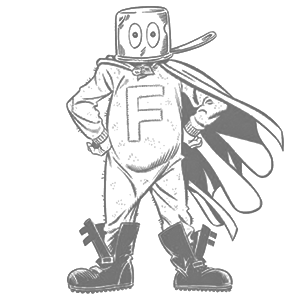
Not Brand Echh was a satiric comic book series published by Marvel Comics that parodied its own superhero stories as well as those of other comics publishers. Running for 13 issues from 1967 to 1969, it included among its contributors such notable writers and artists as Stan Lee, Jack Kirby, Gene Colan, Bill Everett, John and Marie Severin, and Roy Thomas.
With issue #9, it became a 68-page, 25¢ ‘giant,’ relative to the typical 12¢ comics of the times. Its mascot, ‘Forbush Man,’ introduced in the first issue, was a superhero wannabe with no superpowers and a costume of red long johns emblazoned with the letter ‘F’ and a cooking pot, with eye-holes, covering his never-revealed head. His secret identity was eventually revealed in issue #5 (Dec. 1967) as Irving Forbush, Marvel’s fictitious office gofer.
read more »
Posted in Humor |
Leave a Comment »
March 27, 2013

The 2000 Year Old Man is a persona in a comedy skit, originally created by Mel Brooks and Carl Reiner in 1961. Mel Brooks played the oldest man in the world, interviewed by Carl Reiner in a series of comedy routines that appeared on television, as well as being made into a collection of records. In a Jewish accent, Brooks would improvise answers to topics such as the earliest known language (‘basic Rock’). The inspiration for the skit was a tape-recorded exchange between Brooks and Reiner at a party. The tape recorder was brought into the mix shortly after the opening salvos, as the two comics soon had the party audience in stitches.
In 1961, when the duo began doing the skit on television, Brooks had just undergone surgery for gout. Because of his post-surgical discomfort, Brooks quipped, ‘I feel like a 2000-year-old man,’ which led Reiner to begin questioning him about what it’s like to be a 2000-year-old man and to describe history as Brooks saw it. Many of the jokes (especially the caveman jokes) were eventually brought to the screen in Brooks’ film ‘History of the World, Part I.’
Posted in Humor |
Leave a Comment »
March 22, 2013

‘Xavier: Renegade Angel‘ is a 2007 American CGI fantasy-comedy television series created by John Lee, Vernon Chatman, Jim Tozzi and Alyson Levy. Lee and Chatman are also the creators of ‘Wonder Showzen.’ The show was produced by PFFR, with animation by Cinematico. It premiered on Adult Swim on the Cartoon Network. ‘Xavier’ features a style characterized by a nonlinear, incoherent plot following the humorous musings of an itinerant humanoid pseudo-shaman and spiritual seeker named Xavier.
The show is known for its ubiquitous use of ideologically-critical black comedy, surrealist and absurdist humor presented through a psychedelic, New Age lens. The program is also normally rated TV-MA for intense, graphic, often bloody violence (V), as well as strong sexual content, use of racially/ethnically offensive language, grotesque depictions and content that is considered ‘too morbid and too incomprehensible for young viewers.’
read more »
Posted in Art, Humor, Philosophy |
Leave a Comment »
March 22, 2013

The Big Duck is a ferrocement (cement, sand, and steel mesh) building in the shape of a duck located in Flanders, New York, on Long Island. It was originally built in 1931 by duck farmer Martin Maurer in nearby Riverhead, and used as a shop to sell ducks and duck eggs.
The Big Duck is a prime example of literalism in advertising. The building measures 18 feet (5.5 m) wide, 30 feet (9.1 m) long and 20 feet (6.1 m) tall to the top of the head. The duck’s eyes are made from Ford Model T tail lights and the interior floor space is confined to 11 feet (3.4 m) by 15 feet (4.6 m).
read more »
Posted in Humor, Language, Money |
Leave a Comment »
March 22, 2013
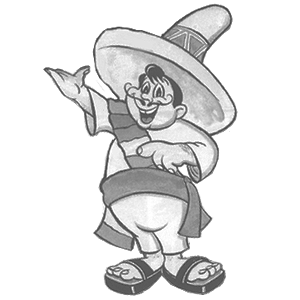
South of the Border is a roadside attraction on Interstate 95 south of the border between North and South Carolina, which serves as a rest stop for vacationers and tourists traveling to and from Florida. The rest area features not only restaurants, gas stations and a motel, but also a small amusement park, shopping (including, formerly, adult entertainment at the ‘Dirty Old Man Shop’), and, famously, fireworks. Its mascot is Pedro, an extravagantly stereotypical Mexican bandido.
It is known for being advertised by hundreds of billboards along surrounding highways, starting over 150 miles away. Federal Reserve Chairman Ben Bernanke, originally from nearby Dillon, South Carolina, worked for a summer as a poncho-wearing waiter at South of the Border to help pay his way through Harvard. South of the Border also hosted the bar/night club ‘Pedro’s’ from 1985-1998. This was a popular spot for revellers including many Lumbee Indians who visited the club from neighboring (and dry) Robeson County.
read more »
Posted in Humor, Money |
Leave a Comment »
March 21, 2013
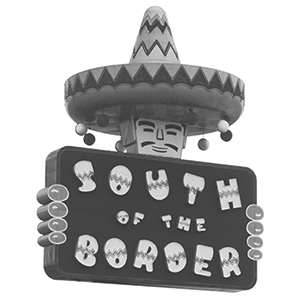
Tourist trap is an establishment, or group of establishments, that has been created or re-purposed with the aim of attracting tourists and their money. Tourist traps will typically provide services, entertainment, souvenirs and other products for tourists to purchase.
While the term may have negative connotations for some, such establishments may be viewed by tourists as fun and interesting diversions. In some areas like Ishpeming, Michigan, Flush toilets may be a sufficient draw to entice tourists to stop as they are not readily available at many tourist facilities in Michigan’s Upper Peninsula. Wall Drug, in South Dakota, began its tourist trade simply by offering ice water.
Posted in Humor, Money |
Leave a Comment »
March 21, 2013

Mutton busting is an event held at rodeos similar to bull riding or bronc riding, in which children ride or race sheep. In the event, a sheep is held still, either in a small chute or by an adult handler while a child is placed on top in a riding position. Once the child is seated atop the sheep, the sheep is released and usually starts to run in an attempt to get the child off.
There are no set rules for mutton busting, no national organization, and most events are organized at the local level. The vast majority of children participating in the event fall off in less than 8 seconds. Organizations such as the ASPCA discourage the practice on the grounds that it does not promote kindness to, or respect of, animals.
Posted in Games, Humor |
Leave a Comment »
March 19, 2013

Yoshiro Nakamatsu (b. 1928), also known as Dr. NakaMats, is Japanese inventor who has become something of a minor celebrity for the dubious science behind his inventions and his eccentricity. He regularly appears on Japanese talk shows which, in conjunction with his appearance, usually craft a humorous segment based on one or more of his inventions. He is a prolific inventor, and he even claims to hold the world record for number of inventions with over 4,000 patents.
In his interviews, Nakamatsu described his ‘creativity process,’ which includes listening to music and concludes with diving underwater, where he says he comes up with his best ideas and records them while underwater. Nakamatsu claims to benefit from lack of oxygen to the brain, making inventions ‘0.5 seconds before death.’ He also built a million dollar toilet room made completely out of gold that he claims helps make him think better. Nakamatsu also has an elevator in his house that he claims helps him think better. He strictly denies that it is an elevator, but rather a ‘vertical moving room.’ Nakamatsu’s goal is to live at least 144 years.
read more »
Posted in Humor, Technology, World |
Leave a Comment »
March 18, 2013

Kung Faux is a 2003 critically acclaimed action comedy television series and audio visual art assemblage created by postmodern revisionist Michael ‘Mic’ Neumann that remixes classic kung fu movies with popular music, comic book style editing with video game style special effects, and new storylines with voice-overs dubbed by contemporary art stars, hip hop personalities, and pop culture icons. ‘Revisionist Mic Neumann has an offering worthy of the Postmodernism canon, alongside Jean-Luc Godard’s ‘Weekend’ and Luis Bunuel’s ‘Chien Andalou,” reported Steve Johnston of ‘The Film Cynics.’
Notable visuals, music and voice-over work was performed by the likes of hip-hop artists De La Soul, Guru, Masta Ace, and Queen Latifah, while other ‘Kung Faux’ artists and performers range from underground to legendary, and contemporary, including Dave Kinsey, KAWS, Steve Powers, break dancer Crazy Legs, Elephant Man, Afrika Bambaataa, Biz Markie, Jean Grae, Roc Raida, Sadat X, Ron van Clief and Harold Hunter.
Posted in Art, Humor |
Leave a Comment »
March 18, 2013

Paul Krassner (b. 1932) is an American author, journalist, stand-up comedian, and the founder, editor and a frequent contributor to the freethought magazine ‘The Realist,’ first published in 1958. Krassner became a key figure in the counterculture of the 1960s as a member of Ken Kesey’s ‘Merry Pranksters’ and a founding member of the Yippies (Youth International Party).
Krassner was a child violin prodigy (and was the youngest person ever to play Carnegie Hall, in 1939 at age six). His parents were Jewish, but Krassner is firmly secular, considering religion ‘organized superstition.’
read more »
Posted in Humor, Language, Politics |
1 Comment »


 The Daily Omnivore