April 8, 2013


One aspect of how women are portrayed in popular culture is a purported rivalry between blonde and brunettes. The rivalry in American society dates back to at least 1875 when the first female professional baseball players were assigned to teams according to their hair color.
Baseball historian John Thorn notes that blonde and brunette baseball teams barnstormed the country in the late 1800s. A more contemporary example is the gridiron football game called ‘blondes vs. brunettes powderpuff football,’ a charity event that raises money for the Alzheimer’s Association. The annual contests were started in the fall of 2005, in Washington D.C.
read more »
Posted in Humor, Love |
Leave a Comment »
April 2, 2013

Oscar the Grouch is a Muppet character on the television program ‘Sesame Street.’ He has a green body (during the first season he was orange), has no visible nose, and lives in a trash can. His favorite thing in life is trash, as evidenced by the song ‘I Love Trash.’ A running theme is his compulsive hoarding of seemingly useless items.
‘The Grouch’ aptly describes his misanthropic interaction with the other characters, but also refers to his species. The character is performed by Caroll Spinney, and has been performed by him since the show’s first episode.
read more »
Posted in Education, Humor |
Leave a Comment »
March 31, 2013
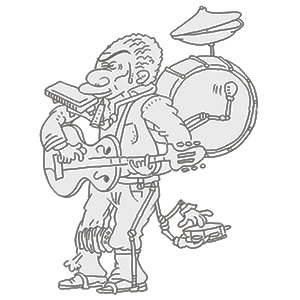
The fotdella was an instrument invented and constructed by Jesse ‘The Lone Cat’ Fuller, an American one-man band musician, who needed an accompaniment instrument beyond the usual high-hat (foot-operated cymbal) or bass drum favored by street musicians. Dreaming it up in the early 1950s, while lying in bed, he set about constructing a foot-operated bass instrument. It ended up as a large upright box with a rounded top, vaguely shaped like the top of a double bass, with a short neck on top. Six bass strings were attached to the neck and stretched over the body.
To play the instrument, there was a homemade set of foot pedals, each one bringing a padded hammer to strike a string when depressed, like the action of a piano. With these six bass notes, Fuller could accompany himself on the 12-string guitar in several keys. The name ‘fotdella’ was given to the instrument by Fuller’s wife, who took to calling it a ‘foot-diller’ (as in the then-current expression, ‘killer-diller,’ meaning ‘exceedingly good’); later, it became shortened to just fotdella.
Posted in Art, Humor |
Leave a Comment »
March 31, 2013
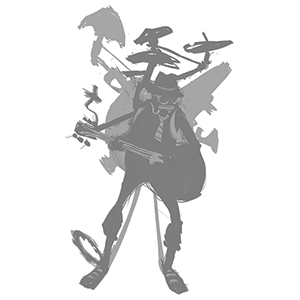
A one-man band is a musician who plays a number of musical instruments simultaneously using their hands, feet, limbs, and various mechanical contraptions. The simplest type of ‘one-man band’ — a singer accompanying themselves on acoustic guitar and harmonica mounted in a metal ‘harp rack’ below the mouth — is often used by buskers.
More complicated setups may include wind instruments strapped around the neck, a large bass drum mounted on the musician’s back with a beater which is connected to a foot pedal, cymbals strapped between the knees or triggered by a pedal mechanism, tambourines and maracas tied to the limbs, and a stringed instrument strapped over the shoulders (e.g., a banjo, ukulele or guitar). Since the development of Musical Instrument Digital Interface (MIDI) in the 1980s, musicians have also incorporated chest-mounted MIDI drum pads, foot-mounted electronic drum triggers, and electronic pedal keyboards into their set-ups.
read more »
Posted in Art, Humor, Technology |
1 Comment »
March 31, 2013

Patrice O’Neal (1969 – 2011) was an American stand-up comedian, radio personality, and actor. He was born in New York City and grew up in the Roxbury neighborhood of Boston. His mother named him after Patrice Lumumba, the leader of the Congolese independence movement. He was raised by his mother and never met his father. At the age of 17, Oneal was convicted of statutory rape of a 15 year old girl and sentenced to 60 days in prison, served during his summer break, so as not to disrupt his schooling.
The act, which occurred when Oneal was still 16, would have been legal in most states, but Massachusetts lacks a close-in-age exception, and has an age of consent of 16. Oneal said his humor helped him to negotiate the harsh realities of prison. Oneal was a star football player at West Roxbury High School, ending his career with 3 letters in varsity football and a state championship his senior year. He turned down football scholarships in order to attend Northeastern University on a public housing grant, majoring in Performing Arts.
read more »
Posted in Humor |
1 Comment »
March 29, 2013

Superfolks is a 1977 novel by Robert Mayer, which satirizes the superhero and comic book genres, and was aimed at a more adult audience than those genres typically attracted. Superfolks examines comic book conventions and clichés from a more serious, ‘literary’ perspective.
The novel was influential on many writers of superhero comic books in the 1980s and 1990s, notably Alan Moore and Kurt Busiek. Although the book’s pop culture references clearly date it to the 1970s, its influence on the deconstruction of the superhero genre is still felt through Moore’s ‘Watchmen,’ ‘Marvelman,’ and ‘Superman: Whatever Happened to the Man of Tomorrow?’
read more »
Posted in Humor, Language |
Leave a Comment »
March 28, 2013
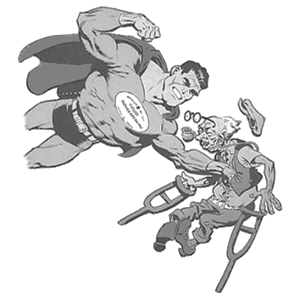
‘Superduperman‘ is a satirical story by cartoonists Harvey Kurtzman and Wally Wood that was published in the fourth issue of ‘Mad’ in 1953. Lampooning both Superman and Captain Marvel, it revolutionized the types of stories seen in ‘Mad,’ leading to greatly improved sales. Writers such as Alan Moore have cited this story as an influence.
The plot parallels the Superman scenario of the period: ‘Clark Bent’ is a lowly assistant to the copy boy at ‘The Daily Dirt’ newspaper, where he tries, unsuccessfully, to woo the narcissistic and indifferent ‘Lois Pain.’
read more »
Posted in Humor, Money |
1 Comment »
March 28, 2013
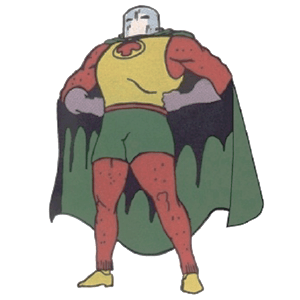
The Red Tornado is a fictional character, a superhero in the DC Comics universe, debuting during the Golden Age of Comic Books. Created by Sheldon Mayer, she first appeared in her civilian identity as Abigail Mathilda ‘Ma’ Hunkel in All-American Publications’ ‘All-American Comics’ #3 (June 1939), and became the ‘Red Tornado’ in ‘All-American Comics’ #20 (Nov. 1940).
As the Red Tornado, she was one of the first superhero parodies, as well as one of the first female superheroes (possibly the very first), and, when occasionally disguised as a man, comics’ first cross-dressing heroine. (Madame Fatal, earlier that year, was the first cross-dressing hero.) Initially as simply ‘Ma Hunkel,’ the Golden Age Red Tornado originated in Sheldon Meyer’s semi-autobiographical humor feature ‘Scribbly,’ about a boy cartoonist, in ‘All-American Comics.’ The feature ran through ‘All-American Comics’ #59, in 1944, the year DC Comics absorbed All-American Publications.
read more »
Posted in Humor |
Leave a Comment »
March 28, 2013
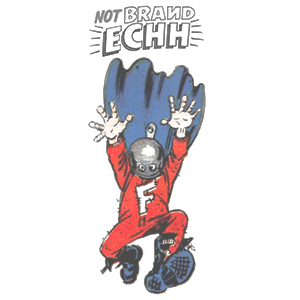
Forbush Man is the mascot of Marvel Comics’ satirical ‘Not Brand Echh’ (1967); he is the alter-ego of Irving Forbush, a fictional gofer at Marvel Comics. Forbush was dreamed up in 1955 by Marvel editor Stan Lee to refer to an imaginary low-grade colleague who was often the butt of Lee’s jokes.
Irving Forbush was originally introduced in 1955 in Marvel’s short-lived ‘Snafu’ magazine as a clone of the ‘Mad Magazine’ mascot Alfred E. Neuman (‘Snafu’ was itself a virtual clone of ‘Mad’). Forbush was given a line in the magazine’s content page where he was credited as Snafu’s founder (much as Benjamin Franklin was given the same credit in the ‘Saturday Evening Post’). (‘Snafu’ also listed another Forbush family member, as the other side of the magazine’s content column read ‘Losted [sic] by his cousin, Melvin Forbush’).
read more »
Posted in Humor |
Leave a Comment »
March 28, 2013
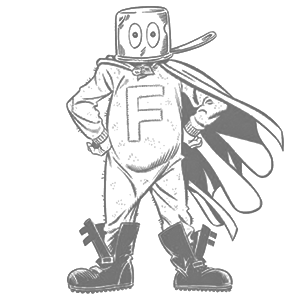
Not Brand Echh was a satiric comic book series published by Marvel Comics that parodied its own superhero stories as well as those of other comics publishers. Running for 13 issues from 1967 to 1969, it included among its contributors such notable writers and artists as Stan Lee, Jack Kirby, Gene Colan, Bill Everett, John and Marie Severin, and Roy Thomas.
With issue #9, it became a 68-page, 25¢ ‘giant,’ relative to the typical 12¢ comics of the times. Its mascot, ‘Forbush Man,’ introduced in the first issue, was a superhero wannabe with no superpowers and a costume of red long johns emblazoned with the letter ‘F’ and a cooking pot, with eye-holes, covering his never-revealed head. His secret identity was eventually revealed in issue #5 (Dec. 1967) as Irving Forbush, Marvel’s fictitious office gofer.
read more »
Posted in Humor |
Leave a Comment »
March 27, 2013

The 2000 Year Old Man is a persona in a comedy skit, originally created by Mel Brooks and Carl Reiner in 1961. Mel Brooks played the oldest man in the world, interviewed by Carl Reiner in a series of comedy routines that appeared on television, as well as being made into a collection of records. In a Jewish accent, Brooks would improvise answers to topics such as the earliest known language (‘basic Rock’). The inspiration for the skit was a tape-recorded exchange between Brooks and Reiner at a party. The tape recorder was brought into the mix shortly after the opening salvos, as the two comics soon had the party audience in stitches.
In 1961, when the duo began doing the skit on television, Brooks had just undergone surgery for gout. Because of his post-surgical discomfort, Brooks quipped, ‘I feel like a 2000-year-old man,’ which led Reiner to begin questioning him about what it’s like to be a 2000-year-old man and to describe history as Brooks saw it. Many of the jokes (especially the caveman jokes) were eventually brought to the screen in Brooks’ film ‘History of the World, Part I.’
Posted in Humor |
Leave a Comment »
March 22, 2013

‘Xavier: Renegade Angel‘ is a 2007 American CGI fantasy-comedy television series created by John Lee, Vernon Chatman, Jim Tozzi and Alyson Levy. Lee and Chatman are also the creators of ‘Wonder Showzen.’ The show was produced by PFFR, with animation by Cinematico. It premiered on Adult Swim on the Cartoon Network. ‘Xavier’ features a style characterized by a nonlinear, incoherent plot following the humorous musings of an itinerant humanoid pseudo-shaman and spiritual seeker named Xavier.
The show is known for its ubiquitous use of ideologically-critical black comedy, surrealist and absurdist humor presented through a psychedelic, New Age lens. The program is also normally rated TV-MA for intense, graphic, often bloody violence (V), as well as strong sexual content, use of racially/ethnically offensive language, grotesque depictions and content that is considered ‘too morbid and too incomprehensible for young viewers.’
read more »
Posted in Art, Humor, Philosophy |
Leave a Comment »



