July 22, 2011

Shel Silverstein (1930 – 1999), was an American poet, musician, cartoonist, and author of children’s books. He styled himself as Uncle Shelby in his children’s books.
Silverstein grew up in Chicago: ‘When I was a kid—12 to 14, around there—I would much rather have been a good baseball player or a hit with the girls, but I couldn’t play ball. I couldn’t dance. Luckily, the girls didn’t want me. Not much I could do about that. So I started to draw and to write. I was also lucky that I didn’t have anybody to copy, be impressed by. I had developed my own style; I was creating before I knew there was a Thurber, a Benchley, a Price and a Steinberg. I never saw their work till I was around 30. By the time I got to where I was attracting girls, I was already into work, and it was more important to me. Not that I wouldn’t rather make love, but the work has become a habit.’
read more »
Posted in Art, Humor, Language |
Leave a Comment »
July 19, 2011
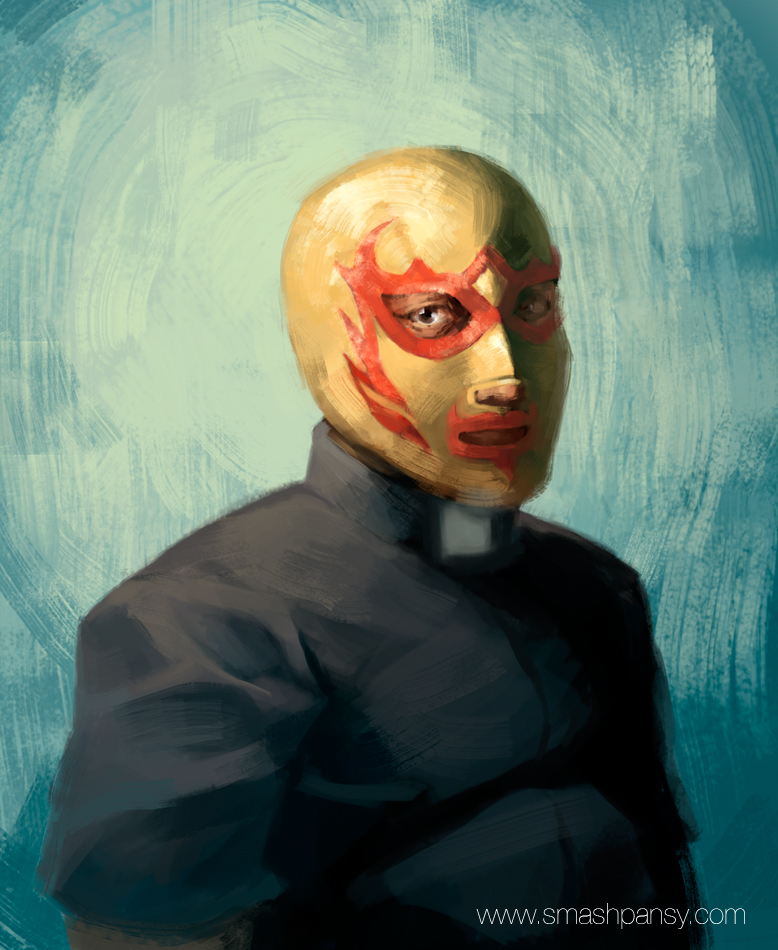
Fray Tormenta (b. 1945) is a Mexican priest who supported an orphanage for 23 years as a lucha libre wrestler. While performing, he wore a red and yellow mask. He is largely retired from wrestling, making only sporadic in-ring appearances, but still wears his mask even in his duties as a priest. Fray Tormenta means ‘Friar Storm’ in English. Father Sergio Gutiérrez Benítez had long been inspired to become a masked luchador after watching two 1963 Mexican films, ‘El Señor Tormenta’ (‘Mister Storm’) and ‘Tormenta En El Ring’ (‘Storm In The Ring’) both of which featured the story of a poor Mexican priest who supported the children of his orphanage by fighting as a lucha libre wrestler at night.
At age 22 he became interested in the priesthood and was inducted into the Piarists Order. His theological training took him to Rome, and then Spain, and for a while he taught philosophy and history at Roman Catholic universities in Mexico. He later became a secular priest in the Diocese of Texcoco, where he founded an orphanage. In need of money to take care of the children, the father became the masked wrestler known as Fray Tormenta. During that time he never let anyone know of his identity as a priest, explaining ‘No one would have taken me seriously as a wrestler had they known I was a priest.’
Posted in Games, Humor, Philosophy |
Leave a Comment »
July 18, 2011

A kludge [klooj] is a workaround, a quick-and-dirty solution, a clumsy or inelegant, yet effective, solution to a problem, typically using parts that are cobbled together. The present word has alternate spellings (kludge and kluge) and pronunciations (rhyming with fudge and stooge respectively), and several proposed etymologies.
Kluge was common Navy slang in the WWII era for any piece of electronics that worked well on shore but consistently failed at sea. In aerospace design a kluge was a temporary design using separate commonly available components that were not flight worthy to proof the design.
read more »
Posted in Humor, Language, Technology |
Leave a Comment »
July 14, 2011

MacGyver is an American action-adventure television series, where the titular character employs his resourcefulness and knowledge of chemistry, physics, technology, and survival skills to resolve what are often life-or-death crises. He creates inventions from simple items to solve these problems. These inventions became synonymous with the character and were called MacGyverisms by fans. MacGyver was unlike secret agents in other television series and films because, instead of relying on high-tech weapons and tools, he carried only a Swiss Army knife and duct tape but never a gun. A boyhood friend of his was accidentally killed by a revolver, and MacGyver has avoided them since.
The show’s writers based MacGyver’s inventions on items they found on location, concepts from scientific advisers John Koivula and Jim Green, and real events. The show also offered a monetary prize to people who sent good ideas for the show. A young fan suggested that MacGyver could patch up a vehicle’s radiator by cracking an egg into it, and the episode ‘Bushmaster’ was constructed around this trick.
Posted in Humor, Language, Technology |
Leave a Comment »
July 13, 2011

A card sharp (or card shark) is a person who uses skill and deception to win at poker or other card games. The label is not always intended as pejorative, and is sometimes used to refer to practitioners of card tricks for entertainment purposes. The term has also taken on the meaning of ‘expert card gambler who takes advantage of less-skilled players,’ without implication of actual cheating at cards, in much the same way that ‘pool shark’ or ‘pool hustler’ can (especially when used by non-players) be intended to mean ‘skilled player’ rather than ‘swindler.’ A card sharp/shark may be a ’rounder’ who travels, seeking out high-stakes games in which to gamble.
Card sharps who cheat or perform tricks use methods to keep control of the order of the cards or sometimes to control one specific card. Most, if not all, of these methods employ sleight of hand. Essential skills are false shuffles and false cuts that appear to mix the deck but actually leave the cards in the same order. More advanced techniques include culling (manipulating desired cards to the top or bottom of the deck), and stacking (putting desired cards in position to be dealt). Dealing the cards can also be manipulated, by dealing either the bottom card from the deck or the second one from the top instead of the top card. These are called Bottom dealing and Second dealing, respectively. Dealing may also be done from the middle of the deck, known as the middle deal or center deal, but this is not as common.
Posted in Games, Humor, Language |
Leave a Comment »
July 13, 2011

Hunter S. Thompson (1937 – 2005) was an American journalist and author. He is credited as the creator of Gonzo journalism, a style of reporting where reporters involve themselves in the action to such a degree that they become central figures of their stories.
He is known also for his unrepentant lifelong use of alcohol, LSD, mescaline, and cocaine (among other substances); his love of firearms; his inveterate hatred of Richard Nixon; and his iconoclastic contempt for authoritarianism. While suffering a bout of health problems, he committed suicide in 2005, at the age of 67.
read more »
Posted in Drugs, Humor, Language |
Leave a Comment »
July 13, 2011

Raoul Duke is the fictional character and antihero based on Hunter S. Thompson in his autobiographical novel ‘Fear and Loathing in Las Vegas.’ The book was originally written under the name Raoul Duke. He is the main character and narrator of many of Thompson’s stories, novels, and articles, often taking part of events in Thompson’s life in Thompson’s place.
He is portrayed as a cynical, eccentric hedonist. He is in a near-perpetual state of intoxication on whatever drugs happen to be available, ranging from marijuana to amyl nitrite to adrenochrome. He usually obtains and consumes these substances in the company of his attorney, Gonzo, a half-crazed 300 pound Samoan, whose drug-induced frenzies give even Duke pause. Thompson based Gonzo on his friend the civil rights lawyer Oscar Zeta Acosta.
read more »
Posted in Drugs, Humor, Language |
Leave a Comment »
July 12, 2011

Rumspringa [room-spring-uh] (German: ‘jumping around’) generally refers to a period of adolescence for some members of the Amish, a subsect of the Anabaptist Christian movement, that begins around the age of sixteen and ends when a youth chooses baptism within the Amish church or instead leaves the community. The vast majority choose baptism and remain in the church.
Not all Amish use this term, but in sects that do, Amish elders generally view this as a time for courtship and finding a spouse. Wenger Mennonites youth go through a period of rumspringa between ages 16 and 18. It is sometimes referred to as a period to ‘sow wild oats.’ As is the case in many societies, Amish adolescents may engage in rebellious behavior, resisting or defying parental norms. In many cultures, enforcement may be relaxed, and misbehavior tolerated or overlooked to a degree.
read more »
Posted in Humor, Philosophy, Sex |
3 Comments »
July 12, 2011

Artist’s Shit (Italian: ‘Merda d’artista’) is a 1961 artwork by the Italian artist Piero Manzoni. The work consists of 90 tin cans, each 30 grams, with a label in Italian, English, French, and German stating: ‘Artist’s Shit; Freshly preserved; Produced and tinned in May 1961.’ At the time the piece was created Manzoni was producing works that explored the relationship between art production and human production, Artist’s Breath (‘Fiato d’artista’), a series of balloons filled with Manzoni’s breath, being an example.
A tin was sold for €124,000 at Sotheby’s in 2007. The cans were originally to be valued according to their equivalent weight in gold — $37 each in 1961 — with the price fluctuating according to the market. One of Manzoni’s collaborators, Agostino Bonalumi, claimed that the tins are full not of faeces but plaster; but some cans have leaked and confirmed they are indeed faeces — though whether human or animal has not been verified.
Posted in Art, Humor, Money |
Leave a Comment »
July 12, 2011

Façade is a 2005 artificial-intelligence-based interactive story created by Michael Mateas and Andrew Stern, and exhibited at several international art shows. Façade puts the player in the role of a close friend of Grace and Trip, a couple who invited you over for cocktails.
This pleasant gathering, however, is somewhat damaged by the clear domestic confrontation between your hosts. Making full use of the incorporated language processing software, the game allows the player to type sentences to ‘speak’ with the couple, either supporting them through their troubles, driving them farther apart, or being thrown out of the apartment.
read more »
Posted in Games, Humor, Technology |
Leave a Comment »
July 12, 2011

Southland Tales is a 2006 science fiction dark comedy-drama film, written and directed by Richard Kelly. The title refers to the Southland, a name used by locals to refer to Southern California and Greater Los Angeles. Set in the then near future of an alternate history, the film is a portrait of Los Angeles and a comment on the military-industrial news-tainment complex. The film features an ensemble cast. Original music for the film was provided by Moby. The film was a critical and financial failure.
The film opens on El Paso and Abilene, Texas, both of which fall victim to twin nuclear attacks on July 4, 2005—a catastrophe of unimaginable proportions which launches America into World War III. The PATRIOT Act has extended authority to a new agency known as US-IDent, which keeps constant tabs on citizens and heavily censors the media and the Internet.
read more »
Posted in Art, Humor, Politics |
Leave a Comment »
July 8, 2011

Dr. Octagon was a fictional character created by American rapper Keith Thornton, better known as Kool Keith. First appearing on Thornton’s 1996 debut solo album, ‘Dr. Octagonecologyst,’ Dr. Octagon is an extraterrestrial time traveling gynecologist and surgeon from the planet Jupiter. Thornton performed and released three albums under the alias. The character was murdered by another of his characters, Dr. Dooom on Thornton’s 1999 album ‘First Come, First Served,’ and was briefly revived before once again being killed on Thornton’s 2008 album ‘Dr. Dooom 2,’ in response to the release of ‘The Return of Dr. Octagon,’ an album largely produced without Thornton’s involvement.
In Dr. Octagonecologyst, Dr. Octagon is described as having yellow eyes, green skin, and a pink-and-white Afro. Further tracks detail a list of services offered by Octagon, who claims to treat chimpanzee acne and moosebumps, and relocate saliva glands. Octagon is described as being incompetent, as many of his surgery patients die as he conducts his rounds. He often engages in sexual intercourse with female patients and nurses. Octagon’s uncle, Mr. Gerbik, is described as being half shark, having the skin of an alligator, and is 208 years old.
read more »
Posted in Art, Humor |
1 Comment »