February 7, 2011

A guy-cry film is the masculine version of the chick flick genre, a film that addresses a male audience, but has strong emotional material. Sports films are important to the guy-cry genre, but sports action is not necessarily essential to qualify a film as a genuine guy-cry. Some notable sports films that could be defined as guy-cry would be Field of Dreams, Rudy, Brian’s Song, and The Wrestler.
While it may seem that ‘guy-cry’ is a neologism, it is a genre that has been around for many years and is now receiving critical attention from scholars and trade publications. Early popular guy-cry films date back to the early 1970s with films such as Five Easy Pieces and One Flew Over the Cuckoo’s Nest. Important themes to the guy-cry genre are concepts of brotherhood, sacrifice, loyalty, and family.
Posted in Art, Humor, Language |
Leave a Comment »
February 3, 2011

Magic smoke (also called factory smoke or blue smoke) is a tongue in cheek reference to smoke produced by malfunctioning electronic circuits. Smoke is frequently observed to come out of electronic components when overheated. According to the joke, manufacturers put a portion of magic smoke into every electronic component, and the device functions normally so long as the smoke does not escape.
The origins of the magic smoke have become a running joke that started among electrical engineers and technicians before it was more recently adopted by computer programmers. The actual origin of blue smoke is the black plastic epoxy material that is used to package most common semiconductor devices such as transistors and integrated circuits, which produces a bluish colored smoke during combustion.
Posted in Humor, Technology |
Leave a Comment »
February 3, 2011

Bang snaps are a type of small novelty firework sold as a trick noisemaker. They consist of a small amount of gravel or coarse sand impregnated with a minute quantity (~.08 milligrams) of silver fulminate high explosive and twisted in a cigarette paper to produce a shape resembling a teardrop with a tail. When stepped on, ignited, or thrown on a hard surface, the friction-sensitive silver fulminate detonates, producing a sharp salute similar to that of a cap gun. Despite producing a legitimate (albeit tiny) high-explosive detonation, the extremely high mass ratio of gravel to explosive acts as a buffer to ensure that the devices produce only the audible ‘crack’ of the supersonic shock wave.
They are incapable of producing physical damage, even if discharged directly against skin, and the detonation frequently fails to even break the thin paper holding the ingredients. The explosion is also too weak to propel the gravel any distance, which usually falls to the ground. This makes them safe for use as a children’s toy, for which purpose they have been widely sold across the world since the 1950s. Currently the only US jurisdiction which restricts the use and sale of bang snaps is the state of New Jersey, which bans all forms of consumer pyrotechnics including sparklers. Other states impose the same age restrictions on purchasing bang snaps as that of permitted fireworks, usually 17 or 18.
Posted in Humor, Technology |
Leave a Comment »
February 3, 2011
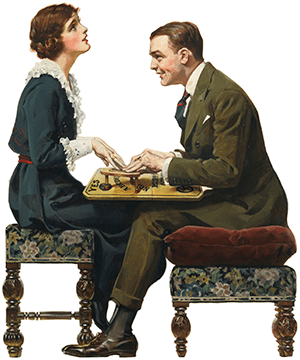
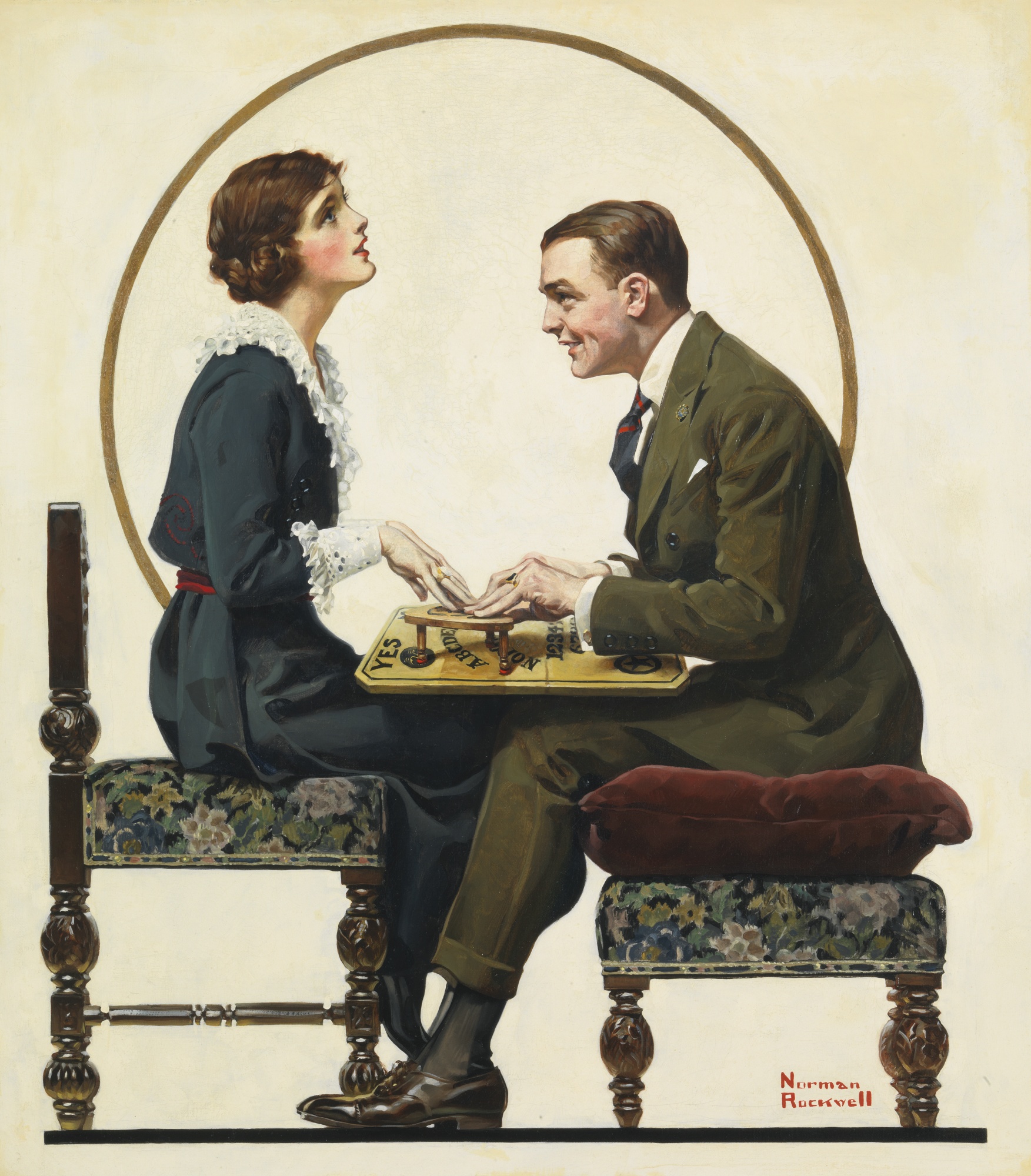
Ouija [wee-jee] is a commercial trademark for a ‘talking board,’ which is a device marked with letters, numbers, and other symbols, supposedly used to communicate with spirits. It uses a planchette (small heart-shaped piece of wood) to indicate the spirit’s message by spelling it out on the board during a séance. The fingers of the séance participants are placed on the planchette, which then moves about the board to spell out words or become physically manifested as a result of the ideomotor effect (a psychological phenomenon wherein a subject makes motions unconsciously).
Following its commercial introduction by businessman Elijah Bond in the late 1890s, the Ouija board was regarded as a harmless parlor game unrelated to the occult until American Spiritualist Pearl Curran popularized its use as a divining tool during World War I. Some mainstream Christian religions have associated use of the Ouija board with the threat of demonic possession, as have certain Occultist movements.
Posted in Death, Games, Humor |
Leave a Comment »
February 2, 2011
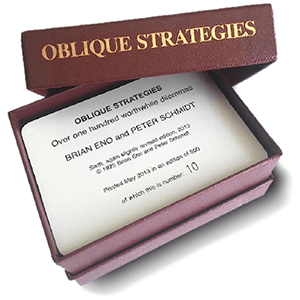
Oblique Strategies (subtitled ‘over one hundred worthwhile dilemmas’) is a set of published cards created by Brian Eno and Peter Schmidt first published in 1975, and is now in its fifth, open ended, edition. Each card contains a phrase or cryptic remark which can be used to break a deadlock or dilemma situation. Some are specific to music composition; others are more general. Examples include: Use an old idea / State the problem in words as clearly as possible / What would your closest friend do? / Are there sections? Consider transitions / Try faking it!
Posted in Humor, Language |
Leave a Comment »
February 2, 2011
The Game is a mental game where the objective is to avoid thinking about The Game itself. Thinking about The Game constitutes a loss, which, according to the rules of The Game, must be announced each time it occurs. It is impossible to win The Game; players can only attempt to avoid losing for as long as they possibly can. The Game has been variously described as pointless and infuriating. There are three rules to The Game: Everyone in the world is playing The Game. You cannot not play The Game. Whenever one thinks about The Game, one loses.
Posted in Games, Humor |
Leave a Comment »
February 2, 2011

Soap Opera Rapid Aging Syndrome (SORAS) is a term used to describe the practice of accelerating the age of a television character (usually a child or teenager) in conflict with the timeline of a series and/or the real-world progression of time. Characters unseen on screen for a time might reappear portrayed by an actor several years older than the original. Usually coinciding with a recast, rapid aging is typically done to open up the character to a wider range of storylines, and to attract younger viewers.
The process originated in (and is most commonly used in) daytime soap operas. SORAS generally refers to cases in which a character’s rapid aging happens off-screen without any explanation, rather than to storylines in science fiction and fantasy in which a character ages rapidly due to technology, magic, or non-human biology. Coined by Soap Opera Weekly founding editor-in-chief Mimi Torchin in the early days of the magazine, the term is now widely used in the soap opera media.
Posted in Art, Humor |
Leave a Comment »
February 2, 2011

Keepon is a small yellow robot designed to study social development by interacting with children. It was developed at the National Institute of Information and Communications Technology (NICT) in Kyoto, Japan. Keepon has four motors, a rubber skin, two cameras in its eyes, and a microphone in its nose.
Its simple appearance and behavior are intended to help children, even those with developmental disorders such as autism, to understand its attentive and emotive actions. The robot, usually under the control of a teleoperator, has interacted with children in schools and remedial centers for developmental disorders since 2003. Keepon is currently available for purchase at $30,000, though a price drop is speculated after simpler mechanisms are developed.
Posted in Health, Humor, Technology |
Leave a Comment »
February 1, 2011

EarthBound is a 1994 role-playing video game co-developed by Ape and HAL Laboratory and published by Nintendo for the Super NES video game console. The game has been lauded by gamers for its humorous depictions of American culture and parody of the RPG genre, and has since become a cult classic.
The game takes place on Earth in the year 199X. The game’s main antagonist is Giygas, an alien from a distant galaxy with the power to influence people using their own evil nature.
Posted in Art, Games, Humor |
Leave a Comment »
January 31, 2011

Rejected is a surrealist animated short comedy film by Don Hertzfeldt that was nominated for an Academy Award for Best Animated Short Film in 2000. A fictional frame story explains that Hertzfeldt was commissioned to do animated segments for commercials and television network interstitials, but they were all rejected upon receipt. Towards the end of the short the animator begins to break down mentally and the animated world he created literally begins to fall apart, brutally killing all of his characters in the process.
Posted in Art, Humor |
Leave a Comment »
January 31, 2011

Photoshop tennis is a game played through sequential alternating photoshopping of an image. Photoshop tennis originated in graphics-related internet forums in the late-1990s/early-2000s. The game was made popular by art director Jim Coudal, and the matches on coudal.com have since been renamed Layer Tennis, as they are no longer restricted to the use of Adobe Photoshop. Each match of Photoshop tennis is generally played with two competing players. The players pick a starting image, or one is ‘served’ by a player, then another player makes some sort of alteration to the image in any chosen image editor (matches are not exclusive to Adobe Photoshop).
He or she then sends that altered image to the other player or players, usually via e-mail or by posting the image to a Photoshop tennis forum, who then edits that image and sends it back to the first player. This process goes back and forth until a predetermined number of rounds have elapsed, or the players otherwise wish to end the game. When the final round is over, there may be an independent judge who determines who has played the best shots, and declares that person the winner, or players may play without a clear winner. Sometimes extra rules can be enforced, such as sticking to one particular software package, or keeping to a particular theme.
Posted in Art, Games, Humor |
Leave a Comment »
January 26, 2011
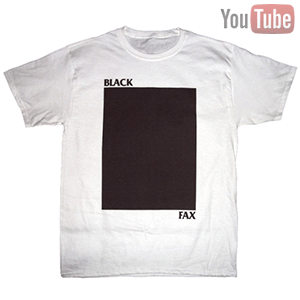
The term black fax refers to a prank fax transmission, consisting of one or more pages entirely filled with a uniform black tone and often made into a loop the sending machine will transmit endlessly. The sender’s intention is typically to consume as much of the recipient’s fax ink, toner or thermal paper or disk space as possible, thus costing the recipient money and/or denying the recipient the use of their machine (this is similar to computer-based denial of service attacks).
Black faxes can be particularly effective as the fax algorithm compresses the solid black image very well, so a very short fax call can produce many pages. They have been used to harass large institutions or government departments, to retaliate against the senders of junk faxes, or merely as simple pranks. In a black fax attack, one or more sheets are fed halfway through the sender’s fax machine and taped end to end, forming an endless loop that cycles through the machine. Not only can solid black be used, but also images which will repeat endlessly on the receiver’s machine until his or her toner runs out.
Posted in Humor, Politics, Technology |
Leave a Comment »


 The Daily Omnivore