February 10, 2011

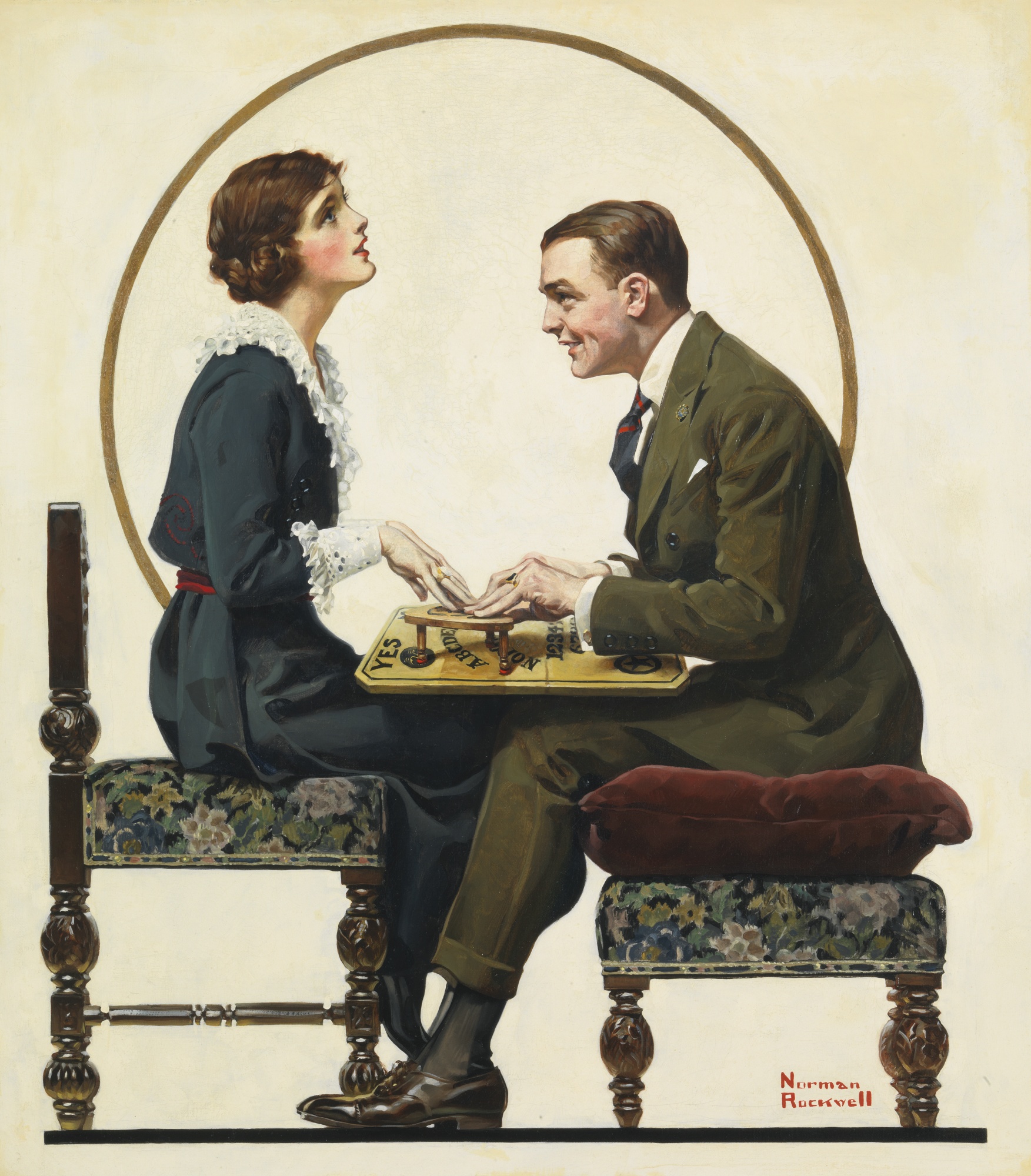
Flipism is a pseudophilosophy under which all decisions are made by flipping a coin. It originally appeared in the Disney comic ‘Flip Decision’ by Carl Barks, published in 1953. Barks called a practitioner of ‘Flipism’ a ‘Flippist.’ In the comic book, Donald Duck meets Professor Batty, who persuades Donald to make decisions based on flipping a coin at every crossroad of life. Donald soon gets into trouble when following this advice. He drives a one way road in the wrong direction and is fined $50.
Posted in Humor, Philosophy |
Leave a Comment »
February 10, 2011
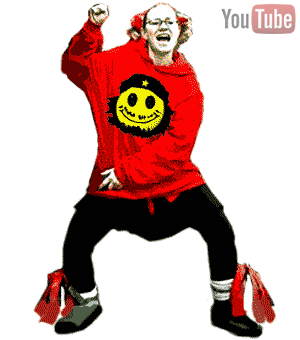
Radical cheerleading is a form of cheerleading that originated in Florida, but has now spread across the United States as well as Canada, Europe and beyond. The idea is to ironically reappropriate the aesthetics of cheerleading, for example by changing the chants to promote feminism and left-wing causes. Radical cheerleaders often perform at demonstrations. They also often perform at feminist and other radical festivals and events.
Radical cheerleading is used at demonstrations to promote a radical message in a media-friendly, people-friendly way. It is also used to support the actions of other activists who put themselves at physical risk and to denounce infiltrators and opponents. Radical cheerleaders are often anti-authoritarian and anti-capitalist. Their cheers are usually written from scratch or by rewriting the words of popular and historic songs. Radical cheerleaders dress in diverse ways but often wear a combination of red or pink and black.
Posted in Games, Humor, Politics |
Leave a Comment »
February 10, 2011
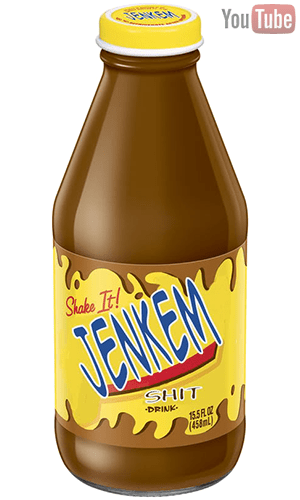
Jenkem is an alleged hallucinogenic recreational drug composed of noxious gas formed from fermented sewage. In the mid to late 1990s, several reports stated that Jenkem was being used by Zambian street children. The surfacing of the drug, or rumors of its existence, has caused at least one US municipality to amend its city ordinance regarding substances that cannot be legally inhaled to include organic substances.
Posted in Drugs, Humor |
1 Comment »
February 10, 2011

Nickelodeon compounds refers to a number of molding substances for children’s play that were created and sold by the children’s television channel Nickelodon and toy company Mattel in the 1990s. Like most molding compounds, they could be kept in their container to retain plasticity, or molded and allowed to harden overnight. They featured a wide variety of compounds with different attributes. The first compound, whose idea was taken from the show ‘You Can’t Do That on Television,’ was Nickelodeon ‘Slime,’ first manufactured in the 1980s.
The most popular compound, ‘Gak,’ was inspired by the game show ‘Double Dare.’ It made a ‘fart’ noise when squeezed into its clear, star-shaped container. In 1994 ‘Floam,’ originally called ‘bubble-gak,’ a compound composed of microbeads in a foam-like substance, was released. ‘Smud’ was much like Play-Doh, but slicker and would not dry out if left out of its container. ‘Skweeez’ was also like Play-Doh but had a more Marshmallow-like feel. ‘Gooze’ was similar to ‘Gak’ but more watery. ‘Sqand,’ or ‘Magic sand,’ begins as ordinary sand, but is dyed and coated in a hydrophobic substance.
Posted in Humor, Money, Technology |
Leave a Comment »
February 9, 2011
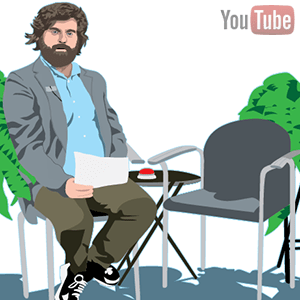
Between Two Ferns With Zach Galifianakis is an interview series on Funny or Die hosted by Zach Galifianakis. Zach conducts interviews with popular celebrities between two potted ferns. The show is filmed to resemble a low-budget amateur production fit for public access television. He maintains an awkward and sometimes antagonistic demeanor with his guests, asking them bizarre and inappropriate questions mixed with off-handed non sequiturs.
Posted in Art, Humor |
Leave a Comment »
February 8, 2011
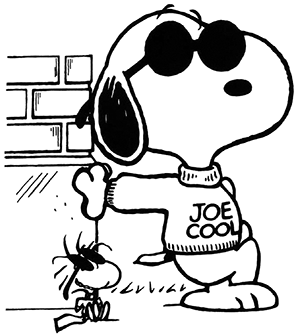
Joe Cool could refer to: Snoopy of Peanuts fame, whose aliases included Joe Cool, generally while wearing dark sunglasses and hanging around the student union. Joe Montana, a former NFL quarterback who earned the nickname for his undaunted poise in adverse, high-pressure game situations. Or, a New-York-based jazz-fusion band of the 1980’s featuring Rob Mounsey, Jeff Mironov, Will Lee, and Christopher Parker.
Posted in Art, Humor, Language |
Leave a Comment »
February 8, 2011

Bo Burnham (b. 1990) is an American comedian and musician. He performs satirical songs with a politically incorrect slant, and rose to fame on YouTube.
Posted in Art, Humor |
1 Comment »
February 7, 2011

A guy-cry film is the masculine version of the chick flick genre, a film that addresses a male audience, but has strong emotional material. Sports films are important to the guy-cry genre, but sports action is not necessarily essential to qualify a film as a genuine guy-cry. Some notable sports films that could be defined as guy-cry would be Field of Dreams, Rudy, Brian’s Song, and The Wrestler.
While it may seem that ‘guy-cry’ is a neologism, it is a genre that has been around for many years and is now receiving critical attention from scholars and trade publications. Early popular guy-cry films date back to the early 1970s with films such as Five Easy Pieces and One Flew Over the Cuckoo’s Nest. Important themes to the guy-cry genre are concepts of brotherhood, sacrifice, loyalty, and family.
Posted in Art, Humor, Language |
Leave a Comment »
February 3, 2011

Magic smoke (also called factory smoke or blue smoke) is a tongue in cheek reference to smoke produced by malfunctioning electronic circuits. Smoke is frequently observed to come out of electronic components when overheated. According to the joke, manufacturers put a portion of magic smoke into every electronic component, and the device functions normally so long as the smoke does not escape.
The origins of the magic smoke have become a running joke that started among electrical engineers and technicians before it was more recently adopted by computer programmers. The actual origin of blue smoke is the black plastic epoxy material that is used to package most common semiconductor devices such as transistors and integrated circuits, which produces a bluish colored smoke during combustion.
Posted in Humor, Technology |
Leave a Comment »
February 3, 2011

Bang snaps are a type of small novelty firework sold as a trick noisemaker. They consist of a small amount of gravel or coarse sand impregnated with a minute quantity (~.08 milligrams) of silver fulminate high explosive and twisted in a cigarette paper to produce a shape resembling a teardrop with a tail. When stepped on, ignited, or thrown on a hard surface, the friction-sensitive silver fulminate detonates, producing a sharp salute similar to that of a cap gun. Despite producing a legitimate (albeit tiny) high-explosive detonation, the extremely high mass ratio of gravel to explosive acts as a buffer to ensure that the devices produce only the audible ‘crack’ of the supersonic shock wave.
They are incapable of producing physical damage, even if discharged directly against skin, and the detonation frequently fails to even break the thin paper holding the ingredients. The explosion is also too weak to propel the gravel any distance, which usually falls to the ground. This makes them safe for use as a children’s toy, for which purpose they have been widely sold across the world since the 1950s. Currently the only US jurisdiction which restricts the use and sale of bang snaps is the state of New Jersey, which bans all forms of consumer pyrotechnics including sparklers. Other states impose the same age restrictions on purchasing bang snaps as that of permitted fireworks, usually 17 or 18.
Posted in Humor, Technology |
Leave a Comment »
February 3, 2011
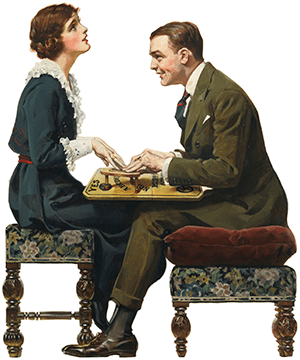
Ouija [wee-jee] is a commercial trademark for a ‘talking board,’ which is a device marked with letters, numbers, and other symbols, supposedly used to communicate with spirits. It uses a planchette (small heart-shaped piece of wood) to indicate the spirit’s message by spelling it out on the board during a séance. The fingers of the séance participants are placed on the planchette, which then moves about the board to spell out words or become physically manifested as a result of the ideomotor effect (a psychological phenomenon wherein a subject makes motions unconsciously).
Following its commercial introduction by businessman Elijah Bond in the late 1890s, the Ouija board was regarded as a harmless parlor game unrelated to the occult until American Spiritualist Pearl Curran popularized its use as a divining tool during World War I. Some mainstream Christian religions have associated use of the Ouija board with the threat of demonic possession, as have certain Occultist movements.
Posted in Death, Games, Humor |
Leave a Comment »
February 2, 2011
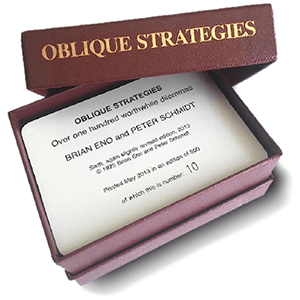
Oblique Strategies (subtitled ‘over one hundred worthwhile dilemmas’) is a set of published cards created by Brian Eno and Peter Schmidt first published in 1975, and is now in its fifth, open ended, edition. Each card contains a phrase or cryptic remark which can be used to break a deadlock or dilemma situation. Some are specific to music composition; others are more general. Examples include: Use an old idea / State the problem in words as clearly as possible / What would your closest friend do? / Are there sections? Consider transitions / Try faking it!
Posted in Humor, Language |
Leave a Comment »