January 3, 2011

A Nice Cup of Tea is an essay by George Orwell, first published in the Evening Standard newspaper in 1946. It is a straight-faced discussion about the craft of making a cup of tea, including his eleven ‘Golden’ rules. Orwell’s rules cover such matters as the best shape for a teacup, the advisability of using water that is still boiling, and his preference for very strong tea.
Posted in Food, Humor, Language |
Leave a Comment »
January 1, 2011

Dox (short for documents) is internet slang for personal information, often including real name, known aliases, addresses, phone numbers, SSN, credit card numbers, place of employment, etc. A person is ‘doxed’ when all their personal information is made public.
Posted in Language, Technology |
Leave a Comment »
December 24, 2010


Pulp from the Latin ‘pulpa’ (animal or plant pulp, pith of wood). Pulp is the fibrous material used to make paper. It is also refers to the juice vesicles of a citrus fruit. The adjective meaning ‘sensational’ is from pulp magazines, named for the wood pulp paper used in cheaply made magazines and books. Pulp magazines (often referred to as ‘the pulps’), also collectively known as pulp fiction, refers to inexpensive fiction magazines published from 1896 through the 1950s. Pulps were printed on inexpensive paper with ragged, untrimmed edges.
Pulp is also name of a 1972 British comedy thriller starring Michael Caine as a writer of cheap paperback detective novels. The English alternative rock band Pulp formed six years later drew its name from the film. Pulp is also the title of the last novel by American writer Charles Bukowski. Additionally, Pulp refers to the central part of a tooth, commonly referred to as the nerve, it branches out and continues down each root through the canals of the tooth and stops just shy of the apex, or tip of the tooth. Red pulp and white pulp describes tissue in the spleen, an organ which creates blood cells.
Posted in Language, Science |
Leave a Comment »
December 23, 2010

Tadoma is a method of communication used by deafblind individuals, in which they place their thumb on the speaker’s lips and their fingers along the jawline. The middle three fingers often fall along the speaker’s cheeks with the little finger picking up the vibrations of the speaker’s throat. It is sometimes referred to as ‘tactile lipreading,’ as the deafblind person feels the movement of the lips, as well as vibrations of the vocal cords, puffing of the cheeks and the warm air produced by nasal sounds such as ‘N’ and ‘M.’
It is a difficult method to learn and use, and is rarely used nowadays. However, a small number of deafblind people successfully use Tadoma in everyday communication. Helen Keller also used a form of Tadoma.
read more »
Posted in Health, Language |
Leave a Comment »
December 22, 2010

An ambigram [am-bi-gram] is a typographical design or artform that may be read as one or more words not only in its form as presented, but also from another viewpoint, direction, or orientation.
The words readable in the other viewpoint, direction or orientation may be the same or different from the original words. Different ambigram artists (sometimes called ambigramists) may create completely different ambigrams from the same word or words, differing in both style and form.
Posted in Art, Language |
Leave a Comment »
December 22, 2010
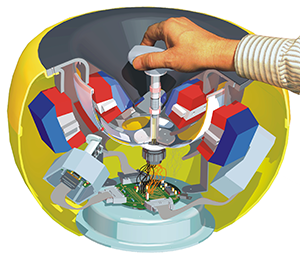

Haptic technology, or haptics [hap-tiks], is a tactile feedback technology that takes advantage of a user’s sense of touch by applying forces, vibrations, and/or motions. This mechanical stimulation aids in the creation and control of virtual objects, and enhances the remote control of machines and devices by teleoperators, such as remote surgeons and military drone pilots. The word haptic, from the Greek (haptikos), means pertaining to the sense of touch.
read more »
Posted in Language, Technology |
Leave a Comment »
December 20, 2010

The V sign is a hand gesture in which the first and second fingers are raised and parted, whilst the thumb and remaining fingers are clenched. With palm inwards, in the United Kingdom and some other English speaking countries, it is an obscene insulting gesture of defiance. During World War II, Winston Churchill popularized its use as a ‘Victory’ sign (for V as in victory) initially with palm inwards and, later in the war, palm outwards.
In the United States, with the palm outwards, and more recently inward, it is also used to mean ‘Peace,’ a meaning that became popular during the peace movement of the 1960s. In East Asia the gesture is commonly used with the palm outward, connoting positive meaning. According to a popular legend the two-fingers salute derives from the gestures of longbowmen fighting in the English army at the Battle of Agincourt (1415) during the Hundred Years’ War. The French claimed that they would cut off the arrow-shooting fingers of all the English and Welsh longbowmen after they had won the battle at Agincourt. But the English came out victorious and showed off their two fingers, still intact.
Posted in Language, War, World |
Leave a Comment »
December 14, 2010
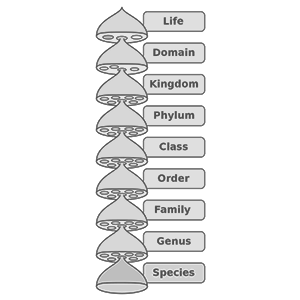
Taxonomy [tak-son-uh-mee] is the practice and science of classification. The word finds its roots in the Greek ‘taxis’ (meaning ‘order’ or ‘arrangement’) and ‘nomos’ (meaning ‘law’ or ‘science’).
Taxonomies are typically organized by generalization-specialization relationships, or less formally, parent-child relationships: the subtype has the same properties, behaviors, and constraints as the supertype plus one or more. For example: car is a subtype of vehicle, so any car is also a vehicle, but not every vehicle is a car.
Posted in Education, Language, Science |
Leave a Comment »
December 14, 2010

The term life hack refers to productivity tricks that programmers devise and employ to cut through information overload and organize their data. The original definition of the term referred to utilities that filtered and processed data streams like email and RSS feeds. Examples of these types of life hacks might include utilities to synchronize files, track tasks, remind yourself of events or filter email. As the meme spread, the definition of the term expanded. Today, anything that solves an everyday problem in a clever or non-obvious way might be called a life hack. The term became popularized in the blogosphere and is primarily used by geeks who suffer from information overload or those with a playful curiosity in the ways they can accelerate their workflow.
The terms hack, hacking, and hacker have a long history of ambiguity in the computing and geek communities, particularly within the free and open source software crowds. However, in the context used here a ‘hack’ is a clever trick or stratagem. British technology journalist Danny O’Brien coined the term after polling a group of productive geeks on the details of their work processes. O’Brien discovered a pattern among these super-productive programmers: that they devised and used ’embarrassing’ scripts and shortcuts to get their work done.
Posted in Language, Technology |
Leave a Comment »
December 14, 2010

Parasite single is a Japanese term for a single person who lives with their parents until their late twenties or early thirties in order to enjoy a carefree and comfortable life. In English, the expression ‘sponge’ or ‘basement dweller’ may sometimes be used. The expression is mainly used in reference to Japanese society, but similar phenomena can also be found in other countries worldwide.
In Italy, 30-something singles still relying on their mothers are derided as ‘bamboccioni’ (literally, big babies) and in Germany they are known as Nesthocker (German for nestling), who are still living at ‘Hotel Mama.’ In the U.K. they are referred to by the acronym NEET (not in employment, education, or training). The expression was first used by Professor Masahiro Yamada of Tokyo Gakugei University in 1999. The catchy phrase quickly found its way into the media and is now a well-known expression in Japan.
Posted in Language, Money, World |
Leave a Comment »
December 13, 2010

Lagom is a Swedish word with no direct English equivalent, meaning ‘just the right amount.’ It is also widely translated as ‘in moderation,’ ‘in balance,’ ‘optimal,’ ‘suitable,’ and ‘average.’ But whereas words like ‘sufficient’ and ‘average’ suggest some degree of abstinence, scarcity, or failure, lagom carries the connotation appropriateness although not necessarily perfection. The archetypical Swedish proverb ‘Lagom är bäst,’ literally ‘The right amount is best,’ is translated as ‘Enough is as good as a feast.’ The concept of lagom is similar to that of the Middle Path in Eastern philosophy, and Aristotle’s ‘golden mean’ of moderation in Western philosophy.
The value of ‘just enough’ can be compared to idiom ‘ess is more,’ or contrasted to the value of ‘more is better.’ It is viewed favorably as a sustainable alternative to the hoarding extremes of consumerism. It can also be viewed as repressive: ‘You’re not supposed to be too good, or too rich.’ In a single word, lagom is said to describe the basis of the Swedish national psyche, one of consensus and equality. In recent times Sweden has developed greater tolerance for risk and failure as a result of severe recession in the early 1990s. Nonetheless, it is still widely considered ideal to be modest and avoid extremes.
Posted in Language, Philosophy, World |
Leave a Comment »
December 10, 2010

‘Red tape‘ is a derisive term for excessive regulation or rigid conformity to formal rules that is considered redundant or bureaucratic and hinders or prevents action or decision-making. It is usually applied to governments, corporations and other large organizations. Red tape generally includes the filling out of seemingly unnecessary paperwork, obtaining of unnecessary licenses, having multiple people or committees approve a decision and various low-level rules that make conducting one’s affairs slower, more difficult, or both.
The origins of the term are somewhat obscure, but it is first noted in historical records in the 16th century, when Henry VIII besieged Pope Clement VII with around eighty or so petitions for the annulment of his marriage to Catherine of Aragon. The documents were rolled, sealed and bound with the obligatory red tape, as was the custom. To this day, most U.K. barristers’ briefs are tied in a pink-colored ribbon known as ‘pink tape’ or ‘legal tape.’ All American Civil War veterans’ records were bound in red tape, and the difficulty in accessing them led to the modern American use of the term. Karl Marx wrote about the phenomenon of changing from one person in control of a complete task, to having multiple people each with specialties in specific tasks. He saw this occurring as society shifts from a Seigneurial system to a capitalist system.
Posted in Language, Politics |
Leave a Comment »


 The Daily Omnivore