January 11, 2011

Gaslighting is a form of psychological abuse in which false information is presented to the victim with the intent of making them doubt their own memory and perception. It may simply be the denial by an abuser that previous abusive incidents ever occurred, or it could be the staging of bizarre events by the abuser with the intention of disorienting the victim. Sociopaths frequently use gaslighting tactics; they consistently transgress social mores, break laws, and exploit others, but are also typically charming and convincing liars who consistently deny wrongdoing. Thus, some who have been victimized by sociopaths may doubt their perceptions.
Gaslighting had a colloquial origin in a 1938 play ‘Gas Light,’ but the term has also been used in clinical and research literature. The play and its 1940 and 1944 film adaptations, concern a husband who attempts to drive his wife mad by manipulating small elements of their environment, and insisting that she is mistaken or misremembering when she points out these changes. The title stems from the husband’s subtle dimming of the house’s gas lights, which she accurately notices and which the husband insists she’s imagining.
Posted in Art, Language |
Leave a Comment »
January 11, 2011


Avram Noam Chomsky (b. 1928) is an American linguist, philosopher, political activist, author, and lecturer. He is a professor emeritus of linguistics at MIT. Chomsky created one of the most important contributions to the field of linguistics made in the 20th century: the theory of generative grammar, a branch of theoretical linguistics that works to provide a set of rules that can accurately predict which combinations of words are able to make grammatically correct sentences. In the 1950’s he helped start the cognitive revolution in psychology through his review of B. F. Skinner’s work.
He challenged the behaviorist way of looking at behavior and language. His natural approach to the study of language also changed the philosophy of language and mind. He invented the Chomsky hierarchy, a way of looking at formal languages in terms of their power to explain language. In the 1960s he criticized the Vietnam War. Because of that, Chomsky became more widely known for his media criticism and politics. He is a key intellectual figure within the left wing of United States politics.
Posted in Language, Philosophy, Politics |
Leave a Comment »
January 10, 2011


A spiritual successor, sometimes called a spiritual sequel or a companion piece, is a successor to a work of fiction which does not directly build upon the storyline established by a previous work as do most traditional prequels or sequels, but nevertheless features many of the same elements, themes, and styles as its source material.
read more »
Posted in Art, Language, Money |
Leave a Comment »
January 10, 2011

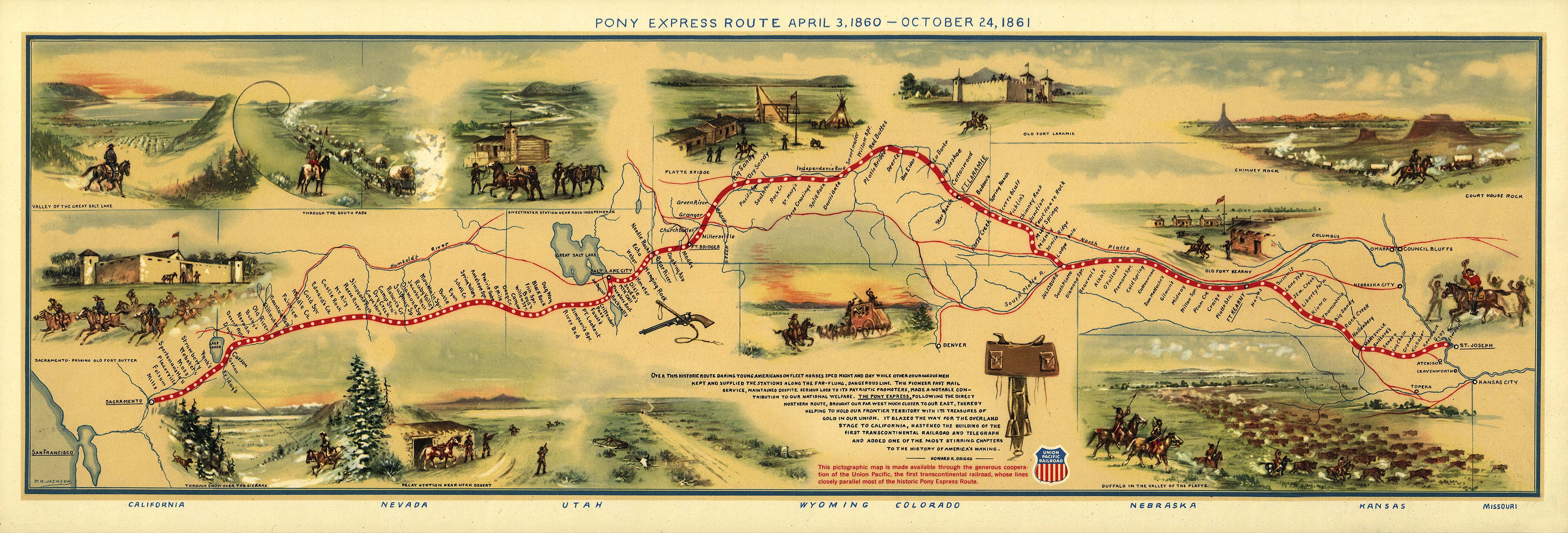
The Pony Express was a fast mail service crossing the Great Plains, the Rocky Mountains, and the High Sierras from Missouri to California, founded in 1860. It became the west’s most direct means of east-west communication before the telegraph and was vital for tying California closely with the Union just before the American Civil War. Patee House (a historic hotel in St. Joseph, Missouri) served as the Pony Express headquarters from 1860 to 1861. It is one block away from the home of infamous outlaw Jesse James, where he was shot and killed by Robert Ford. After his murder, Jesse James’ family took up lodging at the hotel.
Messages were carried by horseback riders in relays to stations across the prairies, plains, deserts, and mountains of the Western United States. For its 18 months of operation, it briefly reduced the time for messages to travel between the Atlantic and Pacific coasts to about ten days, with telegraphic communication covering about half the distance across the continent and mounted couriers the rest. The continued popularity of the Pony Express can be linked to Buffalo Bill Cody who claimed to have been an Express rider.
Posted in Language, Money |
Leave a Comment »
January 5, 2011

Heiligenschein [hahy-li-guhn-shahyn] (German for ‘aureola,’ literally ‘Holy shine’) is an optical phenomenon which creates a bright spot around the shadow of the viewer’s head. It is created when the surface on which the shadow falls has special optical characteristics. Dewy grass is known to exhibit these characteristics, and creates a heiligenschein. Nearly spherical dew droplets act as lenses to focus the light on the surface beneath them. Some of this light ‘backscatters’ in the direction of the sunlight as it passes back through the dew droplet. This makes the antisolar point appear the brightest.
The opposition effect creates a similar halo effect, a bright spot of light around the viewer’s head when the viewer is looking in the opposite direction of the sun, but is instead caused by shadows being hidden by the objects casting them. When viewing the Heiligenschein, there are no colored rings around the shadow of the observer, as in the case of a glory. In the 2006 Scripps National Spelling Bee, this was the word which eliminated crowd and national favorite Rajiv Tarigopula and elicited the audience to give him a standing ovation for receiving 4th place for the second consecutive year in a show of immense respect.
Posted in Language, Science |
Leave a Comment »
January 5, 2011

Osteopathy [os-tee-op-uh-thee] or osteopathic medicine is an approach to healthcare that emphasizes the role of the musculoskeletal system in health and disease. The first school of Osteopathy was founded in 1892 by Andrew Taylor Still, an Army surgeon in the American Civil War. In the United States an American-trained D.O. (Doctor of Osteopathic Medicine) is legally and professionally equivalent to an M.D. in all 50 states, since their medical education and training is mostly identical.
read more »
Posted in Health, Language, Science |
Leave a Comment »
January 3, 2011

A Nice Cup of Tea is an essay by George Orwell, first published in the Evening Standard newspaper in 1946. It is a straight-faced discussion about the craft of making a cup of tea, including his eleven ‘Golden’ rules. Orwell’s rules cover such matters as the best shape for a teacup, the advisability of using water that is still boiling, and his preference for very strong tea.
Posted in Food, Humor, Language |
Leave a Comment »
January 1, 2011

Dox (short for documents) is internet slang for personal information, often including real name, known aliases, addresses, phone numbers, SSN, credit card numbers, place of employment, etc. A person is ‘doxed’ when all their personal information is made public.
Posted in Language, Technology |
Leave a Comment »
December 24, 2010


Pulp from the Latin ‘pulpa’ (animal or plant pulp, pith of wood). Pulp is the fibrous material used to make paper. It is also refers to the juice vesicles of a citrus fruit. The adjective meaning ‘sensational’ is from pulp magazines, named for the wood pulp paper used in cheaply made magazines and books. Pulp magazines (often referred to as ‘the pulps’), also collectively known as pulp fiction, refers to inexpensive fiction magazines published from 1896 through the 1950s. Pulps were printed on inexpensive paper with ragged, untrimmed edges.
Pulp is also name of a 1972 British comedy thriller starring Michael Caine as a writer of cheap paperback detective novels. The English alternative rock band Pulp formed six years later drew its name from the film. Pulp is also the title of the last novel by American writer Charles Bukowski. Additionally, Pulp refers to the central part of a tooth, commonly referred to as the nerve, it branches out and continues down each root through the canals of the tooth and stops just shy of the apex, or tip of the tooth. Red pulp and white pulp describes tissue in the spleen, an organ which creates blood cells.
Posted in Language, Science |
Leave a Comment »
December 23, 2010

Tadoma is a method of communication used by deafblind individuals, in which they place their thumb on the speaker’s lips and their fingers along the jawline. The middle three fingers often fall along the speaker’s cheeks with the little finger picking up the vibrations of the speaker’s throat. It is sometimes referred to as ‘tactile lipreading,’ as the deafblind person feels the movement of the lips, as well as vibrations of the vocal cords, puffing of the cheeks and the warm air produced by nasal sounds such as ‘N’ and ‘M.’
It is a difficult method to learn and use, and is rarely used nowadays. However, a small number of deafblind people successfully use Tadoma in everyday communication. Helen Keller also used a form of Tadoma.
read more »
Posted in Health, Language |
Leave a Comment »
December 22, 2010

An ambigram [am-bi-gram] is a typographical design or artform that may be read as one or more words not only in its form as presented, but also from another viewpoint, direction, or orientation.
The words readable in the other viewpoint, direction or orientation may be the same or different from the original words. Different ambigram artists (sometimes called ambigramists) may create completely different ambigrams from the same word or words, differing in both style and form.
Posted in Art, Language |
Leave a Comment »
December 22, 2010
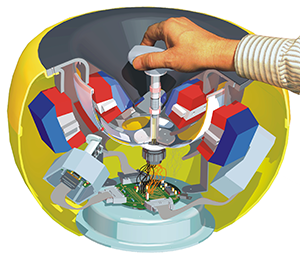

Haptic technology, or haptics [hap-tiks], is a tactile feedback technology that takes advantage of a user’s sense of touch by applying forces, vibrations, and/or motions. This mechanical stimulation aids in the creation and control of virtual objects, and enhances the remote control of machines and devices by teleoperators, such as remote surgeons and military drone pilots. The word haptic, from the Greek (haptikos), means pertaining to the sense of touch.
read more »
Posted in Language, Technology |
Leave a Comment »