November 28, 2012
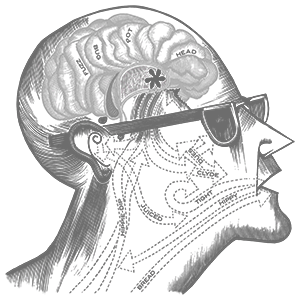
How to Speak Hip is a spoken-word comedy album by improv pioneer Del Close and John Brent, released by Mercury Records in 1959. The album is designed as a satire of language-learning records, where the secret language of the ‘hipster’ is treated as a foreign language.
Part of the joke, however, is that it actually does a good job of describing the Beat Generation/Beatnik sub-culture: Basic concepts such as ‘cool’ and ‘uncool’ are taught, as well as vocabulary building (‘dig,’ ‘dig it,’ ‘dig yourself, baby,’ ‘dig the chick,’ ‘dig the cat,’ ‘What a drag!’).
read more »
Posted in Art, Humor, Language |
Leave a Comment »
November 27, 2012

Patton’s Speech to the Third Army was given by General George S. Patton on June 5, 1944, the day before D-day. Patton delivered variations of the speech on several different occasions to his troops, although the June 5 date is the most well known. A hard copy of the speech exists. It has since become immortalized in George C. Scott’s rendition in the movie ‘Patton,’ where he delivers it in front of a large American flag. Patton’s actual words were so colorful that the movie edited and toned down the language, e.g. substituting ‘fornicating’ for ‘fucking.’ Certain phrases from the speech were also used in Scott’s dialogue later on in the film.
Patton’s speech was largely designed to motivate U.S. troops that were to be under fire. There had been much talk about superior German firepower, and the level of fear and doubt was so great in the armed forces that the U.S. Army even resorted to making propaganda films claiming that the infamous German machine gun, the MG-42 (a reliable and deadly weapon), had a bark louder than its bite. The Army did not want US soldiers to get pinned down, and knew that their forces would have to be motivated as they were to be charging German heavy fire on foot.
read more »
Posted in Death, Language, War |
2 Comments »
November 26, 2012

The Knowledge Graph is a knowledge base used by Google to enhance its search engine’s search results with semantic-search information gathered from a wide variety of sources. Knowledge Graph display was added to Google’s search engine in 2012, starting in the United States. It provides structured and detailed information about the topic in addition to a list of links to other sites. The goal is that users would be able to use this information to resolve their query without having to navigate to other sites and assemble the information themselves.
According to Google, this information is derived from many sources, including the CIA World Factbook, Freebase, and Wikipedia. The feature is similar in intent to answer engines such as Ask Jeeves and Wolfram Alpha. As of 2012, its semantic network contained over 500 million objects and more than 3.5 billion facts about and relationships between these different objects which are used to understand the meaning of the keywords entered for the search.
Posted in Education, Language, Technology |
Leave a Comment »
November 26, 2012
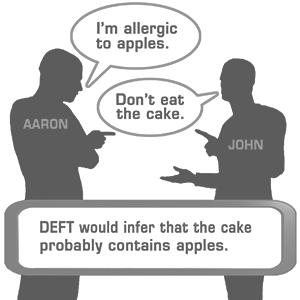
Natural language processing (NLP) is a field of computer science, artificial intelligence, and linguistics concerned with the interactions between computers and human (natural) languages.
As such, NLP is related to the area of human–computer interaction. Many challenges in NLP involve natural language understanding — that is, enabling computers to derive meaning from human or natural language input. An automated online assistant providing customer service on a web page, an example of an application where natural language processing is a major component.
read more »
Posted in Language, Technology, World |
Leave a Comment »
November 20, 2012

A memory hole is any mechanism for the alteration or disappearance of inconvenient or embarrassing documents, photographs, transcripts, or other records, such as from a web site or other archive, particularly as part of an attempt to give the impression that something never happened.
The concept was first popularized by George Orwell’s dystopian novel ‘Nineteen Eighty-Four,’ in which the memory hole is a small chute leading to a large incinerator used for censorship.
read more »
Posted in Language, Politics |
2 Comments »
November 19, 2012
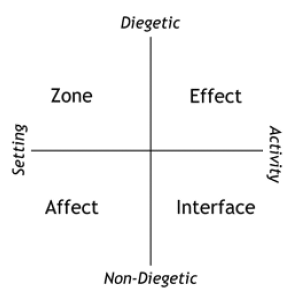
Diegesis [dahy-uh-jee-sis] is a style of storytelling in fiction which presents an interior view of a world and is: that world itself experienced by the characters in situations and events of the narrative; telling, recounting, as opposed to showing, enacting. In diegesis the narrator tells the story. The narrator presents to the audience or the implied readers the actions, and perhaps thoughts, of the characters.
Diegesis (‘narration’) and ‘mimesis’ (‘imitation’) have been contrasted since Plato’s and Aristotle’s times. Mimesis shows rather than tells, by means of action that is enacted. Diegesis, however, is the telling of the story by a narrator. The narrator may speak as a particular character or may be the invisible narrator or even the all-knowing narrator who speaks from above in the form of commenting on the action or the characters.
read more »
Posted in Art, Language, Philosophy |
1 Comment »
November 19, 2012
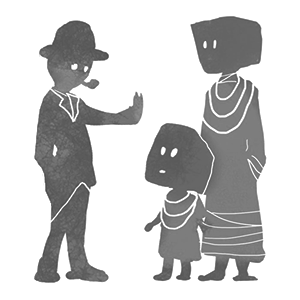
Alterity [all-ter-eh-tee] is a philosophical term meaning ‘otherness,’ strictly being in the sense of the other of two. In the phenomenological tradition it is usually understood as the entity in contrast to which an identity is constructed, and it implies the ability to distinguish between self and not-self, and consequently to assume the existence of an alternative viewpoint. The concept was established by French philosopher Emmanuel Lévinas in a series of essays, collected under the title ‘Alterity and Transcendence.’
The term is also deployed outside of philosophy, notably in anthropology by scholars such as Nicholas Dirks, Johannes Fabian, Michael Taussig, and Pauline Turner Strong to refer to the construction of ‘cultural others.’ The term has gained further use in seemingly somewhat remote disciplines, e.g. historical musicology where it is effectively employed by John Michael Cooper in a study of Goethe and Mendelssohn.
Posted in Language, Philosophy, World |
1 Comment »
November 19, 2012
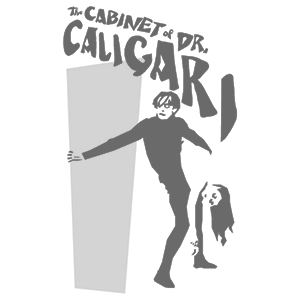
Mise-en-scène [meez-awn-sen] (‘placing on stage’) is an expression used to describe the design aspects of a theater or film production, which essentially means ‘visual theme’ or ‘telling a story’—both in visually artful ways through storyboarding, cinematography, and stage design, and in poetically artful ways through direction.
Mise-en-scène has been called film criticism’s ‘grand undefined term.’ When applied to the cinema, mise-en-scène refers to everything that appears before the camera and its arrangement—composition, sets, props, actors, costumes, and lighting. Mise-en-scène also includes the positioning and movement of actors on the set (‘blocking’).
read more »
Posted in Art, Language |
Leave a Comment »
November 18, 2012
Metafiction [met-uh-fik-shuhn], also known as Romantic irony in the context of Romantic works of literature, is a type of fiction that self-consciously addresses the devices of fiction, exposing the fictional illusion. Metafiction uses techniques to draw attention to itself as a work of art, while exposing the ‘truth’ of a story.
It is the literary term describing fictional writing that self-consciously and systematically draws attention to its status as an artifact in posing questions about the relationship between fiction and reality, usually using irony and self-reflection. It can be compared to ‘presentational theater’ which does not let the audience forget it is viewing a play; metafiction does not let the reader forget he or she is reading a fictional work.
read more »
Posted in Art, Language |
Leave a Comment »
November 18, 2012
Reverse chronology is a method of story-telling whereby the plot is revealed in reverse order. In a story employing this technique, the first scene shown is actually the conclusion to the plot. Once that scene ends, the penultimate scene is shown, and so on, so that the final scene the viewer sees is the first chronologically. Many stories employ flashback, showing prior events, but whereas the scene order of most conventional films is chronological. The unusual nature of this method means it is only used in stories of a specific nature.
For example, ‘Memento’ features a man with anterograde amnesia, meaning he is unable to form new memories. The film parallels the protagonist’s perspective by unfolding in reverse chronological order, leaving the audience as ignorant of the events that occurred prior to each scene (which, played in reverse chronological order, will not be revealed until later) as the protagonist is.
read more »
Posted in Art, Language |
Leave a Comment »
November 17, 2012

‘In medias res‘ (‘into the middle of things’) is a Latin phrase denoting the literary and artistic narrative technique wherein the relation of a story begins either at the midpoint or at the conclusion, rather than at the beginning (‘ab ovo,’ ‘ab initio’), establishing setting, character, and conflict via flashback or expository conversations relating the pertinent past.
The main advantage of in medias res is to open the story with dramatic action rather than exposition which sets up the characters and situation. Because it is a feature of the style in which a story is structured and is independent of the story’s content, it can be employed in any narrative genre, epic poetry, novels, plays, or film.
read more »
Posted in Art, Language |
Leave a Comment »
November 17, 2012

Nonlinear narrative, disjointed narrative or disrupted narrative is a narrative technique, sometimes used in literature, film, websites and other mediums, where events are portrayed out of chronological order. It is often used to mimic the structure and recall of human memory but has been applied for other reasons as well.
Beginning a narrative ‘in medias res’ (Latin: ‘into the middle of things’) began in ancient times as an oral tradition and was established as a convention of epic poetry with Homer’s ‘Iliad’ in the 8th century BCE. The technique of narrating most of the story in flashback also dates back to the Indian epic, the ‘Mahabharata,’ around the 5th century BCE. Several medieval ‘Arabian Nights’ tales also have nonlinear narratives employing ‘in medias res’ and flashback techniques.
read more »
Posted in Art, Games, Language |
Leave a Comment »


 The Daily Omnivore