August 13, 2012

Kinderwhore was an image used by a handful of mostly female punk rock bands in the US during the early to mid 1990s. The kinderwhore look consisted of torn, ripped tight or low-cut babydoll dresses or nighties, heavy makeup, and leather boots or Mary–Jane shoes of various colors.
The exact origin of the kinderwhore image is up for debate, though it is widely accepted that Kat Bjelland of Babes in Toyland was the first to define it and Courtney Love of Hole was the first to popularize it. Christina Amphlett of Divinyls can clearly be seen sporting the image on the cover of her band’s 1983 album, ‘Desperate.’ Love declared in an interview in the Los Angeles zine ‘Ben Is Dead’ that she took the style from Amphlett.
Posted in Art, Language, Sex |
1 Comment »
August 13, 2012

‘Who breaks a butterfly upon a wheel?‘ is a quotation – sometimes misquoted with ‘on’ in place of ‘upon’ – from Alexander Pope’s ‘Epistle to Dr Arbuthnot’ of 1735. It can be taken as referring to putting massive effort into achieving something minor or unimportant, and alludes to ‘breaking on the wheel,’ a form of torture in which victims had their long bones broken by an iron bar while tied to a Catherine wheel.
William Rees-Mogg, as editor of ‘The Times’ newspaper, used the ‘on a wheel’ version of the quotation as the heading (set in capital letters) for an editorial in 1967 about the ‘Redlands’ court case, which had resulted in prison sentences for Rolling Stones members Keith Richards and Mick Jagger. The philosopher Mary Midgley used a variation on the phrase in an article in the journal ‘Philosophy’ written to counter a review praising ‘The Selfish Gene’ by Richard Dawkins, where she cuttingly said that she had ‘not attended to Dawkins, thinking it unnecessary to break a butterfly upon a wheel.’
Posted in Language, Politics, Sex |
1 Comment »
August 10, 2012
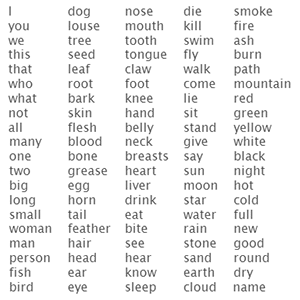
A Swadesh [sway-desh] list is a compilation of concepts for which words are deemed to exist in the largest number of languages. Translations of a Swadesh list into a set of languages allows researchers to quantify the interrelatedness of those languages.
Swadesh lists are named after the U.S. linguist Morris Swadesh. They are used in lexicostatistics (the quantitative assessment of the relatedness of languages) and glottochronology (the dating of language divergence).
read more »
Posted in Language, Science, World |
Leave a Comment »
August 10, 2012

Thomas Pynchon [pin-chuhn] (b. 1937) is an American novelist. A MacArthur Fellow, he is noted for his dense and complex novels. Both his fiction and non-fiction writings encompass a vast array of subject matter, styles, and themes, including (but not limited to) the fields of history, science, and mathematics. For his most praised novel, ‘Gravity’s Rainbow,’ Pynchon won the 1974 U.S. National Book Award for Fiction (which he declined).
After publishing several short stories in the late 1950s and early 1960s, he began composing the novels for which he is best known: ‘V.’ (1963), ‘The Crying of Lot 49’ (1966), ‘Gravity’s Rainbow’ (1973), and ‘Mason & Dixon’ (1997). Pynchon is also known for being very private; very few photographs of him have ever been published, and rumors about his location and identity have circulated since the 1960s.
read more »
Posted in Art, Humor, Language |
Leave a Comment »
August 10, 2012

Gravity’s Rainbow is a 1973 book written by Thomas Pynchon; it is his third and most celebrated novel. The narrative is set primarily in Europe at the end of World War II and centers on the design, production and dispatch of V-2 rockets by the German military, and, in particular, the quest undertaken by several characters to uncover the secret of a mysterious device named the ‘Schwarzgerät’ (‘black device’) that is to be installed in a rocket with the serial number ‘00000.’
Gravity’s Rainbow is transgressive, as it questions and inverts social standards of deviance and disgust and transgresses boundaries of Western culture and reason.
read more »
Posted in Humor, Language, War |
1 Comment »
August 9, 2012


Transgressive fiction is a genre of literature that focuses on characters who feel confined by the norms and expectations of society and who break free of those confines in unusual and/or illicit ways. Because they are rebelling against the basic norms of society, protagonists of transgressional fiction may seem mentally ill, anti-social, or nihilistic. The genre deals extensively with taboo subject matters such as drugs, sex, violence, incest, pedophilia, and crime.
The term ‘transgressive fiction’ was coined by Los Angeles Times literary critic Michael Silverblatt. Rene Chun, a journalist for ‘The New York Times,’ described is as, ‘A literary genre that graphically explores such topics as incest and other aberrant sexual practices, mutilation, the sprouting of sexual organs in various places on the human body, urban violence and violence against women, drug use, and highly dysfunctional family relationships, and that is based on the premise that knowledge is to be found at the edge of experience and that the body is the site for gaining knowledge.’
read more »
Posted in Language, Politics, Sex |
1 Comment »
August 9, 2012

‘What’s the Matter with Kansas? How Conservatives Won the Heart of America’ (2004) is a book by American journalist and historian Thomas Frank, which explores the rise of populist anti-elitist Conservatism in the United States, centering on the experience of Kansas, Frank’s native state.
In the late 19th century, Kansas was known as a hotbed of the left-wing Populist movement, but in recent decades, it has become overwhelmingly conservative. The book was published in Britain and Australia as ‘What’s the Matter with America?’ According to the book, the political discourse of recent decades has dramatically shifted from the social and economic equality to one in which ‘explosive’ cultural issues, such as abortion and gay marriage, are used to redirect anger towards ‘liberal elites.’
read more »
Posted in Language, Philosophy, Politics |
Leave a Comment »
August 9, 2012

‘Irrational exuberance‘ is a phrase used by the then-Federal Reserve Board Chairman, Alan Greenspan, in a speech given at the American Enterprise Institute during the Dot-com bubble of the 1990s. The phrase was interpreted as a warning that the market might be somewhat overvalued.
Greenspan’s comment was made in late 1996: ‘[…] Clearly, sustained low inflation implies less uncertainty about the future, and lower risk premiums imply higher prices of stocks and other earning assets. We can see that in the inverse relationship exhibited by price/earnings ratios and the rate of inflation in the past. But how do we know when irrational exuberance has unduly escalated asset values, which then become subject to unexpected and prolonged contractions as they have in Japan over the past decade?’
read more »
Posted in Language, Money, Politics |
Leave a Comment »
August 9, 2012

Feminazi is a term popularized by radio talk-show host Rush Limbaugh to describe ‘an extreme or militant feminist.’ In 2004, Limbaugh named feminist activists Gloria Steinem, Susan Sarandon, Christine Lahti, and Camryn Manheim as ‘famous feminazis.’
Feminazi is a portmanteau of the nouns feminist and Nazi. The term is used pejoratively by some U.S. conservatives to criticize feminists that they perceive as extreme.
read more »
Posted in Language, Politics, Sex |
Leave a Comment »
August 9, 2012

The Manipulated Man (German: ‘Der Dressierte Mann’) is a 1971 book by author Argentinian-German writer Esther Vilar, which argues that, contrary to common feminist and women’s rights rhetoric, women in industrialized cultures are not oppressed, but rather exploit a well-established system of manipulating men.
A third edition of the book was released in 2009. Vilar writes, ‘Men have been trained and conditioned by women, not unlike the way Pavlov conditioned his dogs, into becoming their slaves. As compensation for their labors men are given periodic use of a woman’s vagina.’ The book contends that young boys are encouraged to associate their masculinity with their ability to be sexually intimate with a woman, and that a woman can control a man by socially empowering herself to be the gate-keeper to his sense of masculinity.
read more »
Posted in Language, Politics, Sex |
Leave a Comment »
August 6, 2012

In science and history, consilience [kun-sil-ee-ehns] (also convergence of evidence or concordance of evidence) refers to the principle that evidence from independent, unrelated sources can ‘converge’ to strong conclusions. That is, when multiple sources of evidence are in agreement, the conclusion can be very strong even when none of the individual sources of evidence are very strong on their own. Most established scientific knowledge is supported by a convergence of evidence: if not, the evidence is comparatively weak, and there will not likely be a strong scientific consensus.
The principle is based on the unity of knowledge (a thesis in philosophy of science that says that all the sciences form a unified whole); measuring the same result by several different methods should lead to the same answer. For example, it should not matter whether one measures the distance between the Great Pyramids of Giza by laser rangefinding, by satellite imaging, or with a meter stick – in all three cases, the answer should be approximately the same. For the same reason, different dating methods in geochronology should concur, a result in chemistry should not contradict a result in geology, etc.
read more »
Posted in Language, Philosophy, Science |
1 Comment »
August 6, 2012

‘Consilience [kun-sil-ee-ehns]: The Unity of Knowledge’ is a 1998 book by biologist E. O. Wilson on the unification of scientific fields of inquiry and the potential unification of hard and soft sciences (humanities). Wilson uses the term to describe the synthesis of knowledge from different specialized fields of human endeavor.
He defines it as: ‘Literally a ‘jumping together’ of knowledge by the linking of facts and fact-based theory across disciplines to create a common groundwork of explanation.’ Examples include the unification of Darwin’s theory of evolution with genetics; the unification of forces in modern physics; Einstein’s work unifying Brownian motion with atomic theory; Rene Descartes’ unification of geometry and algebra; and Newton’s universal gravitation, which unified the laws of falling bodies with the laws of planetary motion.
Posted in Language, Philosophy, Science |
Leave a Comment »



