May 18, 2011

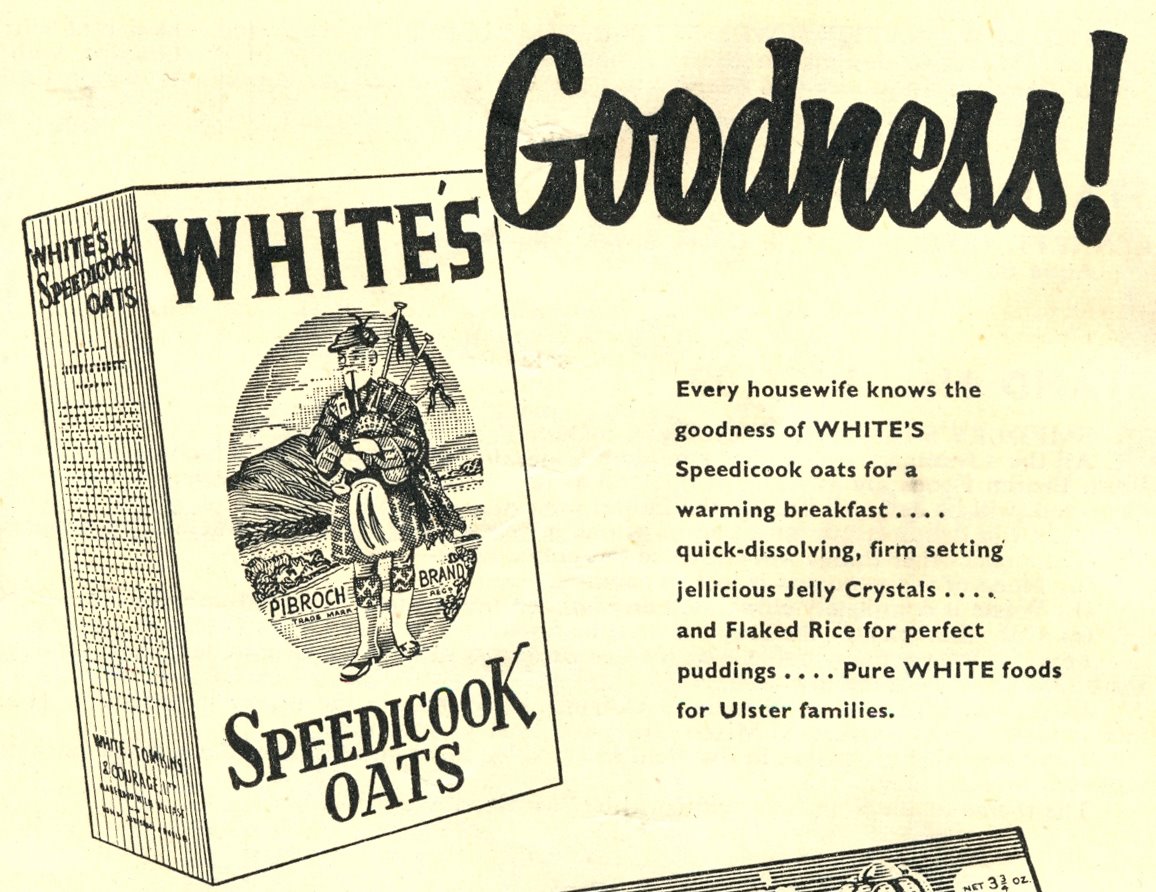
Tartanry [tahr-tn-ree] is a word used to describe the kitsch elements of Scottish culture that have been overemphasized or superimposed on the country first by the emergent Scottish tourist industry in the 18th and 19th centuries, and later by an American film industry. The earliest use of the word ‘tartanry’ itself is said to have been in 1976.
It refers to often misrepresented or invented aspects of Scotland such as clan tartans, kilts, bagpipes, Scottish Gaelic and Highland culture more generally.
Posted in Language, Money, World |
Leave a Comment »
May 16, 2011
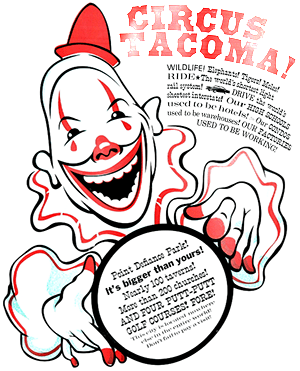
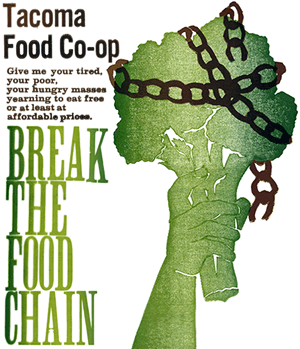
Beautiful Angle is a guerrilla arts poster project in Tacoma, Washington. Approximately once per month, graphic designer Lance Kagey and writer Tom Llewellyn create hand-crafted, letterpress posters and then distribute them around the city’s downtown core via wheat paste and staples.
The first poster, Swirl, was distributed on May 23, 2010. Beautiful Angle has a ‘strange, contradictory relationship with the city’; even though the posters are posted perhaps illegally, the group has won a Chamber of Commerce award of merit.
Posted in Art, Money, Politics |
2 Comments »
May 16, 2011

FAILE is a Brooklyn-based artistic collaboration between Patrick McNeil (b. 1975) and Patrick Miller (b. 1976). Since its inception in 1999, FAILE has been recognized for their pioneering use of wheatpasting and stenciling in the increasingly established arena of street art, and for their explorations of duality through a fragmented style of appropriation and collage.
During this time, FAILE adapted its signature mass culture-driven iconography to a wide array of media, from wooden boxes and window pallets to more traditional canvas, prints, sculptures, stencils, multimedia installation, and prayer wheels. While FAILE’s work is constructed from found visual imagery, and blurs the line between ‘high’ and ‘low’ culture, recent exhibitions demonstrate an emphasis on audience participation, a critique of consumerism, and the incorporation of religious media and architecture into their work.
Posted in Art, Money, Politics |
Leave a Comment »
May 16, 2011

Flyposting is the act of placing advertising posters or flyers in illegal places. In the U.S., these posters are known as bandit signs, snipe signs, or street spam. In most areas, it is illegal to place such posters on private property without the consent of the property owner, or to post on public property without a sign permit from the local government. Some areas, however, have public bulletin boards where notices may be posted. It is an advertising tactic mostly used by small businesses promoting concerts and political activist groups, but there have been occasions where international companies subcontracted local advertising agencies for flyposting jobs as a form of guerrilla marketing.
Flyposting is commonly seen as a nuisance due to issues with property rights, visual appearance and littering and is a misdemeanor in many countries. A particularly noteworthy incident of this type occurred in Boston, Massachusetts. In the case of the 2007 Boston Mooninite Scare, advertisers had placed electronic signboards without notifying local authorities, prompting a costly reaction by the Boston Police Bomb Squad when the signs were mistaken for bombs.
Posted in Art, Money, Politics |
Leave a Comment »
May 16, 2011

Wheatpaste (also known as Marxist glue) is a liquid adhesive made from vegetable starch and water. It has been used since ancient times for various arts and crafts such as bookbinding and papier mache. It is also made for the purpose of adhering paper posters to walls and other surfaces (often in graffiti). Closely resembling wallpaper paste, it is often made by mixing roughly equal portions of flour and water and heating it until it thickens, or by smearing cooked rice into a paste.
The words paste, pasta, and pastry have a common heritage, deriving from the Late Latin pasta (dough or pastry cake), itself deriving from the ancient Greek pasta, meaning ‘barley porridge.’ In English, paste is used as would be ‘dough’ in the 12th century, or ‘glue’ in the 15th century.
read more »
Posted in Art, Language, Money |
Leave a Comment »
May 16, 2011
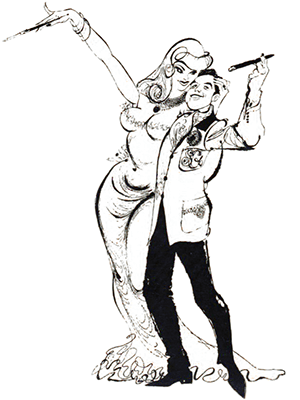
‘What Makes Sammy Run?‘ is a 1941 novel by Budd Schulberg. It is a rags to riches story chronicling the rise and fall of Sammy Glick, a Jewish boy born in New York’s Lower East Side who very early in his life makes up his mind to escape the ghetto and climb the ladder of success.
Reputedly, film mogul Samuel Goldwyn offered Schulberg money to not have the novel published, because Goldwyn felt that the author was perpetuating an anti-Semitic stereotype by making Glick so venal. It was later made into a long-running Broadway musical.
read more »
Posted in Art, Money |
Leave a Comment »
May 9, 2011


An executive toy is a novelty item that is usually a small mechanical gadget placed on the desk of a corporate executive or other office workers. They have no work-related function but are usually interesting to look at and entertaining. The first executive toy may have been a gadget designed by the great mathematician and engineer Philo of Byzantium (c.280 BCE), an octagon-shaped ink pot with openings on each side. One could turn the pot so that any face is on top and dip the pen in the opening, but the ink never ran out through the holes on other sides. The inkwell was suspended in the center on a series of gimbals and remained stationary in spite of any rotation.
Examples of executive toys include: EcoSphere (closed Aquarium), Etch A Sketch, Hoberman sphere (a folding and opening geodesic dome), oil and water liquid motion toys, Drinking bird, Magic 8-Ball, mechanical puzzles, music boxes, Nanoblocks (plastic building blocks similar to Lego but about half the linear dimensions), Newton’s cradle (where a set of metal balls are suspended from above, one is pulled from the rest and kicks them, transferring the kinetic energy to the last one), Perpetual pendulum (which doesn’t stop due to an electric magnet in the base of the toy), Pin Art (a box with thousands of small pins of equal length inserted into a board, that can be pressed from one side with any object so that the other ends of the pins form a three-dimensional image of the object on the other side of the board), Rubik’s Cubes, Tops, Yo-yos, Snow globes, Lava lamps, magnet toys, and stress balls.
Posted in Games, Money |
Leave a Comment »
May 9, 2011


Drop City was an artists’ community that formed in southern Colorado in 1965. Abandoned by the early 1970s, it became known as the first rural ‘hippie commune.’
In 1965, the four original founders, art students and filmmakers from the University of Kansas and University of Colorado, bought a 7-acre tract of land in south eastern Colorado. Their intention was to create a live-in work of what they called ‘Drop Art’ (sometimes called ‘droppings’), which was informed by the ‘happenings’ of Allan Kaprow and the impromptu performances, a few years earlier, of John Cage, Robert Rauschenberg and Buckminster Fuller, at Black Mountain College.
read more »
Posted in Art, Money, Philosophy |
Leave a Comment »
May 3, 2011

Anton Stankowski (1906 – 1998) was a German graphic designer, photographer and painter. Typical Stankowski designs attempt to illustrate processes or behaviors rather than objects. Such experiments resulted in the use of fractal-like structures long before their popularization by Benoît Mandelbrot in 1975. Despite producing many unique examples of concrete art and photographics, Stankowski is best known for designing the simple trademark of the Deutsche Bank.
His work is noted for straddling the camps of fine and applied arts by synthesising information and creative impulse. He was inspired by the abstract paintings of Mondrian, van Doesburg, and Kandinsky. Stankowski advocated graphic design as a field of pictorial creation that requires collaboration with free artists and scientists.
Posted in Art, Money, Technology |
Leave a Comment »
May 3, 2011

The Yellow Kid emerged as the lead character in ‘Hogan’s Alley,’ a comic first drawn by Richard F. Outcault in 1894, which became one of the first Sunday supplement comic strips in an American newspaper. The Yellow Kid was a bald, snaggle-toothed boy who wore a yellow nightshirt and hung around in a ghetto alley filled with equally odd characters, mostly other children.
With a goofy grin, the Kid habitually spoke in a ragged, peculiar ghetto argot printed on his shirt, a device meant to lampoon advertising billboards. His head was drawn wholly shaved as if having been recently ridden of lice, a common sight among children in New York’s tenement ghettos at the time. His nightshirt, a hand-me-down from an older sister, was white or pale blue in the first color strips.
read more »
Posted in Art, Humor, Money |
Leave a Comment »
May 2, 2011

Alien abduction insurance is an insurance policy issued against alien abduction. Simon Burgess, former Managing Director of British Insurance, well known for being involved in the bizarre end of the business, said ‘Of course, the burden of proof lies with the claimant. Let’s face it – insurance is so tedious that if I can enlighten my dreary life with a bit of humor every now and again, I will.’ Policies typically cover injuries suffered during an alien examinations or death caused by aliens. The first company to offer UFO insurance was the St. Lawrence Agency in Florida. The company says that it has paid out at least two claims of $1 per year until their death or for 1 million years, whichever comes first. The insurance is normally purchased by the ‘feeble-minded,’ according to Burgess. Prominent policyholders have included Shirley MacLaine and a Harvard University professor who has written on aliens.
The Heaven’s Gate religious group purchased alien abduction insurance before their mass suicide. Their insurance company (London brokerage Goodfellow Rebecca Ingrams Pearson) stopped offering alien abduction insurance after the suicide – having sold the policy to about four thousand people (mostly in England and the United States). At a cost of roughly $155 a year the GRIP policy would pay about $160,000 to someone who could show that they had been abducted by a being who was not from Earth. The payment would double if the insured person was impregnated during the event. Men were also able to purchase the impregnation insurance for protection against the unknown capabilities of alien technology.
Posted in Humor, Money |
Leave a Comment »
April 28, 2011

Eating your own dog food, also called dogfooding, is when a company (usually, a software company) uses the products that it makes. In 1988, Microsoft manager Paul Maritz wrote an email titled ‘Eating our own Dogfood,’ challenging his team to increase internal usage of the company’s product.
From there, the usage of the term spread through the company. The term is believed to have derived from a 1980s television advertisements for Alpo dog food, where TV actor, Lorne Greene pointed out that he fed Alpo to his own dogs.
read more »
Posted in Humor, Language, Money |
Leave a Comment »




 The Daily Omnivore