January 31, 2011

Spaghetti Western, also known as Italo-western, is a nickname for a broad sub-genre of Western film that emerged in the mid-1960s, so named because most were produced and directed by Italians. The typical team was made up of an Italian director, Italo-Spanish technical staff, and a cast of Italian and Spanish actors, sometimes a fading Hollywood star and sometimes a rising one like the young Clint Eastwood in three of Sergio Leone’s films. The films were typically shot in inexpensive locales resembling the American Southwest, primarily the Andalusia region of Spain, Almería, Sardinia, and Abruzzo.
Because of the desert setting and the readily available low-cost southern Spanish or southern Italian extras, typical themes in spaghetti westerns include the Mexican Revolution, Mexican bandits, and the border region shared by Mexico and the United States. Originally, spaghetti westerns were characterized by their production in the Italian language, low budgets, and a recognizable highly fluid and minimalist cinematography which eschewed many of the conventions of earlier Westerns. This was partly intentional and partly the context of a different cultural background.
Posted in Art, Money, World |
Leave a Comment »
January 28, 2011

FiveFingers are a type of shoe manufactured by Vibram. Originally developed as a ‘barefoot alternative’ for sailing and climbing, the footwear has thin, flexible soles that are contoured to the shape of the human foot, including visible individual sections for the toes. Vibram FiveFingers are meant to replicate being barefoot and allow for the natural biomechanics of the foot to work.
Posted in Health, Money, Technology |
Leave a Comment »
January 28, 2011

The Heineken WOBO (World Bottle) was a beer bottle designed for use as a building material in the developing world. According to the company, when brewing magnate Alfred Heineken was in Curaçao in 1960 he saw many bottles littering the beach because the island had no economic means of returning them to bottling plants. He was also concerned with the lack of affordable building materials and the inadequate living conditions plaguing Curaçao’s lower-class. Envisioning a solution for these problems, he asked Dutch architect N. John Habraken to design what he called ‘a brick that holds beer.’
The bottle was designed to be interlocking, laid horizontally and bonded with cement mortar with a silicon additive. A 10 ft (3.0 m) x 10 ft (3.0 m) shack would take approximately 1,000 bottles to build. In 1963, 100,000 WOBO’s were produced in two sizes, 350 and 500 mm. This size difference was necessary in order to bond the bottles when building a wall, in the same way as a half brick is necessary when building with bricks. Unfortunately, most of them were destroyed, and they are now very rare and have become a collector’s item.
Posted in Food, Money, Technology |
Leave a Comment »
January 26, 2011

The Shard is an 87-story skyscraper in London that forms part of the London Bridge Quarter development. The Shard’s construction began in 2009 and finished in late 2012. Standing approximately 306 metrs (1,004 ft) high, it is currently the tallest building in the European Union. It is the second-tallest freestanding structure in the UK, after the concrete tower at the Emley Moor transmitting station.
It was designed by the Italian architect Renzo Piano, and replaced Southwark Towers, a 24-story office block built on the site in Southwark in 1975. The Shard was developed by Sellar Property on behalf of LBQ Ltd, and is jointly owned by Sellar Property and the State of Qatar.
Posted in Art, Money, Technology |
Leave a Comment »
January 26, 2011

In computer terminology, a honeypot is a trap set to detect, deflect, or in some manner counteract attempts at unauthorized use of information systems. Generally it consists of a computer, data, or a network site that appears to be part of a network, but is actually isolated and monitored, and which seems to contain information or a resource of value to attackers.
A honeypot is valuable as a surveillance and early-warning tool. They should have no production value, and hence should not see any legitimate traffic or activity. Whatever they capture is therefore malicious or unauthorized. One practical application of this is a honeypot that thwarts spam by masquerading as a type of system abused by spammers. Honeypots can carry risks to a network, and must be handled with care. If they are not properly walled off, an attacker can use them to break into a system.
Posted in Language, Money, Technology |
Leave a Comment »
January 26, 2011
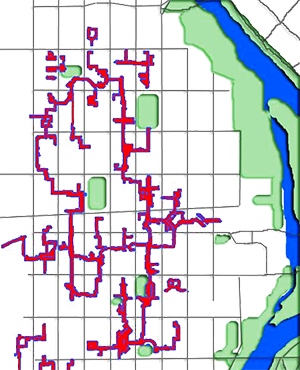
The Plus 15 or +15 Skyway network in Calgary, Alberta, Canada, is the world’s most extensive pedestrian skywalk system with a total length of 16 kilometers (10 mi) and 59 bridges. The system is so named because the skywalks are approximately 15 feet (approximately 4.5 metres) above street level. (Some Plus 15 skywalks are multi-level, with higher levels being referred to as +30’s and +45’s.)
Opening in 1970, the +15 network has expanded to include dozens of downtown Calgary buildings. The central core of the system is a series of enclosed shopping centers, and the city’s flagship department stores. Although there are currently no plans to remove bridges or to discontinue building new ones, the system has been subject to criticism in recent years. It has been identified with a decline in street life in the Downtown Commercial Core. Street life is instead concentrated on streets (such as Stephen Avenue) or in neighbourhoods where there are no bridges (such as Eau Claire and the Beltline).
Posted in Money, Politics, Technology |
Leave a Comment »
January 25, 2011


Prole drift, short for proletarian drift, is a trend in which products, styles or other aspects of culture previously considered to be upscale or upper class become popular among working class people. Prole drift can also go the other way, as when things that were once the purview of the working class become fashionable in the middle or upper classes. The term was coined by, American literary historian, Paul Fussell in 1983 to describe the phenomenon of most aspects of high culture eventually joining the lowest common denominator.
Examples include sales of premium coffee, Burberry clothing or Coach Inc. handbags to working class people. Examples of reverse prole drift include Mockney, the skinhead and punk subcultures, hip hop, rockabilly, dressing down, slumming it (e.g. going to a working class bar) and NASCAR. BMW cars (particularly the 3 series) have also suffered from this phenomenon, in some instances the 3 series outselling more mainstream cars such as the Ford Mondeo and Vauxhall Vectra.
Posted in Language, Money, Politics |
Leave a Comment »
January 25, 2011

A chav is a stereotype of certain people in the United Kingdom. Also known as a charver in Yorkshire and North East England, ‘chavs’ are said to be aggressive teenagers, of white working class background, who repeatedly engage in antisocial behaviour such as street drinking, drug abuse and rowdiness, or other forms of juvenile delinquency. The derivative Chavette has been used to refer to females.
Chav probably has its origins in the Romani word ‘chavi,’ meaning ‘child’ (or ‘chavo,’ meaning ‘boy,’ or ‘chavvy,’, meaning ‘youth’). This word may have entered the English language through the Geordie dialect word charva, meaning a rough child. This is similar to the colloquial Spanish word chaval, meaning ‘kid’ or ‘guy.’ In Italy, chavs are termed as coatto, which basically means ‘working class’ and vulgar.
read more »
Posted in Language, Money, World |
Leave a Comment »
January 25, 2011

‘Ambient 1: Music for Airports‘ is an ambient album by Brian Eno released in 1978. Of four albums released on Eno’s own, then new, Ambient label, ‘Music for Airports’ was the first to carry explicitly the name ‘ambient’ – a term which he coined to differentiate his minimalistic approach to the album’s material and ‘the products of the various purveyors of canned music.’ Notice of similarly quiet, unobtrusive music had been given on his albums such as ‘Evening Star,’ ‘Discreet Music,’ ‘Music for Films,’ and Harold Budd’s ‘The Pavilion of Dreams’ (which Eno produced), but in this album it was given precedence as a fully developed concept.
The music was designed to be continuously looped as a sound installation, with the intent to defuse the tense, anxious atmosphere of an airport terminal. Eno conceived this idea while being stuck at Cologne Bonn Airport in Germany in the mid 70s. He had to spend several hours there and was extremely annoyed by the uninspired sound atmosphere. It was installed at the Marine Air Terminal of New York’s LaGuardia Airport.
Posted in Art, Money, Technology |
Leave a Comment »
January 25, 2011

In the context of the World Wide Web, content farms are companies (or their divisions) that employ large numbers of (often freelance) writers to generate large amounts of textual content. The articles in content farms are written by human beings but may not be written by a specialist in the area. In one of Google’s own promotional videos the majority of the links available were actually produced at content farms.
Content farms contain huge number of articles. For instance, Demand Media will soon be publishing 1 million items a month, the equivalent of four English-language Wikipedias a year. Big content farms are expensive resources, sold for many millions.
read more »
Posted in Language, Money, Technology |
Leave a Comment »
January 25, 2011


A fad, sometimes called a trend, meme or a craze, is any form of behavior that develops among a large population and is collectively followed with enthusiasm for some period, generally as a result of the behavior’s being perceived as novel in some way.
A fad is said to ‘catch on’ when the number of people adopting it begins to increase rapidly, but they fade quickly once the perception of novelty is gone. Though the term trend may be used interchangeably with fad, a fad is generally considered a fleeting behavior whereas a trend is considered to be a behavior that evolves into a relatively permanent change.
read more »
Posted in Language, Money, Politics |
Leave a Comment »
January 25, 2011

The Monty Hall problem is a famous problem in probability science. The problem is based on a game show, ‘Let’s Make a Deal,’ and is named for the show’s host, Monty Hall. In the problem, there are three doors. A car is behind one door and goats behind the other two doors.
read more »
Posted in Humor, Money, Science |
Leave a Comment »




 The Daily Omnivore