March 13, 2012

A wired glove (sometimes called a dataglove or cyberglove) is an input device for human–computer interaction worn like a glove. Various sensor technologies are used to capture physical data such as bending of fingers. Often a motion tracker, such as a magnetic tracking device or inertial tracking device, is attached to capture the global position/rotation data of the glove. These movements are then interpreted by the software that accompanies the glove, so any one movement can mean any number of things.
Gestures can then be categorized into useful information, such as to recognize Sign Language or other symbolic functions. Expensive high-end wired gloves can also provide haptic feedback, which is a simulation of the sense of touch. This allows a wired glove to also be used as an output device. Traditionally, wired gloves have only been available at a huge cost, with the finger bend sensors and the tracking device having to be bought separately. Wired gloves are often used in virtual reality environments.
read more »
Posted in Games, Money, Technology |
Leave a Comment »
March 13, 2012

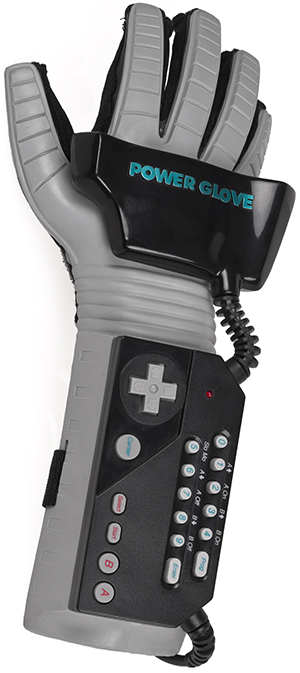
The Power Glove is a controller accessory for the Nintendo Entertainment System, and the first peripheral interface controller to recreate human hand movements on a television or computer screen in real time. The Power Glove was not popular and was criticized for its imprecise and difficult-to-use controls. The Power Glove was originally released in 1989. Though it was an officially licensed product, Nintendo was not involved in the design or release of this accessory. Rather, it was designed by Grant Goddard and Samuel Cooper Davis for Abrams Gentile Entertainment (AGE), made by Mattel in the United States and PAX in Japan.
Additional development was accomplished through the efforts of Thomas G. Zimmerman and Jaron Lanier, a virtual reality pioneer responsible for co-developing and commercializing the DataGlove who had made a failed attempt at a similar design for Nintendo earlier. The Power Glove and DataGlove were based on Zimmerman’s instrumented glove. Zimmerman built the first prototype that demonstrated finger flex measurement and hand position tracking using a pair of ultrasonic transmitters. His original prototype used optical flex sensors to measure finger bending which were replaced with less expensive carbon-based flex sensors by the AGE team.
read more »
Posted in Games, Money, Technology |
Leave a Comment »
March 13, 2012

The Virtual Boy was a video game console developed and manufactured by Nintendo. It was the first video game console that was supposed to be capable of displaying ‘true 3D graphics’ out of the box. Whereas most video games use monocular cues to achieve the illusion of three dimensions on a two-dimensional screen, The Virtual Boy creates an illusion of depth through the effect known as parallax.
In a manner similar to using a head-mounted display, the user looks into an eyepiece made of neoprene on the front of the machine, and then an eyeglass-style projector allows viewing of the monochromatic (in this case, red) image. It was released in 1995 in Japan and North America at a price of around US$180. It met with a lukewarm reception that was unaffected by continued price drops. Nintendo discontinued it the following year.
read more »
Posted in Games, Money, Technology |
Leave a Comment »
March 12, 2012

Oxfam is the largest retailer of second hand books in Europe, selling around 12 million per year. Most of Oxfam’s 750 charity shops around the UK sell books, and around 100 are specialist bookshops or book and music shops. A typical Oxfam bookshop will have around 50 volunteers, as well as a small number of full-time staff. Books are donated directly to shops by the public, or through Oxfam ‘book banks’ in convenient locations around the country. The profits of the book sales support the work of Oxfam.
Oxfam has been trying to shake off the dusty image of its shops, and the rapid expansion of specialist bookshops has formed part of that strategy. Modern Oxfam bookshops typically boast professional fittings and a wide range of stock, including recent novels, specialist textbooks and out-of-print curios. However, charity bookshops, particularly those belonging to Oxfam, have been criticized for forcing traditional bookshops out of business. Small bookshops have complained that Oxfam receives unfair advantages in the form of favorable tax rates and cheaper waste disposal, amongst other things. In response to these criticisms, Oxfam has said that much of the damage to small book retailers has come from supermarkets and online retailers, particularly Tesco and Amazon.
Posted in Money, Politics, World |
Leave a Comment »
March 12, 2012

Sweat equity is a term that refers to a party’s contribution to a project in the form of effort — as opposed to financial equity, which is a contribution in the form of capital. In a partnership, some partners may contribute to the firm only capital and others only sweat equity. Similarly, in a startup company formed as a corporation, employees may receive stock or stock options, becoming thus part-owners of the firm, in return for accepting salaries that are below their respective market values (this includes zero wages). This concept, also called ‘stock for services’ and sometimes ‘equity compensation’ can also be seen when startup companies use their shares of stock to entice service providers to provide necessary corporate services in exchange for a discount or for deferring service fees until a later date,
The term can also be used to describe the value added to real estate by owners who make improvements by their own toil. The more labor applied to the home, and the greater the resultant increase in value, the more sweat equity that has been used. In a successful model used by Habitat for Humanity, families who would otherwise be unable to purchase their own home (based on qualifying factors including need, ability to pay, and willingness to partner) contribute sweat equity hours to the construction of their own home, the homes of other Habitat for Humanity partner families or by volunteering to assist the organization in other ways.
Posted in Language, Money |
Leave a Comment »
March 11, 2012

Brian Bosworth (b.1965), also known as the “The Boz,” is a former American professional football player. He played college football for the University of Oklahoma, and was a two-time All-American. He played professionally for the NFL’s Seattle Seahawks. In college, he was known for his radical hairstyles and criticism of the NCAA as much as his play on the field. Bosworth was never one to shy from publicity or controversy.
On more than one occasion he referred to the NCAA as the ‘National Communists Against Athletes.’ He wore a shirt bearing that slogan during the 1987 Orange Bowl. Banned from the game because of steroid use, Bosworth unveiled the shirt while standing on the sidelines to the shock and outrage of many, including his own coach, Barry Switzer. While Switzer was known for running a loose ship, this incident was too much even for him, and he threw Bosworth off the team.
read more »
Posted in Games, Money |
2 Comments »
March 10, 2012

A meat analogue, also called a meat substitute, mock meat, faux meat, or imitation meat, approximates the aesthetic qualities (primarily texture, flavor, and appearance) and/or chemical characteristics of specific types of meat. Many analogues are soy-based (e.g. tofu, tempeh). Generally, meat analogue is understood to mean a food made from non-meats, sometimes without other animal products such as dairy. The market for meat imitations includes vegetarians, vegans, and people following religious dietary laws, such as Kashrut or Halal. Hindu cuisine features the oldest known use of meat analogues. Meat analogue may also refer to a meat-based and/or less-expensive alternative to a particular meat product, such as surimi (a fish slurry used to make products such as imitation crab meat).
Some vegetarian meat analogues are based on centuries-old recipes for seitan (wheat gluten), rice, mushrooms, legumes, tempeh, or pressed-tofu, with flavoring added to make the finished product taste like chicken, beef, lamb, ham, sausage, seafood, etc. Yuba is another soy-based meat analogue, made by layering the thin skin which forms on top of boiled soy milk. Some more recent meat analogues include textured vegetable protein (TVP), which is a dry bulk commodity derived from soy, soy concentrate, mycoprotein-based Quorn which uses egg white as a binder making them unsuitable for vegans, and modified defatted peanut flour.
Posted in Food, Money, Philosophy |
2 Comments »
March 9, 2012

The Unix philosophy [yoo-niks] is a set of cultural norms and philosophical approaches to developing software based on the experience of leading developers of the Unix operating system. Doug McIlroy, the inventor of Unix, summarized the philosophy as follows: ‘Write programs that do one thing and do it well.’ Additional credos include: ‘Write programs to work together. Write programs to handle text streams, because that is a universal interface.’
Richard P. Gabriel, an expert on the Lisp programming language, suggests that a key advantage of Unix was that it embodied a design philosophy he termed ‘worse is better,’ in which simplicity of both the interface and the implementation are more important than any other attributes of the system—including correctness, consistency, and completeness. Gabriel argues that this design style has key evolutionary advantages, though he questions the quality of some results.
Posted in Money, Philosophy, Technology |
Leave a Comment »
March 9, 2012
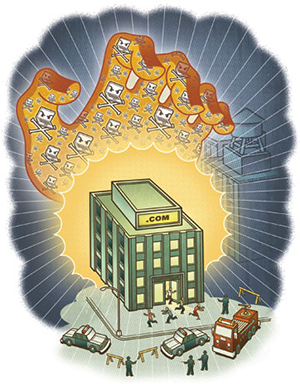
Low Orbit Ion Cannon (LOIC) is an open source network stress testing and denial-of-service attack application. LOIC was initially developed by Praetox Technologies, but was later released into the public domain, and now is hosted on several open source platforms. It’s named after a fictitious weapon from the ‘Command & Conquer’ series of video games.
The software has inspired the creation of an independent JavaScript version, enabling a DoS from a web browser. LOIC performs a DoS attack (or when used by multiple individuals, a DDoS attack) on a target site by flooding the server with TCP packets or UDP packets with the intention of disrupting the service of a particular host. People have used LOIC to join voluntary botnets. LOIC attacks are easily identified in system logs, and the attack can be tracked down to the individual users IP address.
Posted in Money, Politics, Technology |
Leave a Comment »
March 9, 2012

Topiary, real name Jake Davis, is a hacker and self-described ‘Simple prankster turned swank garden hedge. Worked with Anonymous, LulzSec, and other such paragons of intense cyber victory.’ He is an associate of the Internet group Anonymous, which have publicly claimed various online attacks, including hacking HBGary, Westboro Baptist Church, and Gawker. They have also claimed responsibility for the defacing of government websites in countries such as Zimbabwe, Syria, Tunisia, Ireland, and Egypt. 18-year Jake Davis was arrested in Scotland in 2011.
Police confiscated a Dell laptop and a 100-gigabyte hard drive that had 16 different virtual machines. The hard drive also contained details relating to an attack on Sony and hundreds of thousands of email addresses and passwords were found on the computer. A London court released Davis on bail under the conditions that he live under curfew with his mother and have no access to the Internet. His lawyer stated that, while his client did help publicize LulzSec and Anonymous attacks, he lacks the technical skills to have been anything but a sympathizer. After his arrest, Anonymous launched a ‘Free Topiary’ campaign.
Posted in Money, Politics, Technology |
Leave a Comment »
March 9, 2012

Sabu, real name Hector Xavier Monsegur (b. 1983), is an American computer hacker and the founder of the hacking group LulzSec. LulzSec intervened in the affairs of organizations such as News Corporation, Stratfor, British and American law enforcement bodies, and Irish political party Fine Gael.
Sabu later turned informant for the FBI, working with the agency for over ten months to aid them in identifying other hackers from Lulzsec and related groups. His online handle is a reference to a professional wrestler. Monsegur was based out of a housing project on the lower east side of Manhattan while operating as Sabu; he is currently in a witness protection program.
Posted in Money, Politics, Technology |
Leave a Comment »
March 8, 2012

The Intelligent Investor by Benjamin Graham, first published in 1949, is a widely acclaimed book on value investing, an investment approach Graham began teaching at Columbia Business School in 1928 and subsequently refined with David Dodd. Value investing generally refers to buying securities whose shares appear underpriced. Graham’s favorite allegory is that of Mr. Market, an obliging fellow who turns up every day at the shareholder’s door offering to buy or sell his shares at a different price. Often, the price quoted by Mr. Market seems plausible, but sometimes it is ridiculous.
The investor is free to either agree with his quoted price and trade with him, or ignore him completely. Mr. Market doesn’t mind this, and will be back the following day to quote another price. The point of this anecdote is that the investor should not regard the whims of Mr. Market as a determining factor in the value of the shares the investor owns. He should profit from market folly rather than participate in it. The investor is advised to concentrate on the real life performance of his companies and receiving dividends, rather than be too concerned with Mr. Market’s often irrational behavior.
Posted in Language, Money |
Leave a Comment »




 The Daily Omnivore