October 17, 2011

The Spamhaus Project is an international organization (founded by Steve Linford in 1998) to track e-mail spammers and spam-related activity. It is named for the anti-spam jargon term coined by Linford, ‘spamhaus,’ a pseudo-German expression for an ISP or other firm which spams or willingly provides service to spammers.
Spamhaus is responsible for a number of very widely used anti-spam DNS-based Blocklists (DNSBLs) and Whitelists (DNSWLs). Many internet service providers and Internet networks use these services to reduce the amount of spam they take on. The Spamhaus blocks 80 billion spam emails per day globally on the internet (almost 1 million spams per second). Like all DNSBLs, their use is considered controversial by some.
read more »
Posted in Money, Politics, Technology |
Leave a Comment »
October 16, 2011
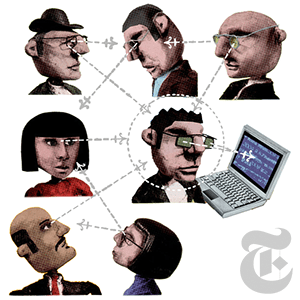
A Keynesian beauty contest [keyn-zee-uhn] is a concept developed by economist John Maynard Keynes in 1936 to explain price fluctuations in equity markets. Keynes described the action of rational agents in a market using an analogy based on a fictional newspaper contest, in which entrants are asked to choose a set of six faces from photographs of women that are the ‘most beautiful.’ Those who picked the most popular face are then eligible for a prize.
Keynes said: ‘It is not a case of choosing those [faces] that, to the best of one’s judgment, are really the prettiest, nor even those that average opinion genuinely thinks the prettiest. We have reached the third degree where we devote our intelligences to anticipating what average opinion expects the average opinion to be. And there are some, I believe, who practice the fourth, fifth and higher degrees.’ Keynes believed that similar behavior was at work within the stock market. This would have people pricing shares not based on what they think their fundamental value is, but rather on what they think everyone else thinks their value is, or what everybody else would predict the average assessment of value is.
Posted in Games, Language, Money |
Leave a Comment »
October 16, 2011

The Thomas theorem is a theory of sociology which was formulated in 1928 by W. I. Thomas (1863–1947): ‘If men define situations as real, they are real in their consequences.’ In other words, the interpretation of a situation causes the action. This interpretation is not objective. Actions are affected by subjective perceptions of situations. Whether there even is an objectively correct interpretation is not important for the purposes of helping guide individuals’ behavior. In 1923, Thomas stated more precisely that any definition of a situation will influence the present. Not only that, but—after a series of definitions in which an individual is involved—such a definition also ‘gradually [influences] a whole life-policy and the personality of the individual himself.’ Consequently, Thomas stressed societal problems such as intimacy, family, or education as fundamental to the role of the situation when detecting a social world ‘in which subjective impressions can be projected on to life and thereby become real to projectors.’
The 1973 oil crisis resulted in the so-called ‘toilet paper panic.’ The rumor of an expected shortage of toilet paper—resulting from a decline in the importation of oil—caused people to stockpile supplies of toilet paper and this caused a shortage. This shortage, seeming to validate the rumor, is also an example of a self-fulfilling prophecy. The Beauty Contest Theory, developed by John Maynard Keynes, justifies why the price of a share of stock does not necessarily develop according to rational expectations. He acts on the assumption that many investors make their decisions not according to their own computations of an asset’s worth but by predicting the conclusions of other market participants.
Posted in Money, Science |
Leave a Comment »
October 16, 2011

The Tinkerbell effect is a term describing things that are thought to exist only because people believe in them. The effect is named for Tinker Bell, the fairy in the play Peter Pan who is revived from near death by the belief of the audience.
Claimed cases include: private property; the value of a nation’s money in a fiat system; the value of gold; civil society; and the ‘rule of law.’
Posted in Humor, Money, Politics |
Leave a Comment »
October 15, 2011


This article lists and discusses the usage and derivation of names of large numbers, together with their possible extensions. There are two main ways of naming a number: scientific notation and naming by grouping. For example, the number 500,000,000,000,000,000,000 can be called 5 x 10²⁰ in scientific notation since there are 20 zeros behind the 5. If the number is named by grouping, it is five hundred quintillion (American) or 500 trillion (European).
At times, the names of large numbers have been forced into common usage as a result of excessive inflation. The highest numerical value banknote ever printed was a note for 1 sextillion pengő (1021 or 1 milliard bilpengő as printed) printed in Hungary in 1946. In 2009, Zimbabwe printed a 100 trillion (1014) Zimbabwean dollar note, which at the time of printing was only worth about US$30.
read more »
Posted in Language, Money, Science |
Leave a Comment »
October 13, 2011

A mind machine (or psychowalkman) uses pulsing rhythmic sound and/or flashing light to alter the brainwave frequency of the user. Mind machines are said to induce deep states of relaxation, concentration, and in some cases altered states of consciousness that have been compared to those obtained from meditation and shamanic rituals. The process applied by these machines is also known as brainwave synchronization or entrainment. Mind machines typically consist of a control unit, a pair of headphones and/or strobe light goggles. The unit controls the sessions and drives the LEDs in the goggles. Professionally, they are usually referred to as Auditory Visual Stimulation devices (AVS). Sessions will typically aim at directing the average brainwave frequency from a high level to a lower level by ramping down in several sequences. Target frequencies typically correspond to delta (1-3 hertz), theta (4–7 Hz), alpha (8–12 Hz) or beta brain waves (13–40 Hz), and can be adjusted by the user based on the desired effects.
There have been a number of claims regarding binaural beats (auditory processing artifacts or apparent sounds), among them that they may help people memorize and learn, stop smoking, tackle erectile dysfunction and improve athletic performance. However, research into binaural beats is very limited. No conclusive studies have been released to support marketing claims for binaural beat systems. Mind machines are often used together with biofeedback or neurofeedback equipment in order to adjust the frequency on the fly. Modern mind machines can connect to the Internet to update the software and download new sessions. When sessions are used in conjunction with meditation, neurofeedback, etc. the effect can be amplified. Rapidly flashing lights may be dangerous for people with photosensitive epilepsy or other nervous disorders. It is thought that one out of 10,000 adults will experience a seizure while viewing such a device; about twice as many children will have a similar ill effect.
Posted in Health, Money, Technology |
Leave a Comment »
October 11, 2011

‘Why the future doesn’t need us‘ is an article written by Bill Joy (then Chief Scientist at Sun Microsystems) in the April 2000 issue of ‘Wired’ magazine. In the article, he argues (quoting the sub title) that ‘Our most powerful 21st-century technologies — robotics, genetic engineering, and nanotech — are threatening to make humans an endangered species.’ Joy warns: ‘The experiences of the atomic scientists clearly show the need to take personal responsibility, the danger that things will move too fast, and the way in which a process can take on a life of its own. We can, as they did, create insurmountable problems in almost no time flat. We must do more thinking up front if we are not to be similarly surprised and shocked by the consequences of our inventions.’
While some critics have characterized Joy’s stance as obscurantism (the practice of deliberately preventing the facts or the full details of some matter from becoming known) or neo-Luddism, others share his concerns about the consequences of rapidly expanding technology.
read more »
Posted in Money, Politics, Technology |
Leave a Comment »
October 10, 2011

A beer koozie [koe-zie] is a fabric or foam device that is designed to insulate a beverage can or bottle. It began as a marketing tool. The primary use of a beer koozie is to keep one’s hand warm while keeping the beer cold.
A secondary use of a beer koozie is to easily identify one’s beverage from another. Many different companies have used the koozie as a promotional giveaway because it is not only inexpensive to manufacture, but its frequent use is more likely to bring the company’s name to a household presence. Originally this logo or image was screen-printed on a round foam cylinder with a foam base (generally a hole is provided in the base to alleviate creation of a vacuum). A koozie can be made from many materials like neoprene, polyester or open cell foam.
Posted in Food, Language, Money |
1 Comment »
September 28, 2011

Morphing is a special effect in motion pictures and animations that changes (or morphs) one image into another through a seamless transition. Most often it is used to depict one person turning into another through technological means or as part of a fantasy or surreal sequence. Traditionally such a depiction would be achieved through cross-fading techniques on film. Since the early 1990s, this has been replaced by computer software to create more realistic transitions.
Though the 1986 movie ‘The Golden Child’ implemented very crude morphing effects from animal to human and back, the first movie to employ detailed morphing was ‘Willow,’ in 1988. A similar process was used a year later in ‘Indiana Jones and the Last Crusade’ to create Walter Donovan’s gruesome demise. Both effects were created by Industrial Light and Magic using grid warping techniques developed by Tom Brigham and Doug Smythe.
read more »
Posted in Art, Money, Technology |
1 Comment »
September 27, 2011

An eponym [ep-uh-nim] is a word, usually a person’s name, that is used to name something else. One who is referred to as eponymous is someone who gives his or her name to something, e.g., John Schnatter, the eponymous owner of Papa John’s Pizza. A common nonstandard usage is that something eponymous is named after a particular person, e.g., Julian’s eponymous restaurant. In contemporary English, the term self-titled is often used to mean eponymous in the case of a work with the same name as the person or persons who created it (e.g., the song ‘Black Sabbath,’ from the album ‘Black Sabbath,’ by the band Black Sabbath).
In intellectual property law an eponym can refer to a genericized trademark or brand name, a form of metonymy (a figure of speech used in which a thing or concept is not called by its own name, but by the name of something intimately associated with that thing or concept — e.g. ‘Kleenex’ for all tissues).
read more »
Posted in Language, Money, Politics |
Leave a Comment »
September 27, 2011

Nazisploitation is a subgenre of exploitation film and sexploitation film that involves villainous Nazis committing criminal acts of a sexual nature often as camp or prison overseers in World War II settings. Most follow the standard women in prison formula, only relocated to a death camp or Nazi brothel, with an added emphasis on sadism, gore, and degradation.
The most infamous and influential title (and the one that set the standards of the genre) is perhaps ‘Ilsa, She Wolf of the SS’ (1974), a Canadian production. Its surprise success and sequels led European film makers, mostly in Italy, to produce dozens of similar films depicting Nazi atrocities. While the Ilsa series and Salon Kitty were profitable, the other films were mostly box-office flops and the genre all but vanished by the mid 1980s.
read more »
Posted in Money, Sex, War |
Leave a Comment »
September 27, 2011

Hypermiling is the act of driving using techniques that maximize fuel economy. Those who practice these techniques are referred to as ‘hypermilers.’ Hypermiling can be practiced in any vehicle regardless of its fuel economy. It gained popularity as a result of the rise in gasoline prices during the 2000s. Some hypermiling techniques are illegal in some jurisdictions because they are dangerous. Hypermiling has come under fire from several quarters due to claims of dangerous or unlawful behavior by some hypermilers, such as tailgating larger vehicles on freeways to save fuel by drafting. As a result, the Hypermiling Safety Foundation was formed in August 2008 to promote a safety and public awareness program, advocating legal fuel-saving techniques.
Hypermiling contests have been held on selected courses. The Maximum Fuel Economy contest was held in Indiana, where ‘world records’ for the Honda Insight (213 miles per gallon), Toyota Prius (136 miles per gallon) and the Ford Escape Hybrid (76 miles per gallon) were set. Contestants used techniques which included rolling through all stop signs and having the vehicle tires inflated well beyond recommended specifications. Another contest is the Tour to the Shore, held in New Jersey, which evaluates drivers of cars and trucks.
Posted in Games, Money, Technology |
Leave a Comment »



