August 8, 2011

Hipster is a slang term that first appeared in the 1940s, was revived in the 1990s, and continued to be used in the 2000s and 2010s, to describe young, recently settled urban middle class adults and older teenagers with musical interests mainly in indie rock. Other interests in media would include independent film, magazines such as Vice and Clash, and websites like Pitchfork Media. In some contexts, hipsters are also called scenesters.
‘Hipster’ has been used in sometimes contradictory ways, making it difficult to precisely define ‘hipster culture,’ which has been described as a ‘mutating, trans-Atlantic melting pot of styles, tastes and behavior.’ Hipsterism fetishizes the authentic elements of all of the ‘fringe movements of the postwar era—beat, hippie, punk, even grunge,’ and draws on the ‘cultural stores of every unmelted ethnicity,’ and ‘regurgitates it with a winking inauthenticity.’ Others, like Arsel and Thompson, argue that hipster signifies a cultural mythology, a crystallization of a mass-mediated stereotype generated to understand, categorize, and marketize indie consumer culture, rather than an objectified group of people.
read more »
Posted in Art, Language, Money |
Leave a Comment »
August 5, 2011

The handicap principle is a hypothesis originally proposed in 1975 by biologist Amotz Zahavi to explain how evolution may lead to ‘honest’ or reliable signaling between animals who have an obvious motivation to bluff or deceive each other. The handicap principle suggests that reliable signals must be costly to the signaler, costing the signaler something that could not be afforded by an individual with less of a particular trait.
For example, in the case of sexual selection, the theory suggests that animals of greater biological fitness signal this status through handicapping behavior or morphology that effectively lowers this quality. The central idea is that sexually selected traits function like conspicuous consumption, signalling the ability to afford to squander a resource simply by squandering it. Receivers know that the signal indicates quality because inferior quality signalers cannot afford to produce such wastefully extravagant signals.
read more »
Posted in Money, Science, Sex |
Leave a Comment »
August 5, 2011

Beef aging is the process of preparing beef for consumption, mainly by breaking down the connective tissue. Dry-aged beef has been hung to dry for several weeks. After the animal is slaughtered and cleaned, either an entire half will be hung, or prime cuts will be placed in a cooler, also known as a ‘hot box.’ This process involves considerable expense, as the beef must be stored near freezing temperatures. Also, only the higher grades of meat can be dry aged, as the process requires evenly distributed fat. For these reasons one seldom sees dry-aged beef outside of steak restaurants and upscale butcher shops. The process changes beef by two means. First, moisture is evaporated from the muscle, concentrating flavor. Second, the beef’s natural enzymes break down the connective tissue in the muscle, which leads to more tender beef.
Dry-aging can promote the growth of certain mold species on the external surface of the meat. This doesn’t cause spoilage, but actually forms an external ‘crust,’ which is trimmed off when the meat is prepared for cooking. These fungal species complement the natural enzymes in the beef by helping to tenderize and increase the flavor of the meat. The genus Thamnidia, in particular, is known to produce collagenolytic enzymes which greatly contribute to the tenderness and flavor of dry-aged meat. Wet-aged beef is beef that has typically been aged in a vacuum-sealed bag to retain its moisture. This is the dominant mode of aging beef in the United States today. Wet-aging is popular because it takes less time (typically only a few days) and none of the weight is lost in the process. In contrast, dry-aging can take 15–28 days, and will see up to a third or more of the weight lost as moisture.
Posted in Food, Money |
Leave a Comment »
August 4, 2011

A stock market crash is a sudden dramatic decline of stock prices across a significant cross-section of a stock market, resulting in a significant loss of paper wealth. Crashes are driven by panic as much as by underlying economic factors. They often follow speculative stock market bubbles.
Stock market crashes are social phenomena where external economic events combine with crowd behavior and psychology in a positive feedback loop where selling by some market participants drives more market participants to sell. Generally speaking, crashes usually occur under the following conditions: a prolonged period of rising stock prices and excessive economic optimism, a market where P/E ratios exceed long-term averages, and extensive use of margin debt and leverage by market participants.
read more »
Posted in Money, Politics, Science |
1 Comment »
August 4, 2011

Recession shapes are used by economists to describe different types of recessions. There is no specific academic theory or classification system for recession shapes; rather the terminology is used as an informal shorthand to characterize recessions and their recoveries. The most commonly used terms are V-shaped, U-shaped, W-shaped, and L-shaped recessions. The letters can also be applied referring to the recoveries (ie ‘V-shaped recovery’).
In a V-shaped recession, the economy suffers a sharp but brief period of economic decline with a clearly defined trough, followed by a strong recovery. V-shapes are the normal shape for recession: ‘There is a strong historical ‘snap back’ relationship between the strength of economic recovery and the severity of the preceding recession. Thus, recessions and their recoveries have a tendency to trace out a ‘V’ shape.’
read more »
Posted in Money, Politics |
Leave a Comment »
August 4, 2011

Jack Herer (1939 – 2010) was an American cannabis activist and the author of ‘The Emperor Wears No Clothes,’ a book which has been used in efforts to decriminalize cannabis. A former Goldwater Republican, he believed that the cannabis plant should be decriminalized because it has been shown to be a renewable source of fuel, food, and medicine that can be grown in virtually any part of the world. A specific strain of cannabis has been named after Herer that has won several awards, including the 7th High Times Cannabis Cup. He ran for US President twice, in 1988 (1,949 votes) and 1992 (3,875 votes) as the Grassroots Party candidate. In July 2000, he suffered a minor heart attack and a major stroke, resulting in difficulties speaking and moving the right side of his body. He mostly recovered, and claimed in 2004 that treatment with amanita muscaria, a psychoactive mushroom had cured him. He died six years later, aged 70.
European experts on hemp, like Dr. Hayo Van der Werf and Dr. Ivan Bûcsa, criticized Herer’ for making unrealistic claims regarding the potential of hemp, for example: Herer claimed that hemp produces higher yields than other crops. Van der Werf argue that is simply wrong. Under most favorable growing conditions, other crops such as maize, sugar beet or potato produced similar dry matter yields. Herer also claimed that hemp hurds, which make up 60 to 80 % of the stem dry weight, contain 77 % cellulose. Van der Werf argue that is wrong. Cellulose content of hemp hurds has been found to vary between 32 and 38 %. Possibly, Herer confused the hurds, which form the woody core of the hemp stem, with the bark, which forms the outer layer of the hemp stem. The bark contains the long bast fibers which are used in textile manufacturing.
Posted in Drugs, Money, Politics |
1 Comment »
August 2, 2011
Rudolf Dassler (1898 – 1974) was the German founder of the sportswear company PUMA and the older brother of Adidas founder, Adolf ‘Adi’ Dassler. The brothers were partners in a shoe company Adi started, Gebrüder Dassler Schuhfabrik (Dassler Brothers Shoe Factory). Rudi joined in 1924, however the brothers became rivals following World War II and started their own companies in 1948. Initially calling the new company ‘Ruda,’ it was soon changed to its present name of Puma. Puma is the word for cougar in German as well as other languages. Under his direction, Puma remained a small provincial company. Only under the direction of his son, Armin Dassler, did it become the worldwide known company it remains today.
With the rise of Adolf Hitler in the 1930s, both Dassler brothers joined the Nazi Party, with Rudolf reputed as being the more ardent National Socialist. Rudolf was drafted, and later captured, while Adi stayed behind to produce boots for the Wehrmacht (Nazi military). During the war, a growing rift between the pair reached a breaking point after an Allied bomb attack in 1943 when Adi and his wife climbed into a bomb shelter that Rudolf and his family were already in: ‘The dirty bastards are back again,’ Adi said, apparently referring to the Allied war planes, but Rudolf was convinced his brother meant him and his family. Rudolf, upon his capture by American troops, was suspected of being a member of the SS, information supposedly supplied by none other than his brother Adi.
Posted in Games, Money, War |
Leave a Comment »
August 2, 2011

Adolf Dassler (1900 – 1978), known as ‘Adi,’ was the founder of the German sportswear company Adidas. Trained as a cobbler, Dassler started to produce his own sports shoes in his mother’s laundry after his return from World War I. His father, Christoph, who worked in a shoe factory, and the Zehlein brothers, who produced the handmade spikes for track shoes in their blacksmith’s shop, supported Dassler in starting his own business. In 1924, his older brother Rudolf joined the business, which became the Gebrüder Dassler Schuhfabrik (Dassler Brothers Shoe Factory). At the 1928 Olympics, Dassler equipped several athletes, laying the foundation for the international expansion of the company. During the 1936 Summer Olympics in Berlin, Dassler equipped Jesse Owens of the USA with his shoes. Owens went on to win four gold medals in that Olympics.
With the rise of Adolf Hitler in the 1930s, both Dassler brothers joined the Nazi Party, with Rudolf reputed as being the more ardent National Socialist. Rudolf was drafted, and later captured, while Adi stayed behind to produce boots for the Wehrmacht (Nazi military). The war exacerbated the differences between the brothers and their wives. Rudolf, upon his capture by American troops, was suspected of being a member of the SS, information supposedly supplied by none other than his brother Adi. By 1948, the rift between the brothers widened. Rudolf left the company to found Puma on the other side of town (across the Aurach River), and Adolf Dassler renamed the company Adidas after his own nickname (Adi Dassler).
Posted in Games, Money, War |
Leave a Comment »
July 31, 2011
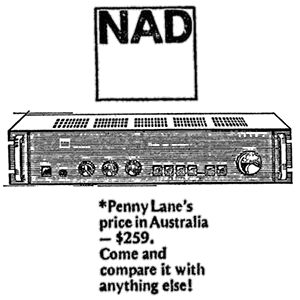
NAD is an electronics firm whose products include low-cost home audiophile amplifiers and related components. NAD was an acronym for New Acoustic Dimension. The company was founded in London, England in 1972 by Dr. Martin L. Borish, an electrical engineer with a Ph.D. in Physics. Its most famous product is the late-1970s NAD 3020 amplifier, designed by Bjørn Erik Edvardsen, which became a staple of low-budget Hi-Fi in Britain. NAD’s philosophy is to include only genuinely useful features for aesthetically understated designs. The company focuses on ‘effective power’ and its amplifiers have been known for delivering generous headroom, meaning that they can deliver dynamic power bursts far in excess of their rated power. The key to this feature is a flexible power supply which stores significant reserve current for quick release at moments of high musical load. The various incarnations of this design have been associated with different names over the years including Power Envelope and recently PowerDrive.
Additional benefits of this approach include the fact that amplifiers using this technology can handle complex, real-life, lower-impedance loudspeaker loads as compared with the simple 8-ohm resistor typically used to calculate advertised power ratings and the fact that the circuitry in this approach requires less cooling, while maintaining ability to handle complex impedance loads as low as 2 ohms. An amplifier that is overdriven, or pushed beyond its designed power capabilities, produces audible distortion known as clipping by cutting off extremes of the music waveform, resulting in harshly unpleasant sound and threatening damage to speakers, particularly tweeters. NAD amplifiers incorporate a user-defeatable ‘Soft-Clipping’ circuit to address this issue. It gently transforms the music waveform as the point of clipping approaches, the goal being clearer reproduction and simultaneous protection of speakers.
Posted in Money, Technology |
Leave a Comment »
July 29, 2011

New Wave is a subgenre of rock music that emerged in the mid to late 1970s alongside punk rock. The term at first generally was synonymous with punk rock before being considered a genre in its own right that incorporated aspects of electronic and experimental music, mod subculture, and disco, rock and 1960s pop music.
While it incorporated much of the original punk rock sound and ethos, such as an emphasis on short and punchy songs, it was characterized by greater complexity in both music and lyrics.
read more »
Posted in Art, Language, Money |
Leave a Comment »
July 29, 2011


Berry Gordy, Jr. (b. 1929) is an American record producer, and the founder of the Motown record label, which played an important role in the racial integration of popular music. Motown achieved a crossover success. In the 1960s, Motown and its soul-based subsidiaries were the most successful proponents of what came to be known as The Motown Sound, a style of soul music with a distinct pop influence.
The Motown Sound typically used tambourines to accent the back beat, prominent and often melodic electric bass-guitar lines, distinctive melodic and chord structures, and a call-and-response singing style that originated in gospel music. Pop production techniques such as the use of orchestral string sections, charted horn sections, and carefully arranged background vocals were also used. Complex arrangements and elaborate, melismatic vocal riffs were avoided. Motown producers believed steadfastly in the ‘KISS principle’ (keep it simple, stupid).
read more »
Posted in Art, Money |
Leave a Comment »
July 25, 2011
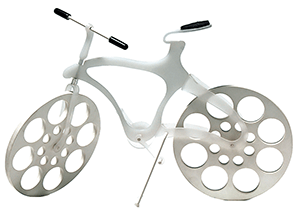

Luigi Colani (b. 1928) is a German industrial designer. The prime characteristic of his designs are the rounded, organic forms, which he terms ‘biodynamic’ and claims are ergonomically superior to traditional designs. His ‘kitchen satellite’ from 1969 is the most prominent example of this school of thought. Many of his designs for small appliances are being mass-produced and marketed, but his larger designs have not been built, ‘a whole host of futuristic concepts that will have us living in pods and driving cars so flat that leg amputation is the only option.’
Colani responding to his critics said, ‘The earth is round, all the heavenly bodies are round; they all move on round or elliptical orbits. This same image of circular globe-shaped mini worlds orbiting around each other follows us right down to the microcosmos. We are even aroused by round forms in species propagation related eroticism. Why should I join the straying mass who want to make everything angular? I am going to pursue Galileo Galilei’s philosophy: my world is also round.’
Posted in Art, Money, Technology |
Leave a Comment »



 The Daily Omnivore