August 15, 2011

A smiley, or happy face, is a stylized representation of a smiling human face. It is commonly represented as a yellow circle with two black dots representing eyes and a black arc representing the mouth. ‘Smiley’ is also sometimes used as a generic term for any emoticon (a facial expression pictorially represented by punctuation and letters, usually to express a writer’s mood).
The first unhappy face recorded on film can be seen in Ingmar Bergman’s 1948 film ‘Hamnstad.’ Later on, in 1953 and 1958, the happy face was used in promotional campaigns for motion pictures ‘Lili’ and ‘Gigi’, respectively.
read more »
Posted in Humor, Money, Politics |
Leave a Comment »
August 15, 2011

Oniomania [oh-nee-uh-mey-nee-uh] (Greek: onios ‘for sale’ and mania ‘insanity’) is the technical term for the compulsive desire to shop, more commonly referred to as compulsive shopping, shopping addiction, shopaholism, compulsive buying or CB. All of these are considered to be either clinical addictions or impulse control disorders, depending on the clinical source. ‘Originally termed oniomania by Kraepelin (1915) and Bleuler (1924), CB has been described for over 100 years’; but though included among other pathological and reactive impulses, CB went largely ignored for the middle quarters of the twentieth century, and even today ‘Compulsive Shopping is a painful yet virtually unknown mental illness.’
‘Some psychiatrists believe compulsive buying is more indicative of an impulse control disorder, others think it is more indicative of an obsessive-compulsive disorder, or bipolar disorder’ or even an addiction. It has been accepted as a disorder by the Deutsche Gesellschaft Zwangserkrankungen (German organization for obsessive-compulsive disorders), for several years; but in the United States, ‘an Impulse control disorder not otherwise specified…is the diagnostic category usually accorded to compulsive buying.’
read more »
Posted in Health, Money |
Leave a Comment »
August 15, 2011

A twin-lens reflex camera (TLR) is a type of camera with two objective lenses of the same focal length. One of the lenses is the photographic objective or ‘taking lens,’ while the other is used for the viewfinder system, which is usually viewed from above at waist level. In addition to the objective, the viewfinder consists of a 45-degree mirror (the reason for the word reflex in the name), a matte focusing screen at the top of the camera, and a pop-up hood surrounding it. The two objectives are connected, so that the focus shown on the focusing screen will be exactly the same as on the film.
However, many inexpensive TLRs are fixed-focus models. Most TLRs use leaf shutters with shutter speeds up to 1/500th sec with a B setting. For practical purposes, all TLRs are film cameras, most often using 120 film, although there are many examples which used other formats. No general-purpose digital TLRs exist, since their heyday ended long prior to the digital era. The main exception is the collector-oriented Rollei Mini-Digi, introduced as a rather expensive ‘toy’ in 2004.
read more »
Posted in Art, Money, Technology |
Leave a Comment »
August 15, 2011

Kopi luwak, or civet coffee, is one of the world’s most expensive and low-production varieties of coffee. It is made from the beans of coffee berries which have been eaten by the Asian Palm Civet, then passed through its digestive tract. A civet eats the berries for their fleshy pulp. In its stomach, enzymes seep into the beans, making shorter peptides and more free amino acids. Passing through a civet’s intestines the beans are then defecated, keeping their shape. After gathering, thorough washing, sun drying, light roasting and brewing, these beans yield an aromatic coffee with much less bitterness, widely noted as the most expensive coffee in the world.
Since the flavor of coffee owes much to its proteins, there is a hypothesis that this shift in the numbers and kinds of proteins in beans after being swallowed by civets brings forth their unique flavor. The proteins are also involved in non-enzymatic Maillard browning reactions brought about later by roasting. Moreover, while inside a civet the beans begin to germinate by malting which also lowers their bitterness. Kopi luwak is produced mainly on the islands of Sumatra, Java, Bali and Sulawesi in the Indonesian Archipelago, and also in the Philippines, and also in East Timor. Weasel coffee is a loose English translation of its name cà phê Chồn in Vietnam, where popular, chemically simulated versions are also produced.
read more »
Posted in Food, Humor, Money |
Leave a Comment »
August 14, 2011

The Anthora is a paper coffee cup design that has become iconic of New York City daily life — its name is a play on the word amphora (ceramic container with two handles and a long neck narrower than the body). The cup was originally designed by Leslie Buck of the Sherri Cup Co. in 1963, to appeal to Greek-owned coffee shops in New York City — and was later copied heavily by other companies. The genuine Anthora depicts an image of an Ancient Greek amphora, a meander design on the top and bottom rim, and the words ‘WE ARE HAPPY TO SERVE YOU’ in a font that resembles ancient Greek writing. The blue and white colors were inspired by the flag of Greece.
Buck never made royalties from his design, but as a salesman he was remunerated handsomely from the success of the product. When he retired from Sherri Cup Co. in 1992, he was presented with 10,000 Anthoras printed with a testimonial inscription. On the occasion of Buck’s death in 2010, a New York Times writer described the motto on the cup as having ‘welcome intimations of tenderness, succor and humility.’ The trademark is currently held by the Solo Cup Company, which licenses sales of the cup.
Posted in Food, Money |
1 Comment »
August 14, 2011

Greenwashing (a compound word modelled on ‘whitewash’), or ‘green sheen,’ is a form of spin in which ‘green’ PR or ‘green’ marketing is deceptively used to promote the perception that a company’s policies or products are environmentally friendly. The term was coined by New York environmentalist Jay Westerveld in a 1986 essay regarding the hotel industry’s practice of placing placards in each room promoting reuse of towels ostensibly to ‘save the environment.’
Westerveld noted that, in most cases, little or no effort toward reducing energy waste was being made by these institutions — as evidenced by the lack of cost reduction this practice effected. Westerveld opined that the actual objective of this ‘green campaign’ on the part of many hoteliers was, in fact, increased profit. Westerveld thus labeled this and other outwardly environmentally conscientious acts with a greater, underlying purpose of profit increase as greenwashing.
read more »
Posted in Money, Politics, Science |
1 Comment »
August 9, 2011

Keynesian economics is a school of macroeconomic thought based on the ideas of 20th-century English economist John Maynard Keynes. Most economists today are primarily Keynesian-influenced. According to the theory, there exists a cycle in the economy, in which there are years of growth, followed by years of depression or recession, called the business cycle. Keynes′ theory suggested that active government policy could be effective in managing the economy.
Rather than seeing unbalanced government budgets as wrong, Keynes advocated what has been called countercyclical fiscal policies, that is, policies that acted against the tide of the business cycle: deficit spending when a nation’s economy suffers from recession or when recovery is long-delayed and unemployment is persistently high—and the suppression of inflation in boom times by either increasing taxes or cutting back on government outlays.
read more »
Posted in Money, Politics |
Leave a Comment »
August 8, 2011

Hipster is a slang term that first appeared in the 1940s, was revived in the 1990s, and continued to be used in the 2000s and 2010s, to describe young, recently settled urban middle class adults and older teenagers with musical interests mainly in indie rock. Other interests in media would include independent film, magazines such as Vice and Clash, and websites like Pitchfork Media. In some contexts, hipsters are also called scenesters.
‘Hipster’ has been used in sometimes contradictory ways, making it difficult to precisely define ‘hipster culture,’ which has been described as a ‘mutating, trans-Atlantic melting pot of styles, tastes and behavior.’ Hipsterism fetishizes the authentic elements of all of the ‘fringe movements of the postwar era—beat, hippie, punk, even grunge,’ and draws on the ‘cultural stores of every unmelted ethnicity,’ and ‘regurgitates it with a winking inauthenticity.’ Others, like Arsel and Thompson, argue that hipster signifies a cultural mythology, a crystallization of a mass-mediated stereotype generated to understand, categorize, and marketize indie consumer culture, rather than an objectified group of people.
read more »
Posted in Art, Language, Money |
Leave a Comment »
August 5, 2011

The handicap principle is a hypothesis originally proposed in 1975 by biologist Amotz Zahavi to explain how evolution may lead to ‘honest’ or reliable signaling between animals who have an obvious motivation to bluff or deceive each other. The handicap principle suggests that reliable signals must be costly to the signaler, costing the signaler something that could not be afforded by an individual with less of a particular trait.
For example, in the case of sexual selection, the theory suggests that animals of greater biological fitness signal this status through handicapping behavior or morphology that effectively lowers this quality. The central idea is that sexually selected traits function like conspicuous consumption, signalling the ability to afford to squander a resource simply by squandering it. Receivers know that the signal indicates quality because inferior quality signalers cannot afford to produce such wastefully extravagant signals.
read more »
Posted in Money, Science, Sex |
Leave a Comment »
August 5, 2011
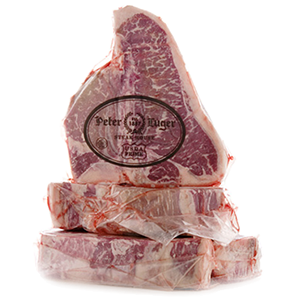
Beef aging is the process of preparing beef for consumption, mainly by breaking down the connective tissue. Dry-aged beef has been hung to dry for several weeks. After the animal is slaughtered and cleaned, either an entire half will be hung, or prime cuts will be placed in a cooler, also known as a ‘hot box.’ This process involves considerable expense, as the beef must be stored near freezing temperatures. Also, only the higher grades of meat can be dry aged, as the process requires evenly distributed fat. For these reasons one seldom sees dry-aged beef outside of steak restaurants and upscale butcher shops. The process changes beef by two means. First, moisture is evaporated from the muscle, concentrating flavor. Second, the beef’s natural enzymes break down the connective tissue in the muscle, which leads to more tender beef.
Dry-aging can promote the growth of certain mold species on the external surface of the meat. This doesn’t cause spoilage, but actually forms an external ‘crust,’ which is trimmed off when the meat is prepared for cooking. These fungal species complement the natural enzymes in the beef by helping to tenderize and increase the flavor of the meat. The genus Thamnidia, in particular, is known to produce collagenolytic enzymes which greatly contribute to the tenderness and flavor of dry-aged meat. Wet-aged beef is beef that has typically been aged in a vacuum-sealed bag to retain its moisture. This is the dominant mode of aging beef in the United States today. Wet-aging is popular because it takes less time (typically only a few days) and none of the weight is lost in the process. In contrast, dry-aging can take 15–28 days, and will see up to a third or more of the weight lost as moisture.
Posted in Food, Money |
Leave a Comment »
August 4, 2011
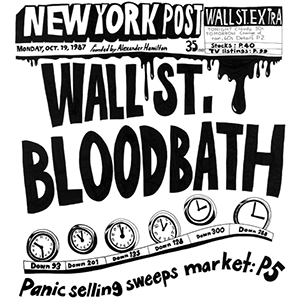
A stock market crash is a sudden dramatic decline of stock prices across a significant cross-section of a stock market, resulting in a significant loss of paper wealth. Crashes are driven by panic as much as by underlying economic factors. They often follow speculative stock market bubbles.
Stock market crashes are social phenomena where external economic events combine with crowd behavior and psychology in a positive feedback loop where selling by some market participants drives more market participants to sell. Generally speaking, crashes usually occur under the following conditions: a prolonged period of rising stock prices and excessive economic optimism, a market where P/E ratios exceed long-term averages, and extensive use of margin debt and leverage by market participants.
read more »
Posted in Money, Politics, Science |
1 Comment »
August 4, 2011

Recession shapes are used by economists to describe different types of recessions. There is no specific academic theory or classification system for recession shapes; rather the terminology is used as an informal shorthand to characterize recessions and their recoveries. The most commonly used terms are V-shaped, U-shaped, W-shaped, and L-shaped recessions. The letters can also be applied referring to the recoveries (ie ‘V-shaped recovery’).
In a V-shaped recession, the economy suffers a sharp but brief period of economic decline with a clearly defined trough, followed by a strong recovery. V-shapes are the normal shape for recession: ‘There is a strong historical ‘snap back’ relationship between the strength of economic recovery and the severity of the preceding recession. Thus, recessions and their recoveries have a tendency to trace out a ‘V’ shape.’
read more »
Posted in Money, Politics |
Leave a Comment »




